
Skip to content
The Encyclopedia of Horology

Clock · Lantern clock

French Louis XV iron-framed rack-striking lantern clock with trip-hour repeat

Partially verified

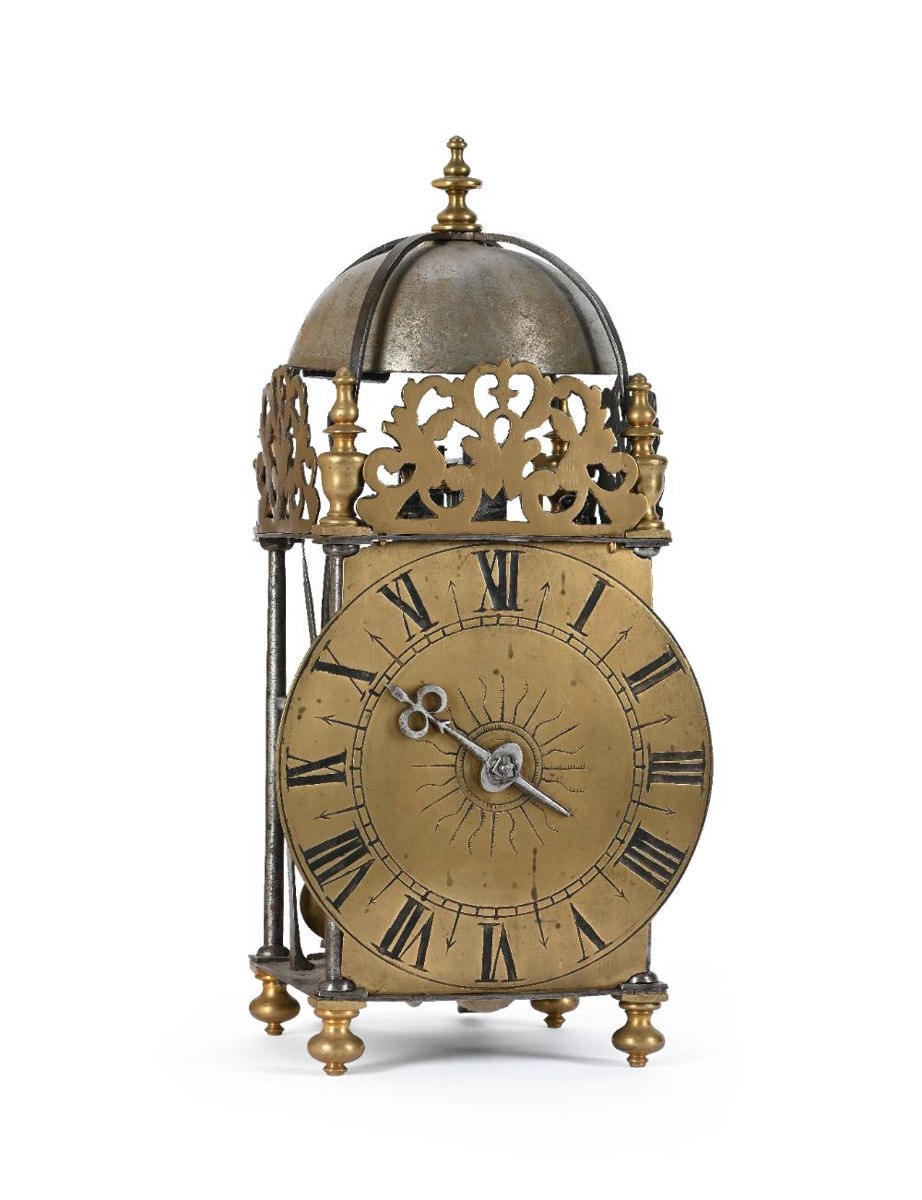
This unsigned French Louis XV lantern clock dates to circa 1730 and features an iron-framed posted bell-striking movement with separately wound brass wheel trains. The going train is equipped with a verge escapement set above the top plate, regulated by a rear-mounted disc bob pendulum on a knife-edge suspension. The striking train employs a gravity rack located within the rear movement bar, indexed by an iron hour wheel snail, and includes a sleeved rack hook tail facilitating cord-pull trip-repeat striking. An engraved brass dial features a radiating starburst center within a Roman numeral chapter ring, framed by pierced foliate scroll frets, turned finials, and an iron-strapped domed bell bearer.

Front three-quarter view of the French Louis XV iron-framed lantern clock
Front three-quarter view of the French Louis XV iron-framed lantern clock — Dreweatts 1759. Rights pending — permission not yet requested. Original source

Catalogue identity

Source
www.invaluable.com
Category
Clock · Lantern clock
Maker / attribution
Not established
Reference
Not recorded
Catalogue / lot identifier
725
Source-reported date
circa 1730
Country
France

Source-reported attribution and specifications are not independent authentication. A listing does not establish present ownership, current display, availability or permission to reproduce.

Object description

Movement and Escapement

The clock features an unsigned, iron-framed, bell-striking movement with separately wound brass wheel trains set between forged-iron strip pivot bars. It is equipped with a verge escapement positioned above the top plate, regulated by a fixed-rod disc bob pendulum with knife-edge suspension.

Observations indicate the knife-edge suspension is located inside the frame, allowing the pendulum assembly to be removed by withdrawing a single pin. The strike train includes an iron second wheel, suggesting it may have been re-used from an earlier clock.

Evidence for this section
  • “The iron-framed posted bell-striking movement with separately wound brass wheel trains, set between forged-iron strip pivot bars”
  • “the going train with verge escapement set above the top plate regulated by fixed-rod disc bob pendulum incorporating knife-edge suspension swinging outside the frame to the rear”
  • “Interestingly the strike train second wheel is iron (rather than brass) hence appears to have been re-used by the maker from an earlier clock.”

Striking Mechanism

The striking train uses a gravity rack located within the rear movement bar, indexed by a snail on the iron hour wheel. The hammer, positioned on the left-hand side, features a sprung bifurcation on the stem to act as a stop against the top plate aperture.

The rack hook is pivoted via a sleeve around the release detent arbor, which enables cord-pull trip-repeat striking.

Evidence for this section
  • “counting via a gravity rack positioned inside the rear movement bar set by a tail engaging with the snail applied to the iron hour wheel”
  • “the rack hook is pivoted via a sleeve around the release detent arbor and incorporates a looped tail for a pull trip-repeat cord”
  • “the hammer is positioned to the left hand-side and incorporates an unusual sprung bifurcation to the stem to serve as the stop by engaging with the edge of the aperture in the top plate”

Dial and Frame

The one-piece brass dial is engraved with a radiating starburst center—combining wavy and straight lines—within a Roman numeral chapter ring featuring arrow half-hour markers. The dial is held by a scroll-pierced hand with a square locking washer.

The iron-framed structure includes forged column corner posts, foliate scroll pierced frets, and turned vase finials, topped by a domed bell bearer with a brass finial. The unit is noted to lack side doors, a backplate, and weights.

Evidence for this section
  • “the one-piece engraved brass dial with alternating wavy and straight line engraved starburst centre within integral Roman numeral chapter ring with arrow half-hour markers”
  • “the frame with forged iron column corner posts and plates beneath foliate scroll pierced frets, turned vase finials and iron-framed domed bell bearer surmounted by a brass finial”
  • “(lacking side doors, backplate and weights).”

Open research questions

  • What criteria distinguish this specific clock's iron/brass construction from late 19th-century Flemish work referenced in the description?
  • Are the unique fret mounting techniques observed here consistent with other clocks attributed to this French regional style?

Source evidence

Recorded claims and source quotations for French Louis XV iron-framed rack-striking lantern clock with trip-hour repeat
FieldSource-reported valueSource quotation
EscapementVerge escapement set above the top plate“the going train with verge escapement set above the top plate regulated by fixed-rod disc bob pendulum”
Striking MechanismRack striking with trip-repeat“strike train with star wheel to lift and release the warning detent, and with counting via a gravity rack positioned inside the rear movement bar”
Height35.5 cm (14 inches)“35.5cm (14ins) high”
Width17 cm (6.75 inches)“17cm (6.75ins) wide”
Depth17 cm (6.75 inches) including spurs“17cm (6.75ins) deep including spurs.”
ProvenanceThe Dr. John A. Robey collection“The Dr. John A. Robey collection of early weight-driven clocks and related items.”
Dimensions35.5cm high, 17cm wide, 17cm deep“35.5cm (14ins) high, 17cm (6.75ins) wide, 17cm (6.75ins) deep including spurs.”
ProvenanceThe Dr. John A. Robey collection“The Dr. John A. Robey collection of early weight-driven clocks and related items.”
AttributionUnsigned, circa 1730“UNSIGNED, CIRCA 1730”

Visible details

  • Single pierced steel hand set against an engraved brass chapter ring with Roman numerals and arrow half-hour markers
  • Dial center engraved with an alternating wavy and straight-line starburst motif
  • Domed bell mounted under arched iron strapwork and surmounted by a turned brass finial
  • Openwork posted iron frame resting on turned brass feet, lacking side panels

Research qualifications

  • Source notes the clock lacks side doors, backplate, and weights.
  • Maker is unsigned.

Photograph identity and source facts were screened before import; rights clearance remains pending.

Terms in this record

Glossary explanations for terms named in this object’s record.