Skip to content
The Encyclopedia of Horology

Clock · Regulator

Floor-standing Vienna Regulator attributed to J. Schulz

Partially verified

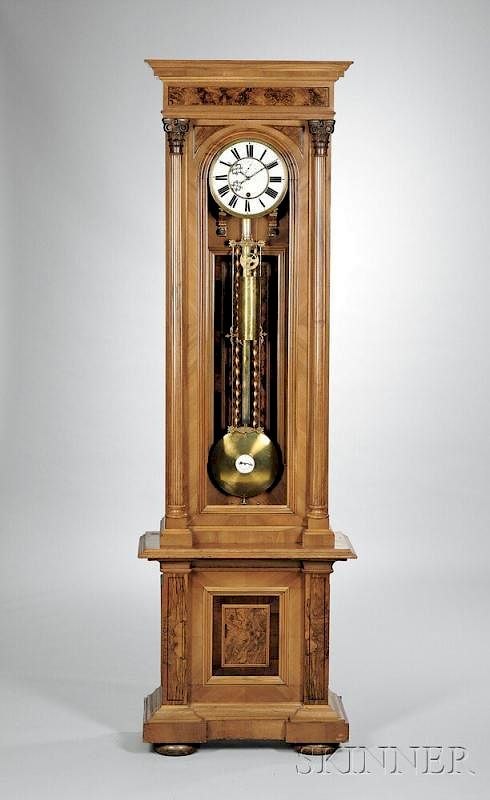
This floor-standing Vienna regulator clock, dated to circa 1880 and attributed by the source to J. Schulz, measures 79 inches in height. The flat-top mahogany-veneered case features contrasting burl accents across the frieze and base, alongside full-length turned columns terminating in Corinthian capitals on the glazed trunk door. The movement is reported as a year-duration time-only mechanism equipped with maintaining power, a deadbeat escapement, and crutch beat adjustment. It drives a two-piece 10 1/4-inch porcelain Roman numeral dial with an auxiliary seconds register, regulated by a seconds pendulum featuring a brass bob with an enameled status indicator.

Floor-standing Vienna regulator attributed to J. Schulz, circa 1880
Floor-standing Vienna regulator attributed to J. Schulz, circa 1880 — Bonhams Skinner. Rights pending — permission not yet requested. Original source

Catalogue identity

Source
www.bidsquare.com
Category
Clock · Regulator
Form
Floor-standing regulator
Maker / attribution
attributed to J. Schulz
Reference
Not recorded
Catalogue / lot identifier
6
Source-reported date
c. 1880
Source-reported place
Not established

Source-reported attribution and specifications are not independent authentication. A listing does not establish present ownership, current display, availability or permission to reproduce.

Object description

Identity and Case Construction

Described by the auction catalog as a floor-standing Vienna regulator standing 79 inches in height, this clock is dated to circa 1880 and attributed to J. Schulz. The housing is catalogued as a flat-top mahogany-veneered case featuring contrasting burl accents in the frieze and the base, with turned columns bearing contrasting Corinthian capitals attached to the door.

The catalog notes that the clock is illustrated in Victor Kochaver's 'Beautiful Vienna Regulators of the 19th Century', page 133. Condition notes record that the base molding is off but present.

Evidence for this section
  • “Year-duration Floor-standing Vienna Regulator, c. 1880, attributed to J. Schulz, flat-top mahogany veneered case with contrasting accents of burl in the frieze and the base, turned columns with contrasting Corinthian capitals attached to the door”
  • “ht. 79 in.”
  • “This clock is illustrated in Victor Kochaver, Beautiful Vienna Regulators of the 19th Century , p. 133.”
  • “base molding off but present”

Dial and Hands

The dial is described as a two-piece porcelain Roman numeral dial measuring 10 1/4 inches, fitted with a subsidiary seconds dial and pierced blued-steel hands. Observations confirm a circular white dial with black Roman numerals and an upper subsidiary seconds dial.

Condition notes from the auction catalog state the presence of dial hairlines.

Evidence for this section
  • “two-piece, 10 1/4-in., porcelain, Roman numeral dial with subsidiary seconds dial, pierced blued-steel hands”
  • “Circular white dial with black Roman numerals and an upper subsidiary seconds dial.”
  • “Dial hairlines.”

Movement and Pendulum Specifications

The clock is catalogued as having a year-duration time-only movement fitted with maintaining power, a deadbeat escapement, and crutch beat adjustment. Power is supplied by a brass-cased weight, which is visible hanging centrally behind the glazed trunk door in physical observations.

Regulation is described as being provided by a seconds pendulum composed of a flattened brass rod flanked by a steel rod and a barleytwist brass rod, terminating in a brass-faced bob with a centered, enameled regulator status dial. The catalog notes that the clock was currently running at the time of cataloging.

Evidence for this section
  • “year-duration time-only movement with maintaining power, deadbeat escapement, and crutch beat adjustment, powered by a brass-cased weight and regulated by a seconds pendulum with flattened brass rod flanked by a steel rod and barleytwist brass rod, brass-faced bob with centered, enameled, regulator status dial”
  • “Glazed trunk door showing a central brass weight and a seconds pendulum with a large circular brass bob and central round insert.”
  • “Clock is currently running.”

Open research questions

  • What markings, stamps, or signatures on the movement or case support the catalog attribution to J. Schulz?
  • What specific details or photographs of this clock are published on page 133 of Victor Kochaver's 'Beautiful Vienna Regulators of the 19th Century'?
  • Where are the dial hairlines located on the two-piece porcelain dial, and do they impact structural stability?

Source evidence

Recorded claims and source quotations for Floor-standing Vienna Regulator attributed to J. Schulz
FieldSource-reported valueSource quotation
Attributionattributed to J. Schulz“attributed to J. Schulz”
Datec. 1880“c. 1880”
Case Height79 in.“ht. 79 in.”
Dial Diameter10 1/4-in.“two-piece, 10 1/4-in., porcelain, Roman numeral dial”
Movementyear-duration time-only“year-duration time-only movement”
Escapementdeadbeat escapement“deadbeat escapement”
LiteratureVictor Kochaver, Beautiful Vienna Regulators of the 19th Century, p. 133“This clock is illustrated in Victor Kochaver, Beautiful Vienna Regulators of the 19th Century , p. 133.”
HandsPierced blued-steel hands“pierced blued-steel hands”
Power SourceBrass-cased weight“powered by a brass-cased weight”
Pendulum Rod ConstructionFlattened brass rod flanked by a steel rod and barleytwist brass rod“flattened brass rod flanked by a steel rod and barleytwist brass rod”
Pendulum BobBrass-faced bob with centered enameled regulator status dial“brass-faced bob with centered, enameled, regulator status dial”

Visible details

  • Full-height light mahogany veneered case with a stepped flat pediment, plinth base, and turned side columns with Corinthian capitals.
  • Circular white dial with black Roman numerals and an upper subsidiary seconds dial.
  • Glazed trunk door showing a central brass weight and a seconds pendulum with a large circular brass bob and central round insert.

Research qualifications

  • The maker attribution to J. Schulz is source-reported without an explicit signature identified.
  • Internal movement features such as year duration, deadbeat escapement, and maintaining power are recorded from the auction description and not directly visible.

Photograph identity and source facts were screened before import; rights clearance remains pending.

Terms in this record

Glossary explanations for terms named in this object’s record.