
Skip to content
The Encyclopedia of Horology

Clock · Regulator wall clock

Black Forest Regulator Wall Clock in Vienna Style

Partially verified

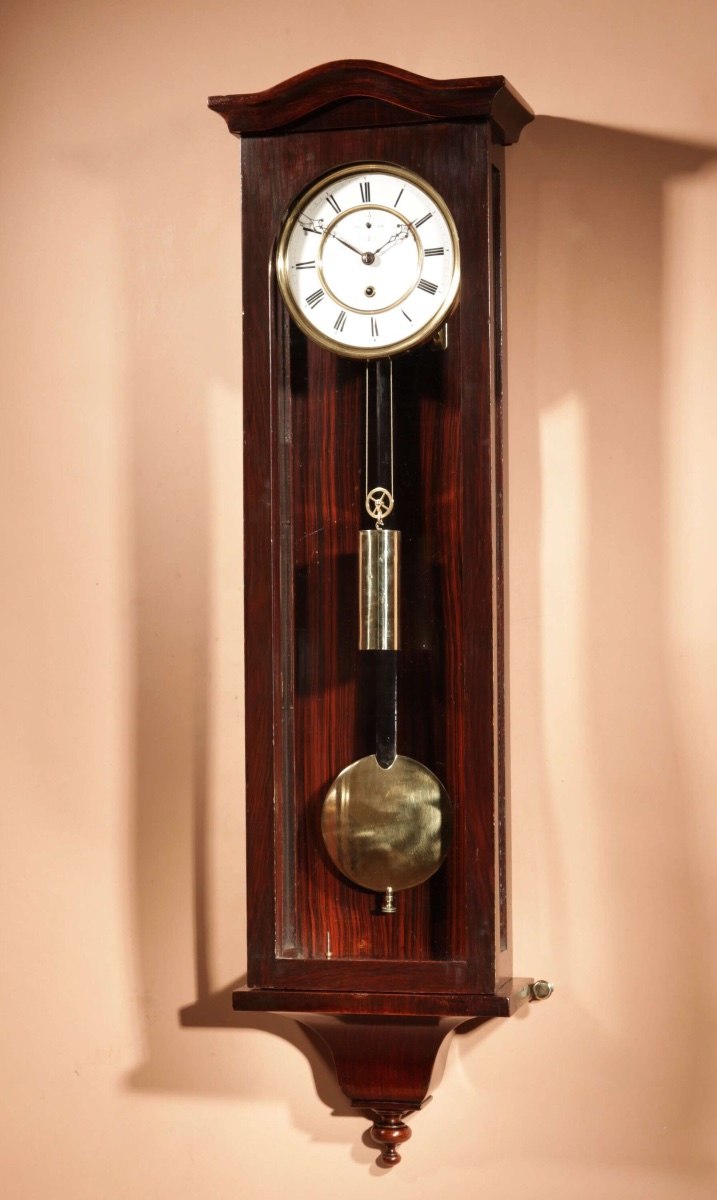
This regulator wall clock in the Vienna style is attributed to Germany's Black Forest region and dated circa 1850–1880. Encased in wood with a lacquer finish simulating rosewood, the case measures 100 cm in height, 30 cm in width, and 15 cm in depth. The white enamel dial is set with black Roman numerals and driven by a single going train without chiming work. According to the seller, the movement incorporates a deadbeat escapement and maintaining power. The clock retains its cylindrical brass weight suspended by a pulley and a circular brass pendulum bob mounted on a wooden rod.

Front view of the Black Forest regulator wall clock showing the case, enamel dial, weight, and pendulum
Front view of the Black Forest regulator wall clock showing the case, enamel dial, weight, and pendulum — Koos Limburg Jnr / Proantic. Rights pending — permission not yet requested. Original source

Catalogue identity

Source
www.proantic.com
Category
Clock · Regulator wall clock
Maker / attribution
Not established
Reference
1822170
Catalogue / lot identifier
Source URL identifies the listing
Source-reported date
circa 1850-1880
Country
Germany

Source-reported attribution and specifications are not independent authentication. A listing does not establish present ownership, current display, availability or permission to reproduce.

Object description

Case Architecture and Exterior Form

The clock is housed in a wooden wall case measuring 100 cm in height, 30 cm in width, and 15 cm in depth, presenting the overall form of a Vienna-style regulator. The exterior is finished to simulate rosewood grain, featuring an arched pediment top and a drop finial at the base.

The seller describes the housing as an "original lacquered clock case simulating rosewood" in used condition with "nice old patination." The source lists the case material as solid wood.

Evidence for this section
  • “100cm high, 30cm wide, 15cm deep”
  • “original lacquered clock case simulating rosewood”
  • “Dark lacquered case simulating rosewood grain, with an arched pediment top and a drop finial at the base”
  • “In very good original used condition, with very nice old patination.”
  • “Material: Solid wood”

Dial and Drive Components

Visual observation shows a white enamel dial with black Roman numerals and a single winding aperture positioned below center. The seller states the clock retains its original enamel dial and hands.

Suspended inside the case is a cylindrical brass weight hung from a spoked brass pulley, alongside a circular brass pendulum bob on a flat dark rod. According to the seller, the brass weight and pendulum bob have been lacquered to avoid the need for polishing.

Evidence for this section
  • “White enamel dial with black Roman numerals and a single winding aperture below center”
  • “Still with the original enamel dial, hands, pendulum and weight.”
  • “Cylindrical brass weight suspended from a spoked brass pulley”
  • “Polished or lacquered brass circular pendulum bob attached to a dark flat rod”
  • “The original brass weight and pendulum have been lacquered, so polishing is not needed.”

Reported Movement and Attribution Limits

The seller reports that the movement features a single going train without chiming work, incorporating a deadbeat escapement and maintaining power. Because internal mechanism photographs are not provided, these horological specifications remain source-reported rather than directly verifiable.

The clock is described as originating from Germany and dated circa 1850–1880, styled as a Black Forest regulator in the Vienna style. No maker name, workshop signature, or serial number is recorded in the source documentation.

Evidence for this section
  • “The original movement has only a original going train (so not chiming)”
  • “movement with deadbeat escapement and maintaining power”
  • “Germany circa 1850-80”
  • “A Interesting Elegant Black Forest Regulator Wall Clock In The Vienna Style.”

Open research questions

  • Are any maker marks, regional stamps, or serial numbers present on the movement backplate?
  • What specific mechanism design is used for the reported maintaining power?
  • What underlying primary wood is used beneath the faux-rosewood lacquered finish?

Source evidence

Recorded claims and source quotations for Black Forest Regulator Wall Clock in Vienna Style
FieldSource-reported valueSource quotation
Case FinishLacquered simulating rosewood“original lacquered clock case simulating rosewood”
EscapementDeadbeat escapement with maintaining power“movement with deadbeat escapement and maintaining power”
Train TypeSingle going train (non-chiming)“original movement has only a original going train (so not chiming)”
Dimensions100 cm high, 30 cm wide, 15 cm deep“100cm high, 30cm wide, 15cm deep”
Origin and DateGermany, circa 1850-1880“Germany circa 1850-80”
Case MaterialSolid wood“Material: Solid wood”
Pendulum and Weight Surface TreatmentLacquered brass“The original brass weight and pendulum have been lacquered, so polishing is not needed.”
Servicing Status (Seller Reported)Cleaned and serviced, fully working order“The movement has been fully cleaned and serviced and is in fully working order.”

Visible details

  • White enamel dial with black Roman numerals and a single winding aperture below center
  • Polished or lacquered brass circular pendulum bob attached to a dark flat rod
  • Cylindrical brass weight suspended from a spoked brass pulley
  • Dark lacquered case simulating rosewood grain, with an arched pediment top and a drop finial at the base

Research qualifications

  • Internal escapement type and maintaining power mechanism are source-reported and not directly visible in the cased photograph
  • Maker is unspecified

Photograph identity and source facts were screened before import; rights clearance remains pending.

Consulted source

Proantic: A Interesting Elegant Black Forest Regulator Wall Clock In T

Reviewed 2026-10-21 · Record a3e9fcfd5a

Terms in this record

Glossary explanations for terms named in this object’s record.