
Skip to content
The Encyclopedia of Horology

Pocket watch · Pendant watch

F. Baronneau 'The Holy Family' pendant watch

Partially verified

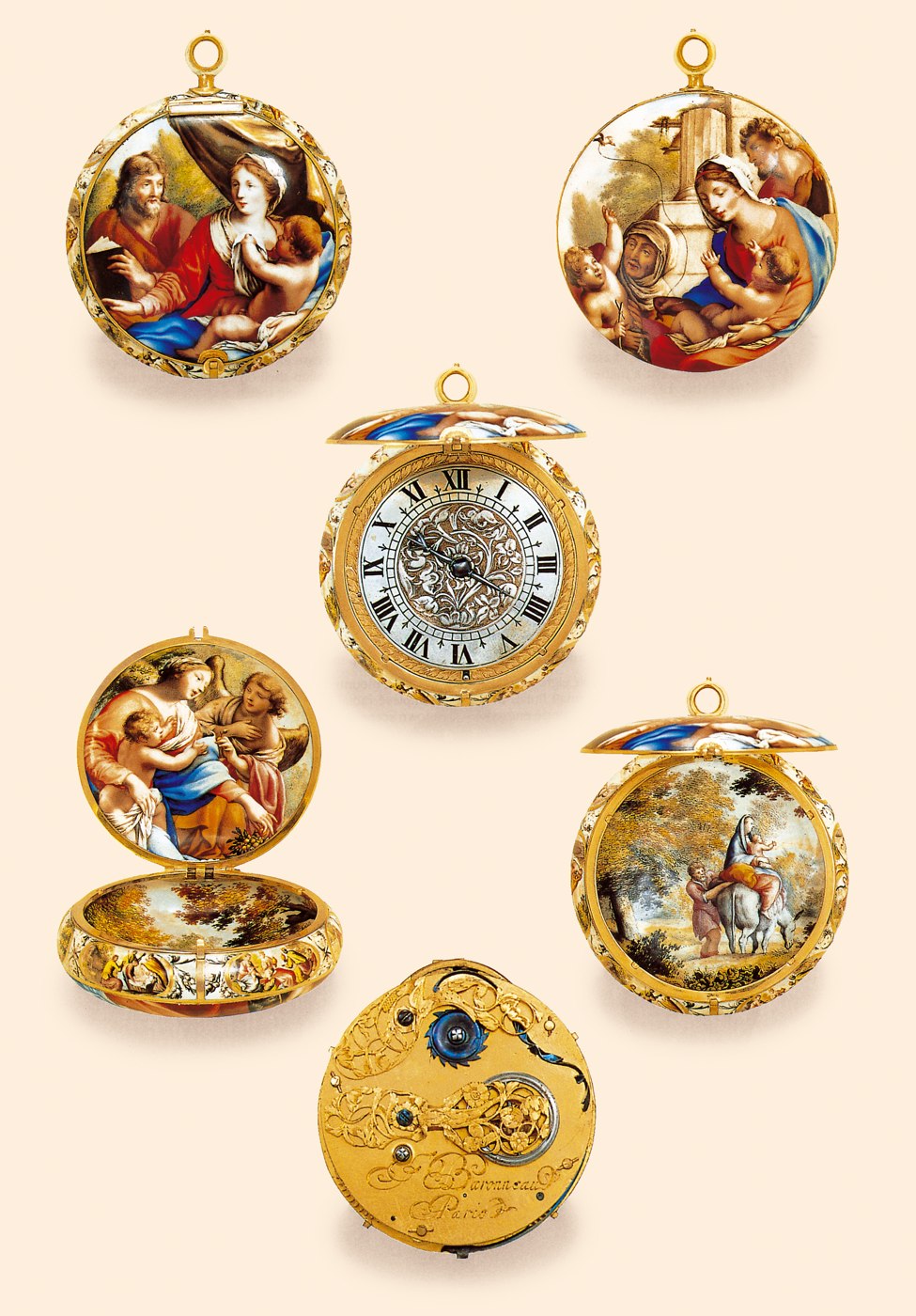
This 22K gold and enamel pendant watch, attributed to F. Baronneau of Paris, dates to circa 1640. The piece features a "bassine fermee" double-body case with an edge that curves inward. The exterior surfaces are entirely decorated with enamel paintings depicting scenes from the life of the Virgin Mary and the Christ Child, based on engravings after Simon Vouet. A silver dial with champlevé Roman numerals and an inner quarter-hour ring sits beneath the concealed cover, featuring a chased and engraved floral center and a blued-steel tulip hand. The internal mechanism consists of a 47.5 mm gilt brass full plate movement with turned baluster pillars, a fusee and gut-line going train, a verge escapement, a two-arm steel circular foliot, and a pierced, engraved gilt cock. The backplate bears the signature of F. Baronneau.

Exterior views of the enameled case, the silver dial, and the gilt brass movement of the F. Baronneau pendant watch.
Exterior views of the enameled case, the silver dial, and the gilt brass movement of the F. Baronneau pendant watch. — Antiquorum. Rights pending — permission not yet requested. Original source

Catalogue identity

Source
catalog.antiquorum.swiss
Category
Pocket watch · Pendant watch
Maker / attribution
F. Baronneau
Reference
Not recorded
Catalogue / lot identifier
87
Source-reported date
circa 1640
Source-reported place
France

Source-reported attribution and specifications are not independent authentication. A listing does not establish present ownership, current display, availability or permission to reproduce.

Object description

Case and Dial Design

The watch is housed in a double-body 22K gold "bassine fermee" case characterized by an inward-curving edge. The entire surface is finished with detailed enamel paintings featuring themes derived from engravings by Simon Vouet. These scenes portray the Holy Family, including the Christ Child, the Virgin Mary, and Saint John the Baptist, often shown with symbolic elements such as a reed cross and a tethered bird.

The watch is designed with a concealed dial, which is revealed upon opening the cover. The silver dial features champlevé Roman numerals for the hours and an integrated inner ring for quarter-hours. The center of the dial is decorated with chased and engraved floral motifs, complemented by a blued-steel hand described as a "tulip" style.

Evidence for this section
  • “Double-body, "bassine fermee" with curved-in edge, entirely enamelled with scenes from the life of the Virgin Mary and the Christ Child”
  • “Silver, with champlevé Roman chapters and inner quarter-hour ring, centre chased and engraved with a floral design”

Movement and Escapement

The internal movement measures 47.5 mm and is constructed as a gilt brass full plate. It incorporates turned baluster pillars to support the plate architecture. Power is transmitted through a fusee and gut-line system, which drives the going train.

Timing regulation is provided by a verge escapement paired with a two-arm steel circular foliot. The balance cock is notably elongated and features pierced and engraved ornamentation, secured to the plate by a screw. The movement also employs a ratchet wheel and click setup for tension control.

Evidence for this section
  • “gilt brass full plate, turned baluster pillars, fusee and gut-line for the going train, verge escapement,two-arm steel circular foliot”
  • “elongated pierced and engraved gilt cock secured by a screw”

Attributions and Provenance

The watch is attributed to the Parisian maker F. Baronneau, who was active on Rue Saint-Jacques in Paris between 1620 and 1649. The enamel work is attributed to The historical record indicates the watch has previously passed through the auction market, having been sold by Antiquorum Geneva in April 2001.

Reference to the watch is found in the Sandberg publication, where it is documented on pages 68-69.

Evidence for this section
  • “F. Baronneau A Paris, painting on enamel attributable to Robert Vauquer, circa 1640.”
  • “This watch is published in the Sandberg book, pages 68-69.”
  • “The present lot was previously sold by Antiquorum Geneva in April 2001.”

Open research questions

  • What is the evidence linking the enamel work specifically to Robert Vauquer rather than another enameler of the period?
  • Are there additional horological features hidden within the movement that would clarify the specific production date within the 1620-1649 window of Baronneau's activity?

Source evidence

Recorded claims and source quotations for F. Baronneau 'The Holy Family' pendant watch
FieldSource-reported valueSource quotation
MakerF. Baronneau“F. Baronneau A Paris”
Datecirca 1640“circa 1640”
Case Material22K gold“large 22K gold and enamel pendant watch”
Case TypeDouble-body“Double-body, "bassine fermee" with curved-in edge”
Dial DetailsSilver with champlevé Roman chapters“Silver, with champlevé Roman chapters and inner quarter-hour ring”
Movement TypeGilt brass full plate“gilt brass full plate, turned baluster pillars”
EscapementVerge escapement“verge escapement”
Movement Diameter47.5 mm“47.5 mm”

Visible details

  • Case decorated with enamel scenes based on engravings by Simon Vouet
  • Silver dial with champlevé Roman numerals and floral engraving
  • Movement features a two-arm circular foliot
  • Blued-steel tulip hand

Research qualifications

  • Enamel painting attribution to Robert Vauquer is suggested but not definitively confirmed
  • Specific date circa 1640 is an estimation

Photograph identity and source facts were screened before import; rights clearance remains pending.

Terms in this record

Glossary explanations for terms named in this object’s record.