
Skip to content
The Encyclopedia of Horology

Pocket watch · Verge fusée pocket watch

English Consular Case Verge Fusée Pocket Watch by Windmills of London

Partially verified

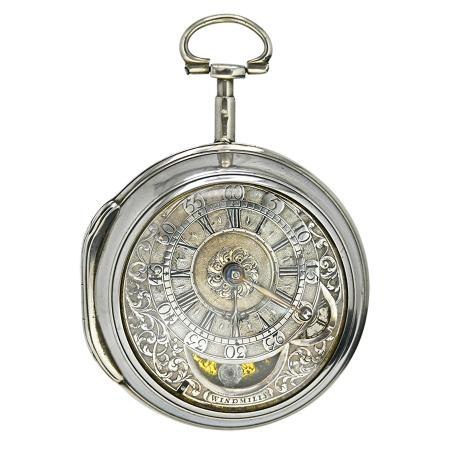
This early eighteenth-century English pocket watch, dated to circa 1710, is attributed to London clockmakers Joseph and Thomas Windmills. The timepiece features a sterling silver consular case designed to open from the front. According to the seller, it houses a key-wound gilt verge fusée movement with Egyptian pillars and a false pendulum, bearing number 2273 on an engraved back plate. The champlevé-style silver dial displays Roman hour numerals and an outer Arabic minute ring against foliate engraving, with an aperture displaying the false pendulum above a cartouche signed 'WINDMILLS'.

Dial and case view of the English consular verge fusée pocket watch signed Windmills
Dial and case view of the English consular verge fusée pocket watch signed Windmills — Renaissance Antiques. Rights pending — permission not yet requested. Original source

Catalogue identity

Source
www.renaissanceantiques.com
Category
Pocket watch · Verge fusée pocket watch
Maker / attribution
Joseph and Thomas Windmills
Reference
Not recorded
Catalogue / lot identifier
DKRO EMAR119
Source-reported date
circa 1710
Country
England
Source-reported serial
2273

Source-reported attribution and specifications are not independent authentication. A listing does not establish present ownership, current display, availability or permission to reproduce.

Object description

Dial Configuration and Visual Features

Visual observation indicates an engraved silver dial centered with blued or steel hands. It is laid out with Roman numerals indicating the hours, a concentric outer band with Arabic five-minute numerals, and foliate scrollwork in the spandrels.

Positioned between approximately 4 and 6 o'clock is an aperture revealing gilded components and a false pendulum balance element. Below this opening is an applied cartouche or banner engraved with the name 'WINDMILLS'.

Evidence for this section
  • “Elaborately engraved silver dial with Roman hour numerals, concentric outer Arabic five-minute numerals, and foliate scrollwork in the spandrels.”
  • “Central blued or steel hands and an aperture between 4 and 6 o'clock revealing gilded movement components and a simulated pendulum balance element.”
  • “Lower applied banner or cartouche engraved with the name 'WINDMILLS'.”
  • “A small open crescent reveals the false pendulum; the Windmills signature is below.”
  • “A beautifully engraved silver dial with Roman hour numerals, outer Arabic minute numerals, and scrolling foliate decoration displays the time.”

Case Construction and Movement Housing

Direct visual inspection shows a polished silver consular pocket watch case with a round pendant, an oval bow, and an external hinge positioned near 9 o'clock.

The seller reports the case material as sterling silver and notes that it opens from the front rather than the back to access the internal mechanism. Specific casemaker marks or silver hallmarks are not recorded in the source text or shown in available imagery.

Evidence for this section
  • “Polished silver consular pocket watch case with prominent oval bow, round pendant, and external case hinge at approximately 9 o'clock.”
  • “beginning with the sterling silver consular case.”
  • “The consular case opens from the front to access the movement versus the back, and houses a gilt verge fusée movement with Egyptian pillars.”

Source-Reported Movement and Engraving

The source describes the internal mechanism as a key-wound gilt verge fusée movement fitted with Egyptian pillars. It is reported to incorporate a false pendulum that moves alongside the mechanism and appears through the dial opening.

According to the dealer, the ornate back plate is numbered 2273, signed, and hand-engraved with scrolling foliates, birds, and a bearded face. The dealer also states the movement has undergone a full restoration.

Evidence for this section
  • “The movement is powered by key winding and features a false pendulum that moves with the mechanism.”
  • “The ornate back plate is signed and numbered 2273, and depicts scrolling foliates, birds, and a bearded face.”
  • “The consular case opens from the front to access the movement versus the back, and houses a gilt verge fusée movement with Egyptian pillars.”
  • “The key wound movement of this fascinating pocket watch bears a full restoration and a one-year warranty.”

Open research questions

  • What specific silver hallmarks or maker's marks are present inside the consular case to confirm the metal purity and London assay date?
  • How is the movement signed on the back plate—under Joseph Windmills, Thomas Windmills, or both?
  • Does movement number 2273 match recorded serial ranges for Joseph and Thomas Windmills around 1710?

Source evidence

Recorded claims and source quotations for English Consular Case Verge Fusée Pocket Watch by Windmills of London
FieldSource-reported valueSource quotation
Maker attributionJoseph and Thomas Windmills of London“made by legendary English watch and clock makers Joseph and Thomas Windmills of London”
DateCirca 1710“Circa 1710”
Case materialSterling silver“sterling silver consular case”
Movement typeGilt verge fusée with false pendulum“Gilt Verge Fusée Movement with False Pendulum”
Movement number2273“Movement #2273”
Inventory numberDKRO EMAR119“SKU: DKRO EMAR119”
Back plate decorationScrolling foliates, birds, and a bearded face“depicts scrolling foliates, birds, and a bearded face”
Movement pillar styleEgyptian pillars“houses a gilt verge fusée movement with Egyptian pillars”
Winding typeKey wound“The movement is powered by key winding”

Visible details

  • Polished silver consular pocket watch case with prominent oval bow, round pendant, and external case hinge at approximately 9 o'clock.
  • Elaborately engraved silver dial with Roman hour numerals, concentric outer Arabic five-minute numerals, and foliate scrollwork in the spandrels.
  • Central blued or steel hands and an aperture between 4 and 6 o'clock revealing gilded movement components and a simulated pendulum balance element.
  • Lower applied banner or cartouche engraved with the name 'WINDMILLS'.

Research qualifications

  • The movement plate, serial number 2273, Egyptian pillars, and interior engravings are not visible in the provided image and rely entirely on dealer statements.
  • Claims of full restoration and attribution to Joseph and Thomas Windmills are source-reported.

Photograph identity and source facts were screened before import; rights clearance remains pending.

Terms in this record

Glossary explanations for terms named in this object’s record.