
Skip to content
The Encyclopedia of Horology

Tool · English astrolabe

English Astrolabe, late 14th century

Partially verified

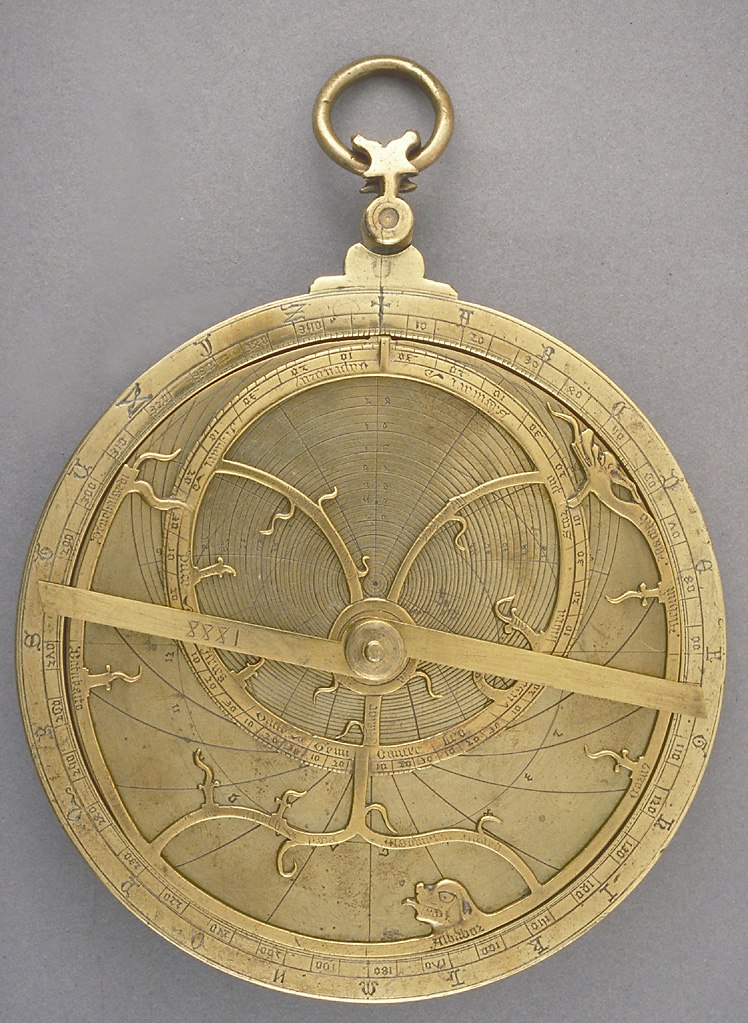
This brass astrolabe, measuring 123 mm in diameter, is of English manufacture, attributed to the late 14th or early 15th century based on stylistic lettering and the inclusion of English saint names and town latitudes on its plates. The instrument features a trilobal throne and a rete with a distinctive Y-shape within the ecliptic, incorporating 23 star pointers that transition between zoomorphic, worm-like, and bent-sword forms. The mater is empty, and the rim displays an equal 24-hour scale calibrated with letters rather than numerals. Three interchangeable plates provide markings for varied English latitudes ranging from Dover to Berwick. While the main body is historical, the rule, alidade, screw, and pin are identified as 1888 replacements. The instrument is currently held in the British Museum collection, having been presented to the institution by Maurice Rosenheim in 1914.

Front view of the 14th-century English brass astrolabe, showing the rete, star pointers, and the 1888 replacement alidade and rule.
Front view of the 14th-century English brass astrolabe, showing the rete, star pointers, and the 1888 replacement alidade and rule. — British Museum, London. Rights pending — permission not yet requested. Original source

Catalogue identity

Source
www.mhs.ox.ac.uk
Category
Tool · English astrolabe
Maker / attribution
Not established
Reference
Not recorded
Catalogue / lot identifier
MLA 1914,2-19.1
Source-reported date
late 14th century ?
Source-reported place
England

Source-reported attribution and specifications are not independent authentication. A listing does not establish present ownership, current display, availability or permission to reproduce.

Object description

Construction and Design

The astrolabe is constructed of brass and measures 123 mm in diameter. It features a trilobal throne and a mater which is largely empty save for specific construction markings. The rim is soldered directly to the back plate and contains both a 24-hour scale and a 360-degree altitude scale, the former utilizing alphabetical characters for calibration rather than traditional numerals.

The rete is characterized by a prominent Y-shape within the ecliptic. It features 23 star pointers, some of which are now illegible. These pointers display diverse, idiosyncratic forms including dragon and dog heads, worms, and bent swords. The ecliptic is divided into zodiacal signs, each subdivided into 30 degrees with 10-degree markings.

Evidence for this section
  • “The rim is soldered to the back plate. The mater is empty except for some construction markings. The throne is trilobal.”
  • “The rim has an equal 24-hour scale and a 360? altitude scale. The hour scale is calibrated by letters instead of numerals”
  • “On the rete with its distinctive Y inside the ecliptic, 23 stars are indicated, some names now illegible.”

Plates and Calendrical Scales

The instrument includes three plates providing astronomical data for specific English locations: Dover, Oxford, Nottingham, York, Newcastle, and Berwick. These plates feature markings for the equator, tropics, azimuths, and almucantars, alongside lines for unequal hours.

The back of the instrument displays multiple concentric circular scales. These include a 360-degree altitude scale, a zodiacal scale, and a Julian calendar scale. Additionally, three bands contain listings of saints and feast days, including English figures such as Dunstan and Augustin of Canterbury. The lower section of the back plate incorporates a double shadow scale to the base 12.

Evidence for this section
  • “The three plates have markings for the equator and the tropics, azimuths for every 221/2?, almucantars for every 2? (numbered by 6?), and lines for the unequal hours (numbered 1 to 12).”
  • “The back has several circular concentric scales as follows”
  • “amongst which are the English saints Dunstan (19 May) and Augustin of Canterbury (26 May).”

Provenance and Modifications

The astrolabe is not signed or dated by the original maker. Stylistic analysis of the lettering and the inclusion of specific English towns and saints suggests an origin in the late 14th or early 15th century. It is attributed to an English workshop.

The instrument has undergone modifications in the modern era. Specifically, the alidade, rule, screw, and pin were replaced in 1888, with these components marked accordingly. The object was donated to the British Museum in 1914 by Maurice Rosenheim and is documented in several academic catalogues.

Evidence for this section
  • “This instrument is neither signed nor dated, but has some features which make it very likely to be English”
  • “The counterchanged rule and alidade as well as the screw and the pin are replacements, all except the screw are marked '1888', the year of their replacement.”
  • “The instrument was presented by Maurice Rosenheim in 1914”

Open research questions

  • What is the specific significance of the reversed 'N' in the alphabetical hour scale?
  • To what extent did the 1888 replacements alter the original astronomical accuracy or utility of the instrument?

Source evidence

Recorded claims and source quotations for English Astrolabe, late 14th century
FieldSource-reported valueSource quotation
Diameter123 mm“123 mm in diameter”
Museum NumberMLA 1914,2-19.1“Registration no. MLA 1914,2-19.1”
ReplacementsRule, alidade, screw, and pin“The counterchanged rule and alidade as well as the screw and the pin are replacements”
Replacement Date1888“all except the screw are marked '1888', the year of their replacement.”
Latitude PlatesDover, Oxford, Nottingham, York, Newcastle, Berwick“1a) 'Dover' 51?; 1b) 'Oxoni{ensis}' 52?; 2a) 'Notin<n>gh<a>m' 53?; 2b) 'Ebo<rum>' 54? [York]; 3a) 'Novu<m>cas{trum}' [Newcastle] 55?; 3b) 'Berwik' 56?.”
Hour Scale24-hour scale marked with letters“The rim has an equal 24-hour scale and a 360? altitude scale. The hour scale is calibrated by letters instead of numerals”

Visible details

  • Trilobal throne at the top of the astrolabe
  • Star pointers on the rete shaped like animal heads and swords
  • Replacement rule and alidade stamped with the year 1888
  • Latitude plates engraved with English city names including Oxoniensis and Notingham

Research qualifications

  • The exact dating remains tentative, indicated as late 14th century with a question mark
  • Star names on the rete are partially illegible due to wear or damage

Photograph identity and source facts were screened before import; rights clearance remains pending.

Consulted source

Astrolabe

Reviewed 2026-10-26 · Record 5f6c283362

Terms in this record

Glossary explanations for terms named in this object’s record.