
Skip to content
The Encyclopedia of Horology

Clock · Regulator mantel clock

Empire gilt bronze four-column regulator mantel clock attributed to Destigny

Partially verified

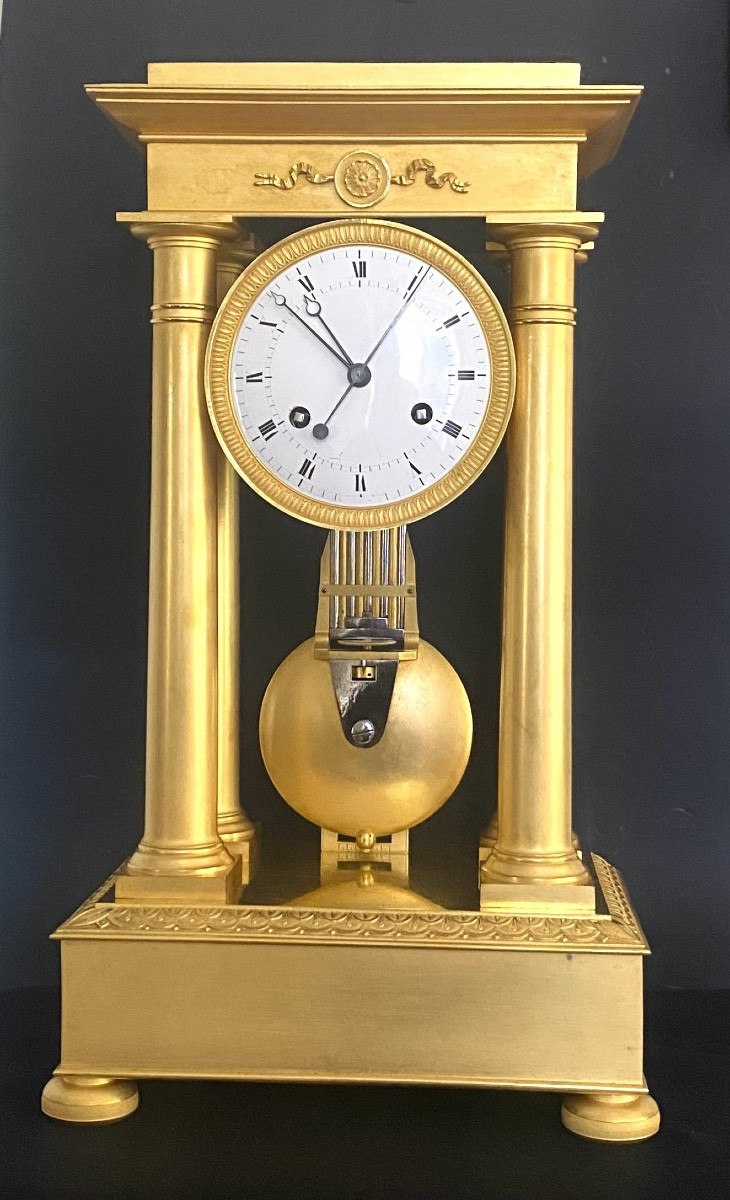
This Empire-period portico regulator mantel clock, dated by the dealer to circa 1815, is constructed in gilt bronze with four columns carrying an entablature and resting on a rectangular base with four flattened spherical feet. The circular white enamel dial features black Roman hour numerals, minute markers, and inner markings, flanked by three winding apertures and blued steel hands. The movement features a pin escapement (échappement à chevilles), knife-edge suspension, and a heavy compensated steel and brass gridiron pendulum ticking half-seconds, providing a reported 21-day power reserve. The dealer reports the enameler inscribed Destigny on the dial reverse, attributing the work to Pierre Daniel Destigny.

Frontal view of the gilt bronze four-column regulator mantel clock showing the enamel dial and gridiron pendulum
Frontal view of the gilt bronze four-column regulator mantel clock showing the enamel dial and gridiron pendulum — Clocks and fine arts. Rights pending — permission not yet requested. Original source

Catalogue identity

Source
www.proantic.com
Category
Clock · Regulator mantel clock
Maker / attribution
Pierre Daniel Destigny
Reference
1523992
Catalogue / lot identifier
Source URL identifies the listing
Source-reported date
circa 1815
Country
France

Source-reported attribution and specifications are not independent authentication. A listing does not establish present ownership, current display, availability or permission to reproduce.

Object description

Architectural Construction

This Empire-period regulator mantel clock features a four-column portico-style case executed in gilt bronze, resting on four flattened spherical feet. The upper portion includes a pedimented entablature, and the structure is supported by columns featuring Ionic capitals.

The base is decorated with a frieze. The clock stands 53 cm in height and incorporates a heavy compensated gridiron pendulum constructed of brass and steel with an oval section intended to reduce air friction.

Evidence for this section
  • “four columns featuring Ionic capitals”
  • “The base, decorated with a frieze, rests on four flattened spherical feet.”
  • “Height: 53 cm”
  • “Heavy compensated pendulum with a brass and steel grid, having an oval section (for better penetration through the air, thus limiting friction).”

Dial and Timekeeping Mechanism

The white enamel dial features black Roman numerals, perimeter minute markers, and supplementary half-second markings. It is equipped with blued steel hands, including a central sweep seconds hand identified by the source as a 19th-century replacement.

The movement utilizes a pin escapement (échappement à chevilles) and a knife-edge (couteau) suspension system. The assembly is reported to have a 21-day power reserve and records half-second intervals.

Evidence for this section
  • “The dial is white enamel with black numerals, minute markings on the perimeter, and half-second markings at the center of the dial.”
  • “The second hand is 19th century, not original.”
  • “21-day power reserve.”
  • “" chevilles" escapement”
  • “"couteau" suspension.”

Attribution and Maintenance History

The clock is attributed to Pierre Daniel Destigny based on an inscription found on the reverse of the dial. While a space for a signature remains visible beneath the numeral 6 on the front of the dial, only faint traces are present; the source suggests the original signature may have been applied cold.

The movement contains various annotations documenting maintenance, including servicing in 1818, 1865, and 1897.

Evidence for this section
  • “The back of the dial (reverse enamel) has two red signatures. The first one is unreadable, and the second is: Destigny.”
  • “The dial has space reserved for the signature beneath the number 6, with traces still visible.”
  • “Annotations of interventions: on springs: Furnisher in January 1818, on barrel covers: cleaning by Ch. Chevalley, worker at Mathey and Dumont, July 1865, on drum movement / repair made by J. GRANGE, worker at Maison Mesnard, April 1897.”

Open research questions

  • Does the 1818 intervention record by 'Furnisher' refer to a specific horological entity or a generic term for a supply house?
  • Are there other documented examples of Destigny clocks featuring this specific pin escapement configuration?

Source evidence

Recorded claims and source quotations for Empire gilt bronze four-column regulator mantel clock attributed to Destigny
FieldSource-reported valueSource quotation
Maker AttributionPierre Daniel Destigny“DESTIGNY refers to Pierre Daniel Destigny, born in Sammerville.”
EscapementPin escapement (échappement à chevilles)“" chevilles" escapement”
Power Reserve21-day“21-day power reserve.”
SuspensionKnife-edge suspension“"couteau" suspension.”
Height53 cm“Height: 53 cm”
Weight14.9 kg“Weight: 14.9 kg”
Dimensions53 cm x 30.5 cm x 19 cm“Height: 53 cm Width: 30.5 cm Depth: 19 cm”

Visible details

  • Architectural portico case crafted in gilt bronze with four columns supporting an upper pediment adorned with an applied ribbon-and-rosette mount.
  • Circular white enamel dial with black Roman numerals, inner concentric markings, and three winding apertures, surrounded by an engine-turned bezel.
  • Central blued steel hands including a sweep center seconds hand.
  • Substantial gridiron pendulum with visible polished brass and steel rods and a large circular pendulum bob.
  • Stepped rectangular base bordered along the top edge by a stylized foliate frieze and resting on four flattened spherical feet.

Research qualifications

  • Source notes the sweep second hand is a 19th-century replacement rather than original.
  • The front signature beneath the numeral 6 has faded, leaving only traces, though the reverse of the dial carries an enamel signature.

Photograph identity and source facts were screened before import; rights clearance remains pending.

Consulted source

Proantic: Regulator Pendulum Clock,échappement à Chevilles,with Precis

Reviewed 2026-10-21 · Record 2d5ae74b14

Terms in this record

Glossary explanations for terms named in this object’s record.