
Skip to content
The Encyclopedia of Horology

Pocket watch · Gourd-shaped watch

Edward East Gourd-Shaped Watch

Partially verified

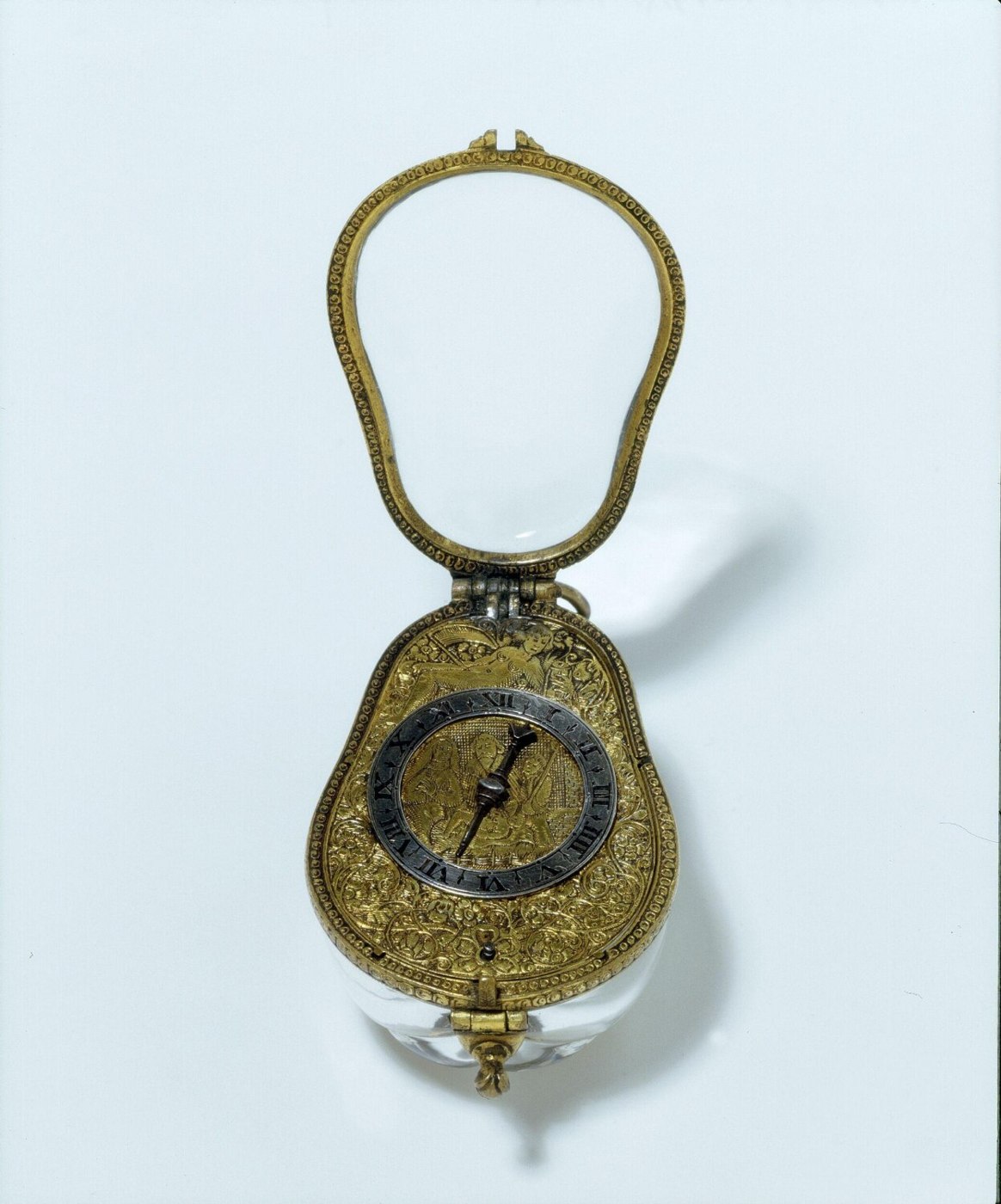
This gourd-shaped pocket watch is attributed to the London maker Edward East, dating to circa 1635. It features a distinct case fashioned from rock crystal mounted in gilt brass. The watch displays a gilt-brass dial, which is engraved with a depiction of the Nativity at its center and a nude figure of Time holding a scythe and an hourglass above the hour ring. The silver hour ring features black enamel-inlaid numerals. Internally, the movement incorporates a verge escapement and a gut-driven fusee mechanism to regulate mainspring power, with the movement plates secured by baluster pillars. This timepiece measures 5.1 cm in height, 3 cm in width, and 2.3 cm in depth.

Front view of the gourd-shaped watch by Edward East showing the engraved dial and rock crystal case.
Front view of the gourd-shaped watch by Edward East showing the engraved dial and rock crystal case. — Victoria and Albert Museum. Rights pending — permission not yet requested. Original source

Catalogue identity

Source
collections.vam.ac.uk
Category
Pocket watch · Gourd-shaped watch
Maker / attribution
Edward East
Reference
Not recorded
Catalogue / lot identifier
M.360-1927
Source-reported date
ca. 1635
Source-reported place
England

Source-reported attribution and specifications are not independent authentication. A listing does not establish present ownership, current display, availability or permission to reproduce.

Object description

Dial and Case Construction

The watch is housed in a distinctive case shaped like a gourd, composed of rock crystal secured by gilt-brass mounts. At the center of the dial, a scene depicting the Nativity is engraved, serving as a decorative focal point within the circular silver hour ring.

Positioned above the hour ring is a nude figure of Time, depicted with traditional iconographic attributes including a scythe and an hourglass. The hour ring itself is constructed from silver, with the numerical indicators inlaid in black enamel for legibility against the gilt-brass background of the dial plate. The structural arrangement of the dial supports the overall gourd-like aesthetic of the object.

Evidence for this section
  • “Gilt-brass dial engraved with the Nativity and a figure of Time”
  • “case is in the shape of a gourd made of rock crystal mounted in gilt brass”
  • “The hour ring is in silver, the figures inlaid with black enamel.”

Movement and Mechanism

The watch utilizes a verge escapement to govern its timing, a common configuration for mid-17th-century pieces. Power delivery is managed by a gut-driven fusee, which served to regulate the torque supplied by the mainspring as it unwound. This system was vital for maintaining more uniform timekeeping throughout the duration of the watch's charge.

The internal mechanics are supported by two plates, which are held together by baluster pillars. This construction suggests a focus on both structural integrity and traditional watchmaking assembly techniques employed by London makers of this period. The movement components facilitate the timekeeping function while remaining enclosed within the specialized rock-crystal housing.

Evidence for this section
  • “The movement has a verge escapement and a gut-driven fusee, which regulated the power of the mainspring.”
  • “The two plates of the movement are held between baluster pillars.”

Maker and Provenance

The object is attributed to Edward East, a highly active London clockmaker during the 17th century. East was an apprentice to Richard Rogers of the Goldsmiths' Company and later became a founder and eventually Master of the Clockmakers' Company. His professional history includes service as Chief Clockmaker to the king.

The watch was acquired by the museum through a donation from Miss E. M. Earle. The specific history of the watch prior to its arrival in the collection is not detailed, though it represents the documented output of East’s London business. The accession number M.360-1927 identifies this object within the institutional archives.

Evidence for this section
  • “Made in London by Edward East”
  • “Given by Miss E. M. Earle”
  • “In 1660 he was appointed Chief Clockmaker to the king.”

Open research questions

  • What is the specific mechanical state of the original verge escapement and fusee chain?
  • Are there any maker's marks or signatures located on the internal movement plates?

Source evidence

Recorded claims and source quotations for Edward East Gourd-Shaped Watch
FieldSource-reported valueSource quotation
MakerEdward East“Made in London by Edward East”
Accession NumberM.360-1927“M.360-1927”
Dateca. 1635“ca. 1635”
Dial decorationEngraved Nativity and figure of Time“Gilt-brass dial engraved with the Nativity and a figure of Time”
Case materialRock crystal and gilt brass“case is in the shape of a gourd made of rock crystal mounted in gilt brass”
EscapementVerge“The movement has a verge escapement”
Place of originLondon“Made in London”

Visible details

  • Gourd-shaped profile
  • Engraved gilt-brass dial surface
  • Silver hour ring with black enamel-inlaid numerals
  • Visible hinge and mounting at the top of the watch

Research qualifications

  • The exact identity of the rock crystal case source is not documented.
  • The extent of later mechanical restoration or modifications to the verge movement is unstated.

Photograph identity and source facts were screened before import; rights clearance remains pending.

Consulted source

Watch, East, Edward, ca. 1635

Reviewed 2026-11-02 · Record 0a7690e034

Terms in this record

Glossary explanations for terms named in this object’s record.