
Skip to content
The Encyclopedia of Horology

Clock · Lantern clock

Early 17th-century English lantern clock

Partially verified

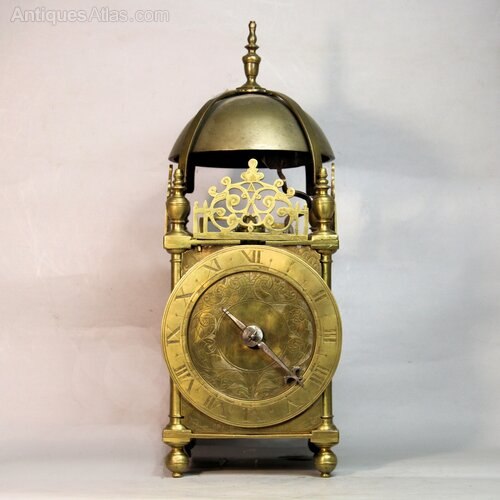
This early seventeenth-century English lantern clock, dated by the dealer to 1615 and stylistically compared to the work of London clockmaker Robert Harvey, is constructed of brass and iron. It features a six-inch chapter ring with Roman numerals, an inner quarter-hour track, and a single tailed iron hand. The dial centre is engraved with foliate fronds around an unengraved central area intended for an alarm setting disc. Surmounting the frame are three cast brass frets beneath a bell supported on cross straps. Converted from a balance wheel to a verge escapement with short pendulum, the movement incorporates countwheel striking on the top-mounted bell.

Front view of the English lantern clock showing the engraved dial, single hand, pierced fret, and bell assembly
Front view of the English lantern clock showing the engraved dial, single hand, pierced fret, and bell assembly — M C Taylor Clocks. Rights pending — permission not yet requested. Original source

Catalogue identity

Source
www.antiques-atlas.com
Category
Clock · Lantern clock
Maker / attribution
Robert Harvey
Reference
as1197a124 / AA14529
Catalogue / lot identifier
Source URL identifies the listing
Source-reported date
circa 1615
Country
United Kingdom

Source-reported attribution and specifications are not independent authentication. A listing does not establish present ownership, current display, availability or permission to reproduce.

Object description

Construction and Dial Configuration

The clock is constructed from brass and iron. It features a thinly beaten dial plate with foliate engraving in the center and a blank area intended for an alarm setting disc.

A six-inch diameter chapter ring features broad Roman numerals, an inner track with alternate shaded divisions, and line-and-star half-hour marks. The clock uses a single tailed iron hand. The frame includes turned, tapered pillars with ribbed feet and urn finials, surmounted by three cast brass frets.

Evidence for this section
  • “The very thinly beaten dial plate is frond foliate engraved to the centre with a blank area for the alarum setting disc.”
  • “The very substantial, 6" diameter chapter ring has 2 outer circles, broad Roman hour numerals, line-and-star half hour marks and an inner, divided quarter track with alternate shaded divisions.”
  • “The case frame has turned, tapered pillars with elaborated 'ribbed' feet and well-formed top urn finials.”

Movement and Modifications

The movement is stated to have a duration of 9, 12, or 15 hours and utilizes separate winding sprockets for the two trains. It was originally equipped with a balance wheel escapement, which has been converted to a verge escapement with a short pendulum.

The movement includes tapered, un-colleted arbors and countwheel striking on a top-mounted bell supported by a cross strap.

Evidence for this section
  • “The short duration movement (9, 12 or 15 hours) with separate winding sprockets to both trains.”
  • “The original balance wheel escapement has been converted to the much more accurate Verge and short pendulum escapement.”
  • “Also, countwheel striking on the top-mounted, smooth-cast bell that is hung from a cross strap”

Condition and Attribution

The clock is unsigned, though the dealer suggests it resembles the work of Robert Harvey based on stylistic similarities. The dial plate has blank spaces in the lower corners where a signature was not applied.

The clock is incomplete, missing its alarm mechanism, setting disc, doors, iron backplate, pendulum rod and bob, chains, and weights. Several components, including the top finial, bell, bell carrier, and the back-left finial, are identified as replacements.

Evidence for this section
  • “This is an extremely early and rare antique clock resembling the work of Robert Harvey.”
  • “The 4 corners are also engraved but the lower 2 have spaces left for the maker's signature which has not been applied.”
  • “All of the alarum work and setting disc are missing as are the doors, iron backplate, pendulum rod and bob, chains and weights.”
  • “The bell are carrier are replacements and the back left finial is a matched, turned replacement.”

Open research questions

  • What specific criteria are used to determine the date of 1615 for this unsigned piece?
  • Does the pivot hole mentioned near the X and XI numerals provide evidence of the original alarm mechanism configuration?
  • Are there records of other lantern clocks with 'ribbed' feet that confirm this as a period-specific feature?

Source evidence

Recorded claims and source quotations for Early 17th-century English lantern clock
FieldSource-reported valueSource quotation
Date1615“Date 1615 Early 17th Century Antiques”
MaterialsBrass and Iron“Material Brass and Iron”
Dimensions15 1/2" high x 5 7/8" deep x 5 3/4" wide“Dimensions 15 1/2" high x 5 7/8" deep x 5 3/4" wide (at the frame).”
Chapter ring size6 inches diameter“The very substantial, 6" diameter chapter ring has 2 outer circles, broad Roman hour numerals, line-and-star half hour marks and an inner, divided quarter track”
Escapement conversionConverted from balance wheel to verge with short pendulum“The original balance wheel escapement has been converted to the much more accurate Verge and short pendulum escapement.”
Date1615“Date 1615”
Dimensions15 1/2 inches high x 5 7/8 inches deep x 5 3/4 inches wide“Dimensions 15 1/2" high x 5 7/8" deep x 5 3/4" wide (at the frame).”

Visible details

  • Front-facing view of a brass lantern clock with a single iron hand pointing past the four o'clock position.
  • A decorative pierced and engraved brass fret is positioned directly above the dial plate.
  • A bell surmounts the top, suspended beneath four curved bell straps terminating in a central turned finial.
  • The dial plate shows foliate engraving in the center, flanked by turned corner pillars with turned feet.

Research qualifications

  • Attribution to Robert Harvey is speculative and not confirmed by a signature.
  • The seller reports missing side doors, iron backplate, alarm mechanism, pendulum, weights, and chains, as well as replacement bell, bell carrier, top finial, and rear left finial.

Photograph identity and source facts were screened before import; rights clearance remains pending.

Consulted source

Antiques Atlas - Early 1600's English Lantern Clock as1197a124 / AA14529

Reviewed 2026-10-25 · Record 7d84fa7aea

Terms in this record

Glossary explanations for terms named in this object’s record.