
Skip to content
The Encyclopedia of Horology

Pocket watch · Dual time zone pocket watch

Dual time zone pocket watch with split-center seconds

Partially verified

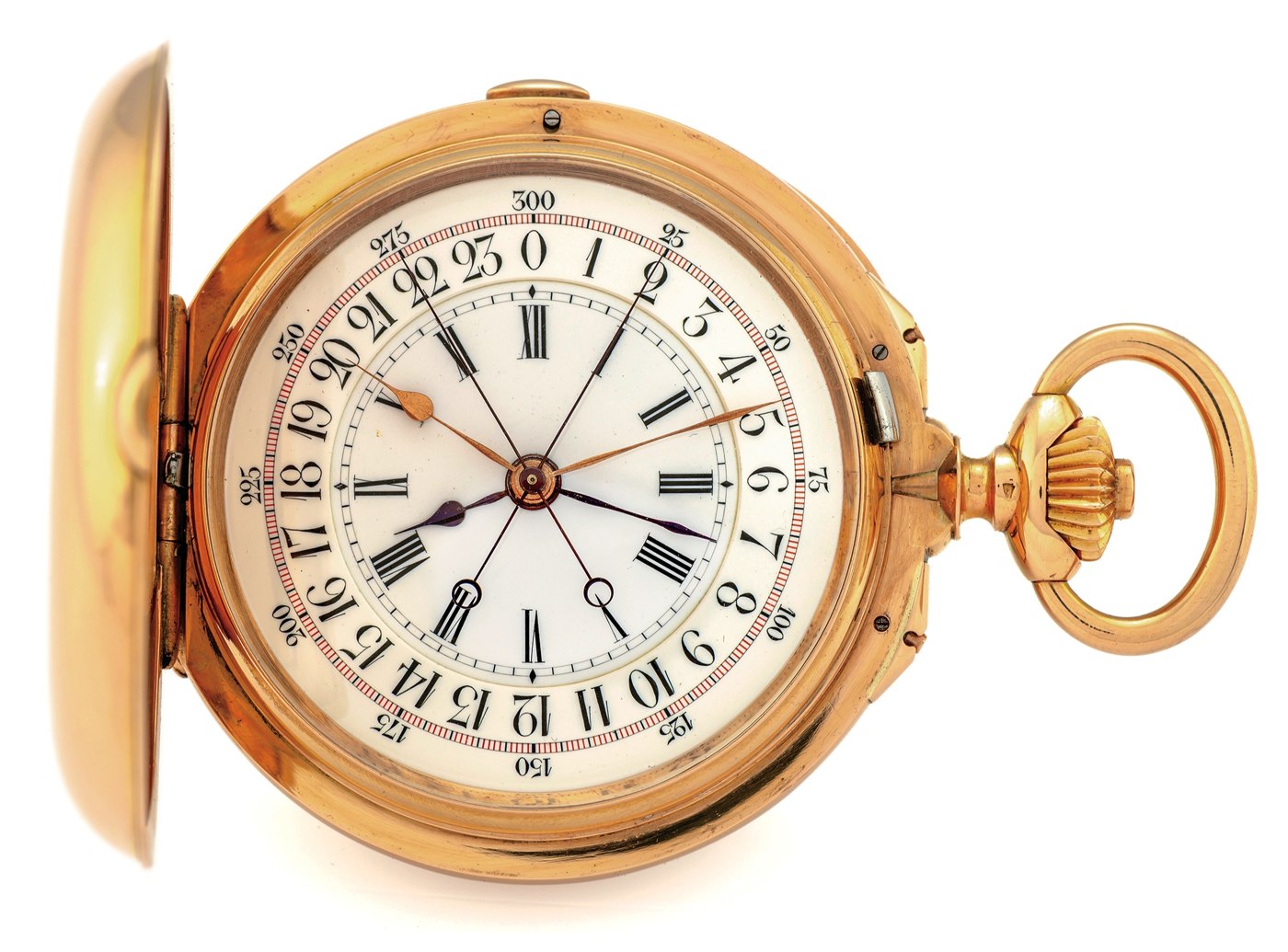
This Swiss-made pocket watch, dated circa 1890, features a heavy 18K pink gold four-body bassine et filets case measuring 55 mm in diameter. The timepiece is designed with two independently adjustable concentric dials, enabling the display of time in 12-hour and 24-hour formats. All functions, including the 12-hour and 24-hour hour hands, the minute hands, and the center-seconds, are driven from the center. The watch includes a continuous center-seconds hand with a split-seconds function that can be stopped and rejoined; however, it lacks a return-to-zero mechanism. Setting the dual time zones is facilitated by two protected buttons on the case flanking the crown, while a button in the band at 12 o'clock controls the split-seconds. The 19-ligne movement is a three-quarter plate matte gilt caliber, jeweled to the center with screwed gold chatons and featuring a lateral lever escapement with a compensation balance.

18K pink gold dual time zone pocket watch featuring 12-hour and 24-hour concentric dials with split-seconds functionality.
18K pink gold dual time zone pocket watch featuring 12-hour and 24-hour concentric dials with split-seconds functionality. — Antiquorum. Rights pending — permission not yet requested. Original source

Catalogue identity

Source
catalog.antiquorum.swiss
Category
Pocket watch · Dual time zone pocket watch
Maker / attribution
Not established
Reference
Not recorded
Catalogue / lot identifier
155
Source-reported date
circa 1890
Source-reported place
Switzerland
Source-reported serial
60049

Source-reported attribution and specifications are not independent authentication. A listing does not establish present ownership, current display, availability or permission to reproduce.

Object description

Case and Dial Design

The pocket watch is housed in an 18K pink gold, four-body, bassine et filets polished case, measuring 55 mm in diameter. It includes a hinged gold cuvette and is fitted with two protected buttons located on either side of the crown, which serve to adjust the two time zones independently. A further button is set into the case band at the 12 o'clock position to operate the split-seconds function.

The two-piece white enamel dial is configured with nested time displays. The inner section uses Roman numerals for a 12-hour display, while the outer section uses an Arabic numeral ring for a 24-hour display. The dial includes an outer minute track and a peripheral chronograph track calibrated to 300 units. Hands are differentiated by material and color, featuring blued steel spade hands for the 12-hour display, gold spade hands for the 24-hour display, and blued steel hands for the chronograph functions.

Evidence for this section
  • “Four-body, bassine et filets, polished, two protected buttons flanking the crown for the independent setting of both time zones”
  • “Two-piece, white enamel with inner radial Roman numerals for the 12-hour dial, outer minute track, outer 24-hour ring and outermost chronograph track calibrated to 300 units.”

Movement and Chronograph Functionality

The 19-ligne, matte gilt, three-quarter plate movement is jeweled to the center and utilizes screwed gold chatons. The technical specification includes a lateral lever escapement, a cut bimetallic compensation balance, and an index regulator. A blued steel Breguet balance spring with an overcoil is employed for regulation.

A defining technical feature of this movement is that all six hands are driven from the center. The watch provides a continuous center-seconds hand with a split-seconds function that allows for stopping and resuming the timing hand. Unlike standard chronographs, the mechanism does not possess a return-to-zero function for the timing hand.

Evidence for this section
  • “19''', matte gilt, three-quarter plate, jeweled to the center with screwed gold chatons, lateral lever escapement”
  • “Remarkably the hands for all functions are driven from the center. The constant running center-seconds has a split-seconds function that can be used as a chronograph but without the return-to-zero function of a true chronograph.”

Condition and Attribution

The auction description reports the object as being in excellent condition overall under their grading system, with the case and movement individually noted as being in very good condition. The dial is classified as very good, and the hands are identified as original.

The piece is identified as Swiss-made, with a production date estimated to be circa 1890. The case is stamped with the serial number 60049.

Evidence for this section
  • “Grading System Grade: AAA Excellent Case: 2 Very good Movement: 2-8* Very good Slightly scratched Overhaul recommended, at buyer's expense Dial: 2-01 Very good”
  • “Swiss, case No. 60049. Made circa 1890.”

Open research questions

  • What is the specific horological mechanism used to achieve center-driven dual time displays?
  • Can the manufacturer be identified based on the specific movement caliber layout?

Source evidence

Recorded claims and source quotations for Dual time zone pocket watch with split-center seconds
FieldSource-reported valueSource quotation
Case material18K pink gold“heavy 18K pink gold”
Diameter55 mm“DIAM. 55 mm.”
Case typeFour-body, bassine et filets“Four-body, bassine et filets”
EscapementLateral lever“lateral lever escapement”
Balance springBlued steel Breguet overcoil“blued steel Breguet balance spring with overcoil”
Serial number60049“case No. 60049”

Visible details

  • Case features two buttons flanking the crown for time adjustment
  • White enamel dial includes inner Roman numerals for 12-hour display and outer Arabic numerals for 24-hour display
  • Outermost track on dial is calibrated to 300 units for chronograph functions
  • Six hands originate from the center

Research qualifications

  • The movement is noted as requiring an overhaul
  • The split-seconds chronograph lacks a return-to-zero function

Photograph identity and source facts were screened before import; rights clearance remains pending.

Terms in this record

Glossary explanations for terms named in this object’s record.