
Skip to content
The Encyclopedia of Horology

Pocket watch · Clock watch

Clock-watch and pair case by Johannes Bayes

Partially verified

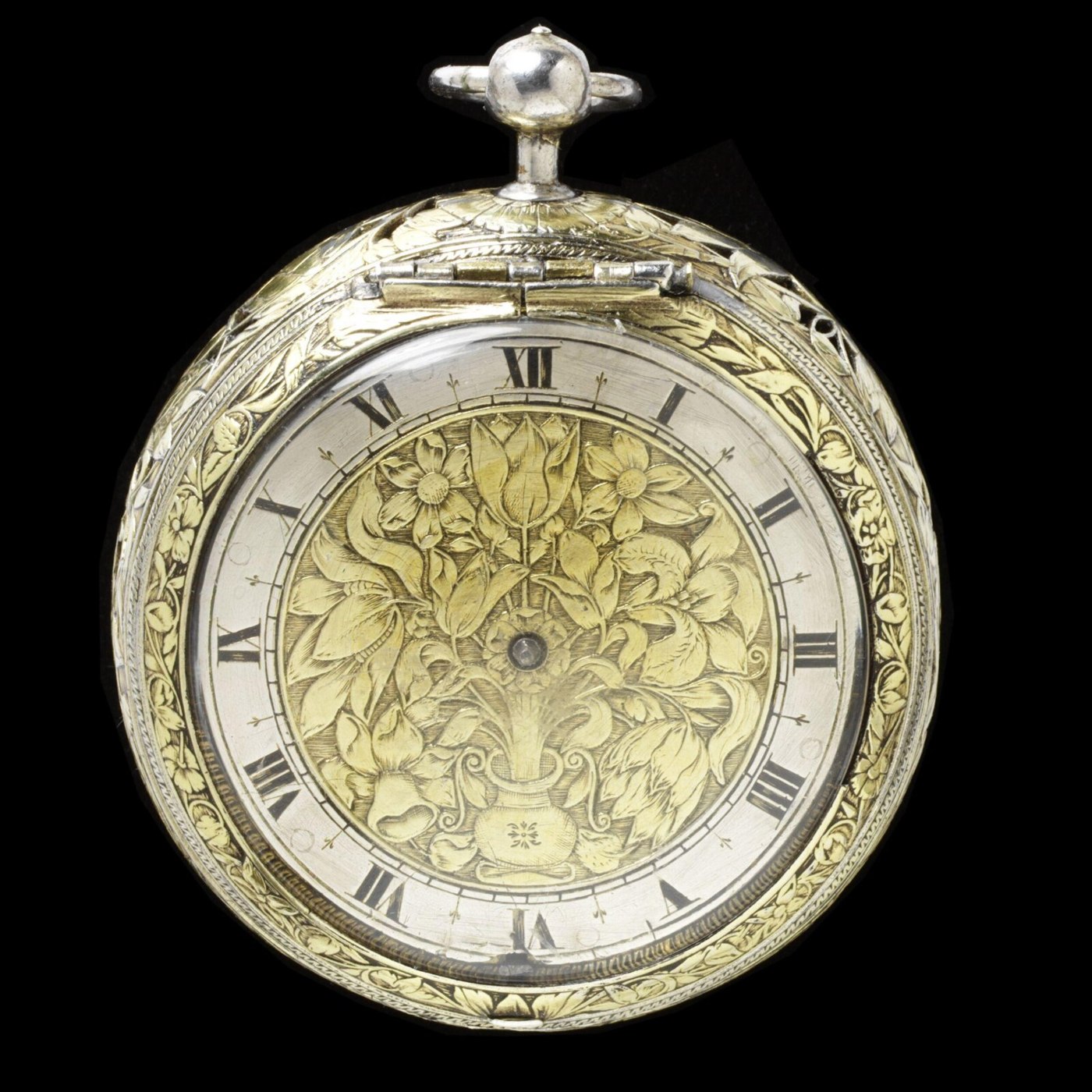
This English clock-watch and its associated protective pair case originate from London, with the watch movement attributed to Johannes Bayes. The watch is signed 'Johannes Bayes Londini' and dates to approximately 1660. It is constructed from silver, featuring parcel-gilt surfaces, intricate piercing, and detailed engraving. The accompanying outer pair case, dated by the museum to approximately 1690, is crafted from brass and clad in tortoiseshell, further ornamented with silver-gilt elements. The circular watch face displays an engraved floral arrangement in a vase within a central gilded field, enclosed by a silver chapter ring with Roman numerals. The bezel is decorated with dense foliage and scrolling patterns, complemented by pierced silverwork on the outer casing. The object is held in the Victoria and Albert Museum collection as accession number 395&A-1888, serving as a documented example of seventeenth-century English horological construction and decorative metalwork.

The face of the clock-watch, showing the engraved floral vase design and Roman numeral chapter ring.
The face of the clock-watch, showing the engraved floral vase design and Roman numeral chapter ring. — Victoria and Albert Museum. Rights pending — permission not yet requested. Original source

Catalogue identity

Source
orbiscollectibles.com
Category
Pocket watch · Clock watch
Maker / attribution
Johannes Bayes
Reference
Not recorded
Catalogue / lot identifier
395&A-1888
Source-reported date
ca. 1660
Source-reported place
England

Source-reported attribution and specifications are not independent authentication. A listing does not establish present ownership, current display, availability or permission to reproduce.

Object description

Case and Dial Construction

The timepiece possesses a circular form characterized by a distinctive top suspension loop and stem. The dial is dominated by a central gilded field featuring a detailed engraved floral arrangement set within a vase. Encircling this centerpiece is a silver chapter ring, which incorporates Roman numerals to indicate the hours, accompanied by subtle track markings.

The exterior of the watch case features a bezel densely ornamented with foliage and scrolling patterns. The outer construction incorporates pierced silver work, which is partially gilded. This is housed within a protective pair case, which is distinct from the primary watch construction. The outer case is composed of brass clad in tortoiseshell, finished with decorative silver-gilt elements.

Evidence for this section
  • “The timepiece displays circular form with a top suspension loop and stem.”
  • “The visible dial features an engraved floral arrangement set within a vase at the centre, rendered in a gilded finish.”
  • “The accompanying outer pair case, dated to approximately 1690 according to the museum record, utilizes brass clad in tortoiseshell with decorative silver-gilt elements.”

Maker and Attribution

The clock-watch movement is attributed to the London-based maker Johannes Bayes. The identification of the maker is supported by an engraved signature found on the watch, specifically reading 'Johannes Bayes Londini'.

While the watch itself is dated to circa 1660, the accompanying protective pair case is dated by the Victoria and Albert Museum to approximately 1690.

Evidence for this section
  • “The movement is attributed to Johannes Bayes, and the watch bears the engraved signature 'Johannes Bayes Londini'.”
  • “This object is an English clock-watch and pair case originating from London around 1660.”
  • “The accompanying outer pair case, dated to approximately 1690 according to the museum record”

Documentation and Provenance

This object is part of the collections held by the Victoria and Albert Museum. It is identified under the accession number 395&A-1888. The details provided in this record are derived from the museum's own documentation, which confirms the materials and the general period of the watch and its pair case.

The record serves to archive the physical attributes of the object, noting both the primary watch and the separate outer casing as a combined ensemble. No additional catalogue references or provenance histories were provided in the source documentation beyond the museum's primary registration data.

Evidence for this section
  • “Transcribed from the Victoria and Albert Museum collection record for this single object”
  • “Museum object number 395&A-1888”

Open research questions

  • What specific type of movement (e.g., verge escapement) is utilized within the watch?
  • Is there evidence indicating when the pair case was paired with the watch?

Source evidence

Recorded claims and source quotations for Clock-watch and pair case by Johannes Bayes
FieldSource-reported valueSource quotation
MakerJohannes Bayes“The movement is attributed to Johannes Bayes”
SignatureJohannes Bayes Londini“the watch bears the engraved signature 'Johannes Bayes Londini'”
OriginLondon, England“originating from London around 1660”
Watch materialsParcel-gilt, pierced, and engraved silver“parcel-gilt, pierced, and engraved silver watch”
Pair case materialsBrass, tortoiseshell, silver-gilt“brass covered with tortoiseshell and ornamented with silver gilt”
Accession number395&A-1888“Museum object number 395&A-1888”

Visible details

  • Engraved floral vase motif on the dial
  • Silver chapter ring with Roman numerals
  • Dense engraved foliage patterns on the bezel
  • Top suspension loop and stem

Research qualifications

  • The 1690 date for the pair case is attributed specifically to museum records
  • Attribution of the movement to Johannes Bayes relies on the engraved signature

Photograph identity and source facts were screened before import; rights clearance remains pending.

Consulted source

Clock-watch and pair case

Reviewed 2026-11-02 · Record 7ef44d585b

Terms in this record

Glossary explanations for terms named in this object’s record.