
Skip to content
The Encyclopedia of Horology

Component · Educational model

Chronometer Escapement Model

Partially verified

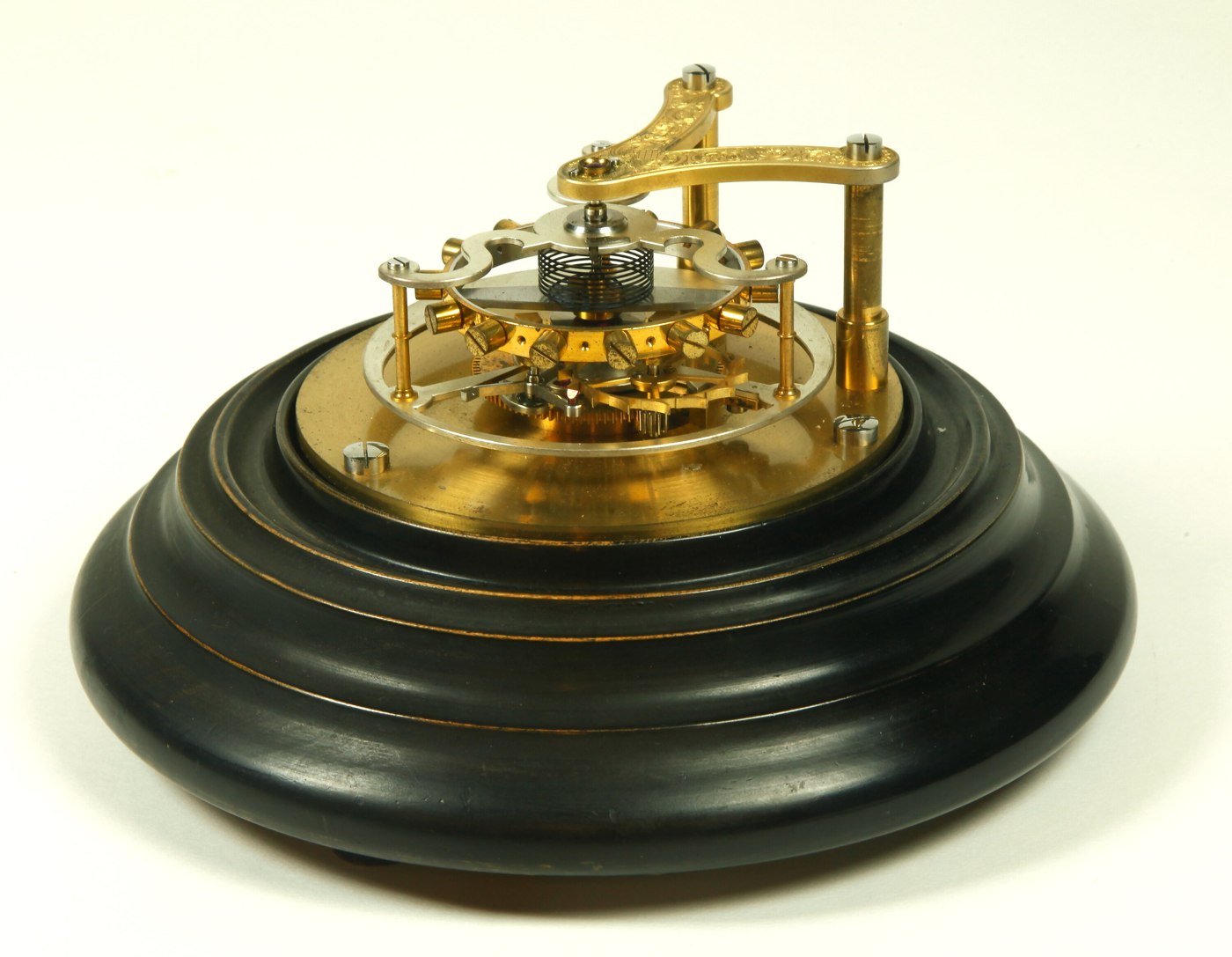
This object is an enlarged working model of a chronometer escapement, attributed to Thomas Earnshaw and dated to the late 18th century. The assembly features a metal chronometer mechanism mounted onto a circular, tiered wooden base. The model demonstrates the mechanical components of a chronometer escapement, which was historically used in portable timekeeping devices for maritime navigation and longitude determination. The construction includes jewelled pallets and an endstone. The mechanism is supported by a series of vertical pillars and a curved, decorated bridge. The model stands 10 cm high with an outside diameter of 20 cm. It was acquired by Museum Victoria through a loan and subsequent donation by Joseph Lowy in 1954.

Side profile view showing the wooden base, vertical support pillars, and the chronometer escapement mechanism of the Earnshaw model.
Side profile view showing the wooden base, vertical support pillars, and the chronometer escapement mechanism of the Earnshaw model. — Museums Victoria. Rights pending — permission not yet requested. Original source

Catalogue identity

Source
collections.museumsvictoria.com.au
Category
Component · Educational model
Maker / attribution
Thomas Earnshaw
Reference
Not recorded
Catalogue / lot identifier
ST 23659
Source-reported date
late 18th century
Source-reported place
England

Source-reported attribution and specifications are not independent authentication. A listing does not establish present ownership, current display, availability or permission to reproduce.

Object description

Construction and Design

The chronometer escapement model is constructed as an enlarged representation of an Earnshaw chronometer escapement. The mechanism is elevated above a circular wooden base, which features a tiered profile and small feet. The internal assembly is supported by vertical brass pillars, which anchor the framework to a brass plate fixed upon the wooden base.

At the top of the assembly, a curved bridge with decorative engraving provides stability to the upper pivot point of the escapement.

Evidence for this section
  • “Enlarged working model of Earnshaw chronometer escapement on round wooden base”
  • “Pallets and endstone are jewelled.”

Historical Context and Attribution

The model is attributed to Thomas Earnshaw, a British watchmaker noted for his contributions to the development of the chronometer. During the late 18th century, the refinement of these devices was critical for maritime operations, particularly in the calculation of longitude.

The object served as an educational tool for visualizing the complex internal function of chronometers.

Evidence for this section
  • “Originally a watchmaker Thomas Earnshaw went on to become one of the pioneers of chronometer development.”
  • “A chronometer might be best decribed as a highly accurate portable timekeeping device.”

Acquisition and Documentation

Museum Victoria catalogues this object under the registration number ST 23659. The item was initially held by the museum through a loan agreement before transitioning to a permanent donation. The donor, Joseph Lowy, provided the object to the institution in March 1954.

The museum maintains this object within its science and measurement collections, grouping it with other horological chronometer models.

Evidence for this section
  • “Registration number: ST 23659”
  • “Loan & Subsequent Donation from Joseph Lowy, 05 Mar 1954”

Open research questions

  • What specific historical educational programme or institution was this model originally intended for?
  • Are there similar Earnshaw-attributed models in other museum collections to verify the construction techniques employed?

Source evidence

Recorded claims and source quotations for Chronometer Escapement Model
FieldSource-reported valueSource quotation
MakerThomas Earnshaw“Earnshaw, England”
Registration numberST 23659“Registration number: ST 23659”
Datelate 18th century“late 18th century”
Dimensions10 cm height, 20 cm diameter“10 cm (Height), 20 cm (Outside Diameter)”
AcquisitionDonated by Joseph Lowy, 1954“Loan & Subsequent Donation from Joseph Lowy, 05 Mar 1954”
ConstructionJewelled pallets and endstone“Pallets and endstone are jewelled.”

Visible details

  • Large, non-functional wooden tiered base with feet
  • Intricate brass metalwork including a decorated bridge
  • Visible balance spring and jewelled components within the escapement mechanism
  • Vertical pillar-based framework supporting the top bridge structure

Research qualifications

  • The exact provenance beyond the 1954 donation is not detailed.
  • The assertion that it is a working model is based on the source text, though functional state is unverified.

Photograph identity and source facts were screened before import; rights clearance remains pending.

Consulted source

Chronometer Escapement Model - Earnshaw, England, late 18th century

Reviewed 2026-10-26 · Record 47e106a42a

Terms in this record

Glossary explanations for terms named in this object’s record.