
Skip to content
The Encyclopedia of Horology

Marine chronometer · Box marine chronometer (without case)

Charles Frodsham Box Chronometer

Partially verified

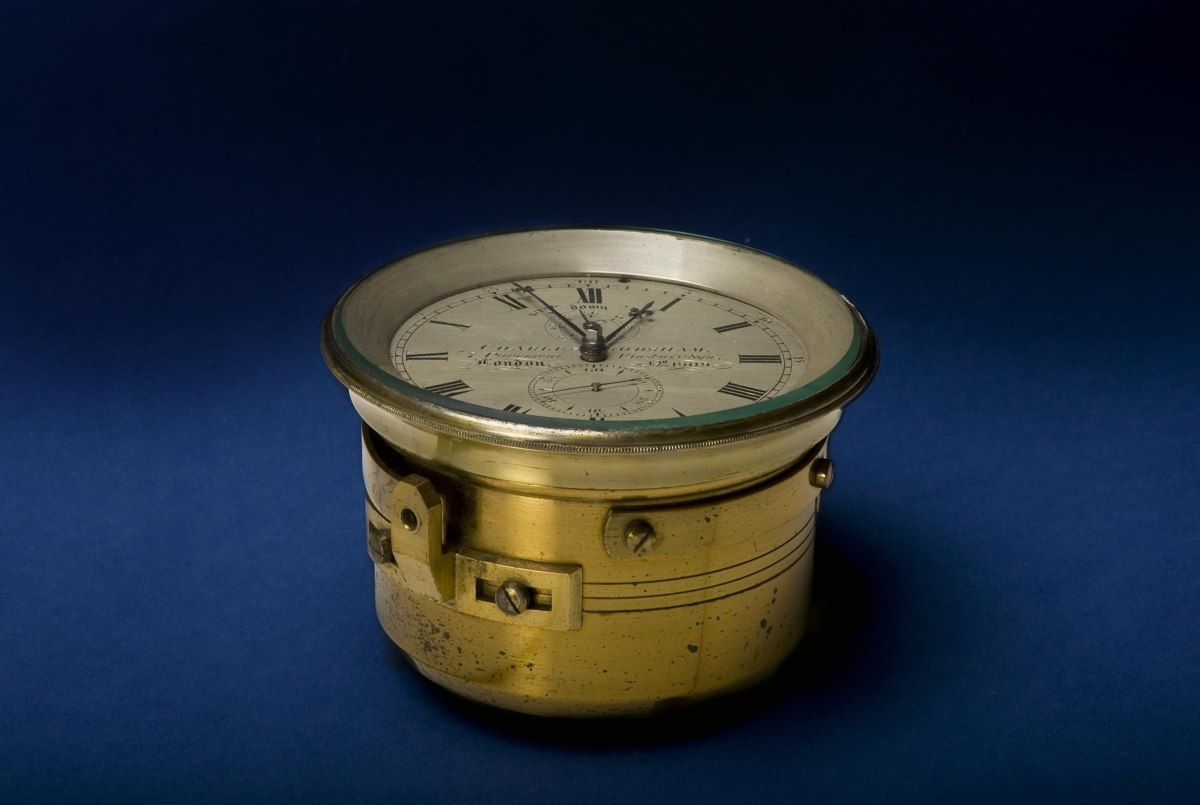
This marine chronometer was finished by the London firm of Charles Frodsham between 1838 and 1843. Designed for determining longitude at sea, it features an engraved and silvered brass dial with blued steel hands, Roman numerals, a subdial for seconds, and an up-and-down winding indicator. According to the Smithsonian Institution, the movement utilizes an Earnshaw spring detent escapement, a helical blued steel balance spring, and a 56-hour spring drive governed by chain and fusee. Housed in a brass bowl with external gimbal mountings, the chronometer is preserved without its outer wooden box, key, or gimbal ring, and was transferred from the U.S. Navy Bureau of Ships.

Oblique view of the brass chronometer bowl showing the silvered dial and gimbal mounting brackets
Oblique view of the brass chronometer bowl showing the silvered dial and gimbal mounting brackets — National Museum of American History. Rights pending — permission not yet requested. Original source

Catalogue identity

Source
www.si.edu
Category
Marine chronometer · Box marine chronometer (without case)
Maker / attribution
Charles Frodsham
Reference
Not recorded
Catalogue / lot identifier
ME.314267
Source-reported date
1838-1843
Country
United Kingdom
Source-reported serial
1909

Source-reported attribution and specifications are not independent authentication. A listing does not establish present ownership, current display, availability or permission to reproduce.

Object description

Identity and Provenance

This marine chronometer, identified by serial number 1909, is the work of the firm Charles Frodsham. It was produced between 1838 and 1843 in London, England.

The object was transferred to the Smithsonian Institution from the U.S. Navy’s Bureau of Ships. It is currently preserved without its original outer box, gimbal ring, or winding key.

Evidence for this section
  • “maker Charles Frodsham”
  • “date made 1838-1843”
  • “place made United Kingdom: England, London”
  • “It was transferred to the Smithsonian from the U.S. Navy’s Bureau of Ships.”
  • “Key missing”
  • “Brass fittings for gimbal, gimbal missing”

Dial and Visual Features

The instrument features an engraved, silvered brass dial. Visual features include blued steel fleur-de-lys hands, a subsidiary seconds dial, and a state-of-wind indicator for the 56-hour duration.

The dial is inscribed: 'CHARLES FRODSHAM / 7 Pavement Finsbury Squr, / London No.1909'. It is protected by a flat glass crystal with a small, unpolished chamfer, secured by a milled, screwed brass bezel.

Evidence for this section
  • “Engraved and silvered brass”
  • “Hands: blued steel, fleur-de-lys”
  • “Inscription: "CHARLES FRODSHAM / 7 Pavement Finsbury Squr, / London No.1909””
  • “Bezel screwed and milled”
  • “Crystal flat, small unpolished chamfer”

Mechanism and Construction

The movement uses an Earnshaw spring detent escapement and a helical, blued steel balance spring. Power is provided by a spring drive with a chain and fusee.

The movement is enclosed in a brass bowl. A sprung cylindrical inner bowl is present, serving as a dust cover. The exterior of the bowl features brass fittings for gimbal suspension.

Evidence for this section
  • “Escapement: Earnshaw, spring detent”
  • “Balance spring: helical, blued steel”
  • “Power source: Spring drive with chain and fusee”
  • “Brass bowl, fitted with a sprung cylindrical inner bowl as a dust cover (original work)”
  • “Brass fittings for gimbal”

Open research questions

  • Are there extant production records for Charles Frodsham that provide further history for serial number 1909?
  • Does the U.S. Navy Bureau of Ships retain logbooks or records identifying the specific maritime vessel where this chronometer was deployed?

Source evidence

Recorded claims and source quotations for Charles Frodsham Box Chronometer
FieldSource-reported valueSource quotation
MakerCharles Frodsham“maker Charles Frodsham”
EscapementEarnshaw, spring detent“Escapement: Earnshaw, spring detent”
Duration56-hour“Duration: 56-hour”
Power SourceSpring drive with chain and fusee“Power source: Spring drive with chain and fusee”
Place MadeUnited Kingdom: England, London“place made United Kingdom: England, London”
InscriptionCHARLES FRODSHAM / 7 Pavement Finsbury Squr, / London No.1909“Inscription: "CHARLES FRODSHAM / 7 Pavement Finsbury Squr, / London No.1909””
Overall Dimensions2 3/4 in x 4 1/4 in (6.985 cm x 10.795 cm)“overall: 2 3/4 in x 4 1/4 in; 6.985 cm x 10.795 cm”
Accession Number198140“accession number 198140”

Visible details

  • Cylindrical brass bowl fitted with screw-mounted exterior brass brackets for gimbal suspension.
  • Engraved and silvered dial featuring Roman numerals, blued steel hands, subsidiary seconds dial, and state-of-wind indicator below 12 o'clock.
  • Milled brass bezel holding a flat circular glass crystal with chamfered edge.
  • Dial inscription visible between the center arbor and subsidiary seconds dial: 'CHARLES FRODSHAM / 7 Pavement Finsbury Squr, / London No.1909'.

Research qualifications

  • The outer wooden chronometer case, gimbal ring, and winding key are missing as noted by the source.
  • Internal movement components including the Earnshaw escapement and helical balance spring are not visible in the photograph.

Photograph identity and source facts were screened before import; rights clearance remains pending.

Consulted source

Charles Frodsham Box Chronometer | Smithsonian Institution

Reviewed 2026-10-25 · Record c59f7c0986

Terms in this record

Glossary explanations for terms named in this object’s record.