
Skip to content
The Encyclopedia of Horology

Clock · Floorstanding observatory regulator longcase clock

Burr walnut eight-day observatory regulator longcase clock by Baron Hill of Crewe

Partially verified

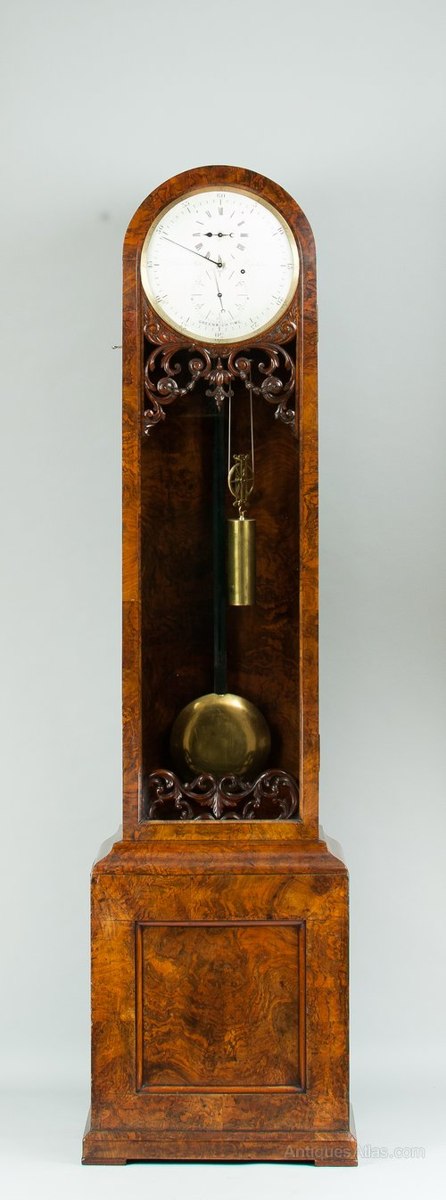
Source reports this mid-Victorian floorstanding observatory regulator longcase clock was made by Baron Hill of Crewe circa 1850. The arched-top case is veneered in figured burr walnut, standing 6 feet 7 inches high, with glazed trunk door and carved fretwork below the dial and door base. The engraved silvered brass regulator dial displays an outer minute track, with subsidiary dials showing hours at the top and seconds below. The movement is an eight-day mechanism with shaped plates, Harrison's maintaining power, and a deadbeat escapement, driving a cylindrical brass weight via a spoked pulley and a heavy brass bob on an ebonised wooden rod.

Full front view of the burr walnut observatory regulator longcase clock by Baron Hill of Crewe
Full front view of the burr walnut observatory regulator longcase clock by Baron Hill of Crewe — Story Antique Clocks / Antiques Atlas. Rights pending — permission not yet requested. Original source

Catalogue identity

Source
www.antiques-atlas.com
Category
Clock · Floorstanding observatory regulator longcase clock
Maker / attribution
Baron Hill of Crewe
Reference
Baron/16
Catalogue / lot identifier
as731a020
Source-reported date
c. 1850
Country
United Kingdom

Source-reported attribution and specifications are not independent authentication. A listing does not establish present ownership, current display, availability or permission to reproduce.

Object description

Case Construction

The clock is housed in an arched-top case veneered in figured burr walnut, described as a jeweller's shop style. It features a glazed trunk door with carved decorative work beneath the dial and at the lower section of the door.

The base is designed as a box with a recessed panel, mounted on a plinth skirt and pad feet. The overall height is 6 feet 7 inches.

Evidence for this section
  • “The high quality and substantial case veneered in beautifully figured burr walnut.”
  • “The arched top jewellers shop style case with glazed trunk door, having fine quality carved work beneath the dial and also to the lower section of the door.”
  • “The richly figured box base with recessed panel, mounted on a plinth skirt and pad feet,”
  • “6ft 7" tall”

Dial and Movement

The circular engraved silvered brass dial is mounted within a cast brass sighting ring and features an outer minute track. It displays an unconventional layout with the hour subsidiary dial at the top and the seconds subsidiary dial at the bottom.

The movement is of eight-day duration with thick shaped plates and four large turned pillars.

Evidence for this section
  • “The circular engraved silvered brass dial with outer minute tack and subsidiary dials for the hours and seconds. (Observatory markings), unusual having the seconds dial to the lower section and hours to the top.”
  • “Cast brass sighting ring.”
  • “The substantial movement of eight day duration with thick shaped plates united by four large turned pillars.”

Mechanical Components and Restoration Status

The clock includes a cylindrical brass weight, a spoked pulley, and a heavy brass-cased pendulum suspended from an ebonized wooden rod, featuring a pointer and calibrated rating nut. Hands are fashioned from blued steel.

Dealer records state that the movement, dial, pendulum, pulley, and weight were unrestored at the time of cataloguing. Features such as Harrison's maintaining power and the deadbeat escapement are reported by the source.

Evidence for this section
  • “The polished brass cylindrical weight with ornate fretted and spoked pulley. Large and heavy brass cased pendulum with calibrated rating nut and pointer, ebonised wooden rod. Blued steel hands.”
  • “Harrison’s maintaining power, deadbeat escapement with beat setting adjustment to the crutch.”
  • “The movement, dial, pendulum, pulley and weight are currently unrestored”

Open research questions

  • Is Baron Hill of Crewe a documented maker or a trade name associated with specific retail establishments?
  • Does the 'observatory regulator' nomenclature correlate with standard 19th-century horological classification or serve as a retail descriptor?

Source evidence

Recorded claims and source quotations for Burr walnut eight-day observatory regulator longcase clock by Baron Hill of Crewe
FieldSource-reported valueSource quotation
MakerBaron Hill of Crewe“Maker: Baron Hill of Crewe”
Datec. 1850“c.1850”
Duration8 day“8 day Floorstanding Observatory Regulator Longcase Clock”
Case materialBurr walnut“The high quality and substantial case veneered in beautifully figured burr walnut.”
EscapementDeadbeat escapement“Harrison’s maintaining power, deadbeat escapement with beat setting adjustment to the crutch.”
Height6ft 7"“6ft 7" tall”

Visible details

  • Arched top burr walnut case with matching figured veneer on trunk backboard and plinth base
  • Carved openwork fretwork brackets beneath the circular dial and above the plinth inside the glazed trunk
  • Silvered circular dial featuring regulator layout with central minute hand and two subsidiary dials
  • Suspended cylindrical brass drive weight on a spoked pulley and a large circular brass pendulum bob mounted on a dark rod

Research qualifications

  • Maker attribution and specific movement features such as Harrison's maintaining power and deadbeat escapement are source-reported and not externally visible in the photograph
  • Dealer notes the movement, dial, pendulum, pulley, and weight were unrestored at time of cataloguing

Photograph identity and source facts were screened before import; rights clearance remains pending.

Consulted source

Antiques Atlas - Burr Walnut Regulator as731a020 / Baron/16

Reviewed 2026-10-22 · Record ff5bec8617

Terms in this record

Glossary explanations for terms named in this object’s record.