
Skip to content
The Encyclopedia of Horology

Marine chronometer · Two-day marine chronometer

Breguet No. 104 Two-Day Double-Boxed Marine Chronometer

Partially verified

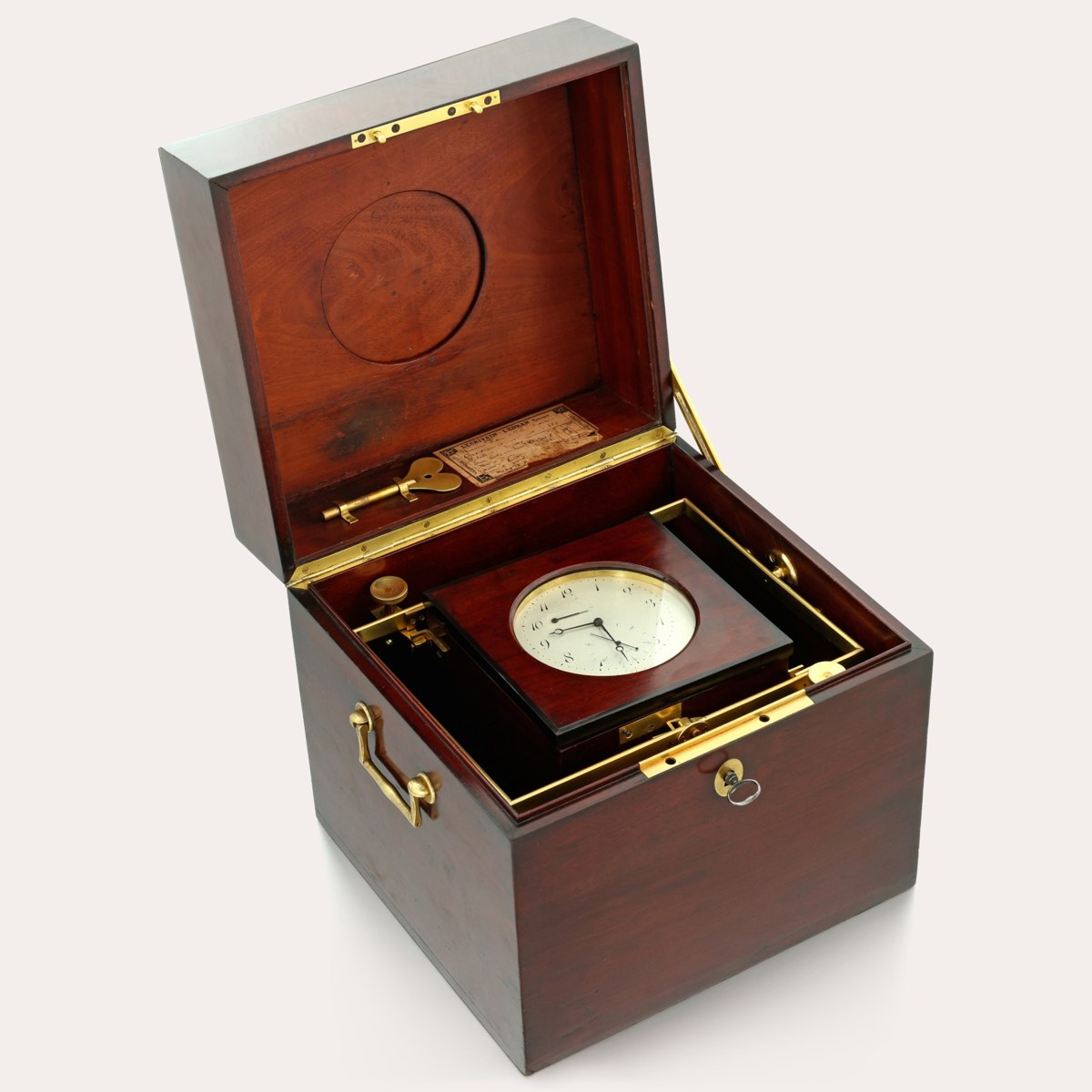
Breguet No. 104 is a gilt-brass and mahogany two-day marine chronometer documented by the maker's certificate as begun in 1795 and completed in 1818. Constructed on an ébauche supplied by Samuel Roy, the movement utilizes two tandem-wound going barrels driving a single double-helix chain fusee, an Earnshaw-type spring detent escapement, and an undersprung helical spring. The matte silvered dial features black Breguet numerals, subsidiary seconds, and a 40-hour up-and-down indicator. The instrument is suspended in rectangular brass gimbals within an inner mahogany case, housed in an outer transport box with carrying handles. Originally sold to Captain Charles Baudin in 1818, it is Breguet's lowest-numbered known surviving marine chronometer.

Breguet marine chronometer No. 104 in double mahogany box with rectangular gimbal mount
Breguet marine chronometer No. 104 in double mahogany box with rectangular gimbal mount — Sotheby's. Rights pending — permission not yet requested. Original source

Catalogue identity

Source
www.sothebys.com
Category
Marine chronometer · Two-day marine chronometer
Maker / attribution
Breguet et Fils
Reference
Not recorded
Catalogue / lot identifier
29
Source-reported date
begun 1795, finished 1818
Country
France
Source-reported serial
104

Source-reported attribution and specifications are not independent authentication. A listing does not establish present ownership, current display, availability or permission to reproduce.

Object description

Production and Provenance

Breguet No. 104 is identified as the maker's lowest-numbered surviving marine chronometer. According to archival records, its production span was extensive; initial work began in 1795 utilizing an ébauche from Samuel Roy, but manufacturing was interrupted in 1804 and 1812 before reaching completion in 1818.

The instrument was first sold on April 9, 1818, to Captain Charles Baudin. Service records indicate the piece was returned to Breguet for maintenance five times between 1821 and 1853. A 1853 service record specifically notes the chronometer required refurbishment following an immersion event.

Evidence for this section
  • “begun in 1795 using an ébauche supplied by Samuel Roy”
  • “finished in 1818 when it was sold to Captain Charles Baudin”
  • “returned to Breguet for service five times between 1821 and 1853”
  • “noted that the chronometer required full refurbishment having suffered an immersion”

Mechanical Specifications

The movement features a brass Samuel Roy ébauche incorporating two tandem-wound going barrels that drive a single double-helix chain fusee. The regulation system utilizes an Earnshaw-type spring detent escapement, a roller with a ruby impulse pallet, and a large free-sprung bi-metallic compensation balance with moveable timing weights and additional timing screws. A grey-finished steel helical spring is undersprung, and the movement includes a diamond endstone.

The matte silvered dial displays black Breguet numerals, an outer minute ring, and large subsidiary seconds. A 40-hour up-and-down indicator is integrated as a sector display.

Evidence for this section
  • “brass Samuel Roy ébauche , two large tandem-wound going barrels turning a single double helix chain fusee”
  • “Earnshaw-type spring detent escapement, roller with ruby impulse pallet”
  • “large free-sprung bi-metallic compensation balance with moveable timing weights each with additional timing screw”
  • “large undersprung grey-finished steel helical spring, diamond endstone”
  • “matt silvered dial, black Breguet numerals, sector for 40-hour up-and-down indication”

Casing and Configuration

The chronometer is mounted in rectangular brass gimbals within an inner mahogany box. This inner unit is housed inside a larger outer mahogany transport box, which includes a front lock escutcheon and side carrying handles. The outer lid features a sliding viewing aperture containing an inset brass plaque signed and numbered Breguet 104.

The interior of the upper inner lid secures a brass winding key and a printed paper repair/trade label. The piece underwent conservation and restoration by Anthony Gray following its 2019 auction.

Evidence for this section
  • “inner mahogany box with spring arms, outer box with rectangular brass gimbal”
  • “sliding viewing aperture to lid with inset brass plaque signed and numbered Breguet 104”
  • “A brass winding key and a printed paper repair/trade label are secured inside the upper inner lid.”
  • “undergone an extensive and highly skilled programme of conservation and restoration by the specialist conservator Anthony Gray”

Open research questions

  • Does the 'printed paper repair/trade label' mention specific dates or workshops that can further clarify the post-1853 service history?
  • Are there identifiable maker's marks on the gimbal system that correlate with the 1818 assembly date?

Source evidence

Recorded claims and source quotations for Breguet No. 104 Two-Day Double-Boxed Marine Chronometer
FieldSource-reported valueSource quotation
Maker SignatureBreguet et Fils, No. 104“signed and numbered Breguet et Fils, No. 104”
Ébauche MakerSamuel Roy“brass Samuel Roy ébauche”
EscapementEarnshaw-type spring detent“Earnshaw-type spring detent escapement, roller with ruby impulse pallet”
Power Reserve Indicator40-hour up-and-down indication“sector for 40-hour up-and-down indication”
Dial Diameter115 mm“dial diameter 115mm”
Original Sale Date9 April 1818“Sold to Captain Charles Baudin on 9 April 1818 for Fr. 2,000”
Dial Diameter115 mm“dial diameter 115mm”
Balance DesignFour-armed balance with semicircular weights“four arms with semicircular weights secured by what appear to be gold and platinum screws”

Visible details

  • High-angle view of the chronometer mounted inside its inner mahogany case and rectangular brass gimbal system within the outer mahogany box.
  • A brass winding key and a printed paper repair/trade label are secured inside the upper inner lid.
  • A circular recess is carved into the underside of the outer lid.
  • Brass side carrying handle and front lock escutcheon with key inserted on the exterior of the mahogany box.

Research qualifications

  • Movement details and ébauche origins are reported by the cataloguing text and archival certificates, but internal components are not visible in the closed-cased image.
  • The source reports that the piece underwent conservation and restoration by Anthony Gray following its 2019 auction sale.

Photograph identity and source facts were screened before import; rights clearance remains pending.

Consulted source

An extremely rare and historical early gilt-brass and mahogany

Reviewed 2026-10-25 · Record 4b253f23a5