
Skip to content
The Encyclopedia of Horology

Clock · Carriage clock

Breguet & Fils "Pendule à Almanach" carriage clock no. 3414

Partially verified

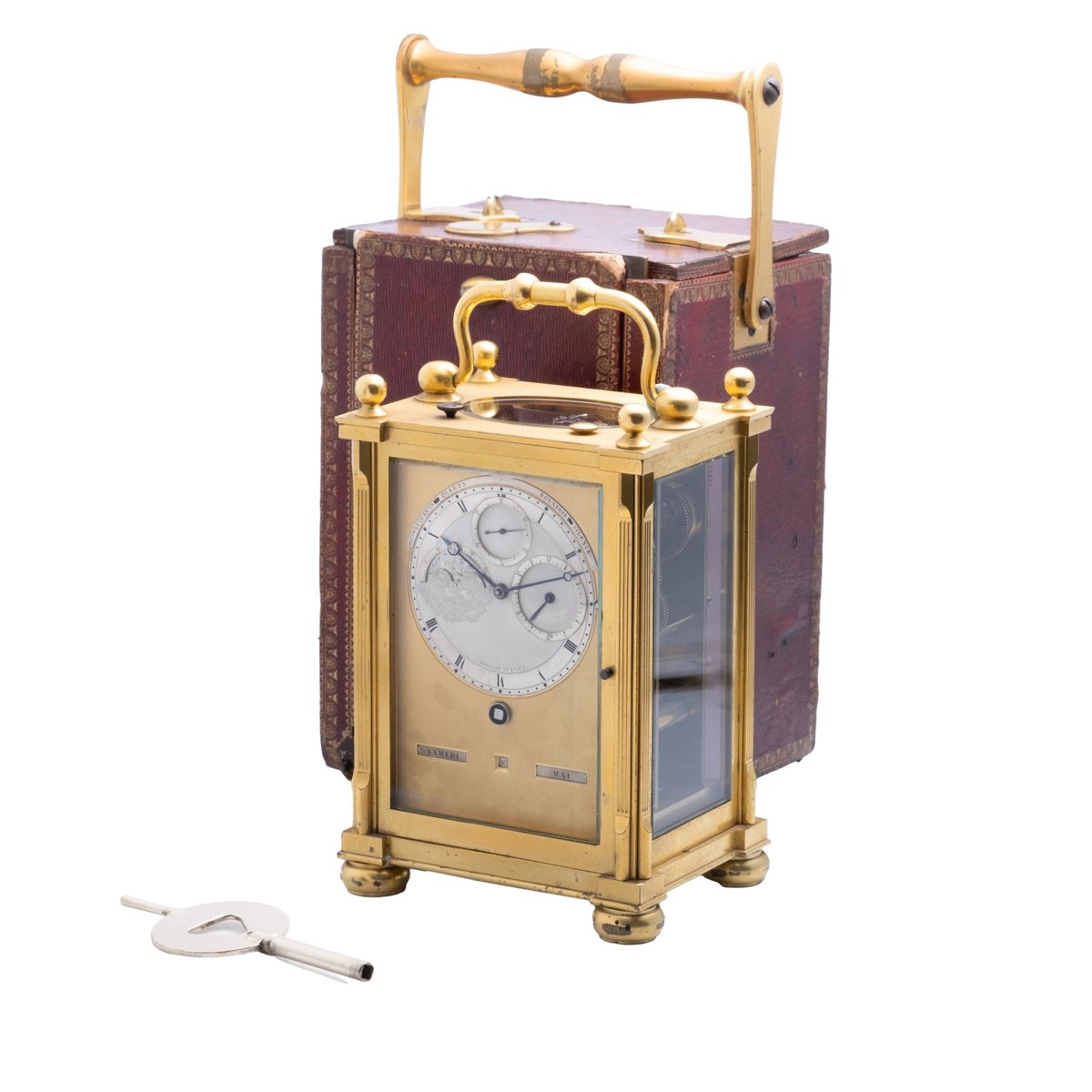
According to the auction catalog, this Breguet & Fils astronomical carriage clock, titled 'Pendule à Almanach' and numbered 3414, was sold on January 18, 1826. It features a gilt bronze multi-piece Empire case glazed on four sides and the top, framed by Doric-style corner columns and supported on four gilt feet. The movement features a lateral lever escapement, bimetallic compensation balance, and pare-chute shock protection on the top pivot. The silver and brass dial displays Roman numerals, blued-steel hands, subsidiary dials for seconds and alarm, a moon-phase aperture, and digital apertures for day, date, and month. Functions include grande and petite sonnerie repeating and an alarm. The clock is accompanied by a fitted red morocco traveling box.

Three-quarter front view of the Breguet & Fils gilt bronze carriage clock with winding key and red morocco travelling box
Three-quarter front view of the Breguet & Fils gilt bronze carriage clock with winding key and red morocco travelling box — Antiquorum. Rights pending — permission not yet requested. Original source

Catalogue identity

Source
catalog.antiquorum.swiss
Category
Clock · Carriage clock
Maker / attribution
Breguet & Fils
Reference
Not recorded
Catalogue / lot identifier
615
Source-reported date
Sold January 18, 1826
Country
France
Source-reported serial
3414

Source-reported attribution and specifications are not independent authentication. A listing does not establish present ownership, current display, availability or permission to reproduce.

Object description

Case Construction

The clock is housed in a large, multi-piece gilt bronze 'Empire' style case. The design incorporates four Doric-style columns at the corners and is glazed on the four sides and the top.

Operational access to the dial and movement is achieved through hinged front and back doors. The case includes an engine-turned top with a glazed center, pivoted handle hinges, and four gilt feet. Repeating and alarm functions are controlled via buttons on the top of the case.

Evidence for this section
  • “large, gilt bronze, manual wind multi-piece case, "Empire", glazed on four sides and the top, four Doric type columns”
  • “hinged front and back doors for access to the dial and the movement”
  • “buttons for repeating and pull-wind alarm on the top of the case”

Movement and Escapement

The movement is rectangular, measuring 117 x 79 mm, and constructed of gilt brass. It operates with a single barrel for the timing and striking trains.

Technical specifications include a lateral lever escapement with sapphire inserts in the pallet fork and a cut-bimetallic two-arm compensation balance. The movement features a Breguet balance spring with a platinum temperature sliding weight and a pare-chute system on the top pivot.

Evidence for this section
  • “Rectangular, 117 x 79 mm., gilt brass, with a single barrel for the oing and striking train”
  • “lateral lever escapement with pallet fork having sapphire insert for the pallets”
  • “cut-bimetallic two-arm compensation balance with Breguet balance spring with platinum temperature sliding weight”
  • “pare-chute on the top pivot”

Dial and Complications

The engine-turned silver dial is signed 'Breguet et Fils' and features Roman numerals on a plain reserve with outer minute dot divisions. Blued-steel Breguet hands indicate the time, supplemented by subsidiary dials for seconds and alarm settings.

The clock includes an engine-turned gilt-brass dial plate with digital apertures for the days of the week, date, and months. A moon-phase aperture is present, with the age of the moon engraved on the border.

Evidence for this section
  • “Engine-turned silver dial, signed: "Breguet et Fils"”
  • “Engine-turned gilt-brass dial plate with apertures for days of the week, the date and the months”
  • “aperture for phase of the moon with the age engraved on the border”

Open research questions

  • What is the specific mechanical status of the movement, given the auction house recommendation for an overhaul?
  • Are there additional archival documents that clarify the exact transition of ownership from the Countess of Bobrinsky to Prince Mentzikoff?

Source evidence

Recorded claims and source quotations for Breguet & Fils "Pendule à Almanach" carriage clock no. 3414
FieldSource-reported valueSource quotation
Case and Movement Number3414“Movement No. 3414 Case No. 3414”
Original Sale DateJanuary 18, 1826“Sold on January 18, 1826 to the Countess of Bobrinsky”
Case Style and MaterialEmpire, gilt bronze“large, gilt bronze, manual wind multi-piece case, "Empire"”
EscapementLateral lever escapement with sapphire inserts“lateral lever escapement with pallet fork having sapphire insert for the pallets”
Included AccessoriesRed morocco leather fitted travelling box and archive extract“Accompanied by the original gold-tooled red morocco leather fitted travelling box and extract from the archive”
Movement and Case Number3414“Movement No. 3414 Case No. 3414”
Initial SaleJanuary 18, 1826“Sold on January 18, 1826 to the Countess of Bobrinsky for the price of 5500 French Francs.”
Reported Secondary OwnershipPrince Mentzikoff“The next client to purchase this carriage clock was the Prince Mentzikoff.”

Visible details

  • Carriage clock shown with top carrying handle, spherical corner finials, and glazed side panels revealing internal movement wheelwork.
  • Engine-turned dial face features French calendar apertures displaying 'SAMEDI', '10', and 'MAI'.
  • A winding key lies beside the clock in front of the red leather travelling case.

Research qualifications

  • Internal escapement components, movement plates, and exact hallmarks are not directly visible in the primary photograph.
  • Condition assessments and historical provenance notes are derived directly from auction house records.

Photograph identity and source facts were screened before import; rights clearance remains pending.

Terms in this record

Glossary explanations for terms named in this object’s record.