
Skip to content
The Encyclopedia of Horology

Tool · Arabic-inscribed astrolabe

Brass Astrolabe with Zawraq Rete

Partially verified

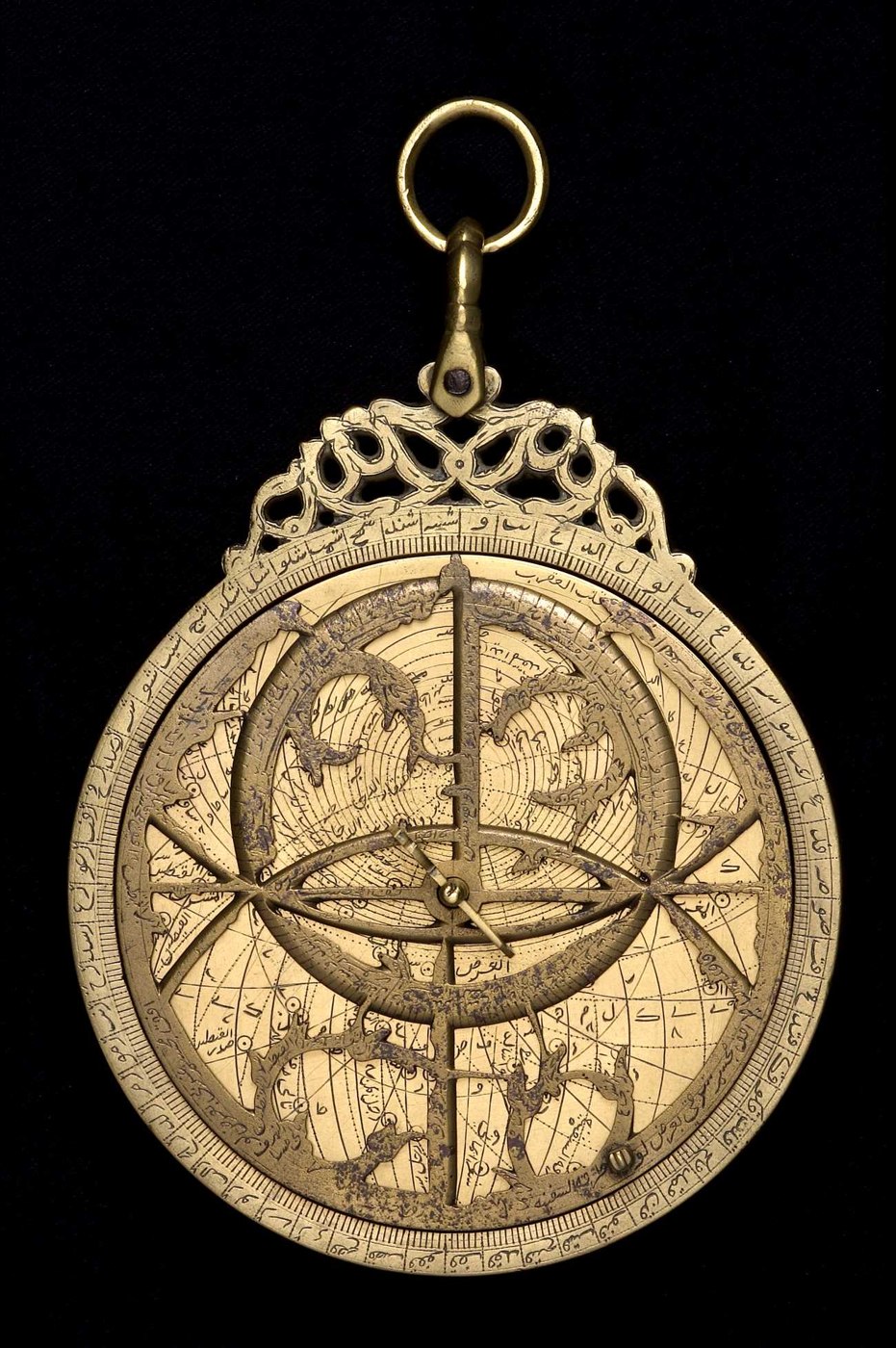
This 17th-century brass astrolabe (inventory 33796) features a distinctive 'zawraq' or ship-style rete, which incorporates two horizon bands and two meridian bands. The instrument comprises a mater with a one-piece limb inscribed with a gazetteer of 69 cities, a pierced Indo-Persian throne, and eight plates covering latitudes from 18° to 66°. The back of the instrument is engraved with 12 distinct scales, including altitude, declination, and shadow squares. The rete, designed for use with two local latitudes, lacks star pointers. The instrument is equipped with a double-ended alidade, though the pin and horse are considered non-original. The alidade exhibits minor damage, including cracks at the base of the left sight, and the sights appear slightly loose and askew.

Front view of the brass astrolabe showing the rete, throne, and limb gazetteer.
Front view of the brass astrolabe showing the rete, throne, and limb gazetteer. — History of Science Museum, University of Oxford. Rights pending — permission not yet requested. Original source

Catalogue identity

Source
www.mhs.ox.ac.uk
Category
Tool · Arabic-inscribed astrolabe
Maker / attribution
Not established
Reference
Not recorded
Catalogue / lot identifier
33796
Source-reported date
17th century
Source-reported place
India (?)

Source-reported attribution and specifications are not independent authentication. A listing does not establish present ownership, current display, availability or permission to reproduce.

Object description

Construction and Design

The astrolabe is constructed primarily of brass and features a one-piece mater and limb. The throne is of a pierced, Indo-Persian type, supported by integrated brass elements and a round cross-section ring. The instrument is suspended by an omega-shaped shackle attached via an iron pin, which is currently oxidized. The limb serves as a degree scale and contains a comprehensive gazetteer listing coordinates for 69 cities.

The rete is of a foliate, single-knob design, incorporating two horizon bands and two meridian bands. These bands are visualized as representing ships with masts, and the zodiacal signs are labeled in Arabic script. Eight separate plates are included, facilitating use across latitudes ranging from 18 to 66 degrees.

Evidence for this section
  • “The mater and limb are of one-piece construction.”
  • “The throne is of the indo-persian, pierced type”
  • “The womb contains a gazetteer with coordinates for 69 cities”
  • “This zawraq or 'ship' rete is visualised as containing two representations of ships”

Astronomical Scales and Features

The back of the astrolabe is highly functional, housing 12 distinct astronomical scales. These include multiple altitude scales, declination markers, and an azimuth of the Qibla. Furthermore, the instrument provides sine, cosine, and cotangent scales, alongside a shadow square for calculating heights and distances. These are arranged in concentric circular and box-type formats on the back plate.

The instrument also incorporates lunar mansions and zodiacal sign markings, providing additional utilities for timekeeping and astrological calculations. While the rete is equipped with zodiacal labels, it contains no star pointers, a detail suggesting a specialized or focused function within its historical context.

Evidence for this section
  • “The back contains 12 scales of the following types: Altitude; Declination; Azimuth of Qibla; Sine/Cosine; Cotangent; Shadow square; Lunar Mansions; Zodiacal signs.”
  • “The rete contains 0 stars.”

Provenance and Condition

This astrolabe was previously part of the Gunther Collection, founded by R. T. Gunther, and was included in his publication, 'The Astrolabes of the World', prior to 1932. It was subsequently acquired by the museum in 1986. The object currently displays signs of age and wear.

The alidade is described as double-ended but exhibits structural issues, specifically loose sights and a crack at the base of the left sight. Additionally, the pin and horse components are believed to be later, non-original additions to the instrument. The iron pin for the shackle is noted to be oxidized, consistent with the age of the metallic materials.

Evidence for this section
  • “It was in his possession before 1932, when it was included in his book The Astrolabes of the World.”
  • “Both sights are a bit askew and loose. The alidade is cracked at the base of the left sight.”
  • “Neither the simple pin nor the horse look original to the instrument.”

Open research questions

  • What is the definitive provenance of the astrolabe prior to R. T. Gunther's possession?
  • Are there similar 'zawraq' rete astrolabes of 17th-century Indian origin that can confirm the intended use of the 29 and 36-degree horizons?

Source evidence

Recorded claims and source quotations for Brass Astrolabe with Zawraq Rete
FieldSource-reported valueSource quotation
Inventory Number33796“Inventory no. 33796”
MaterialBrass“Material Brass”
Date17th century“Date 17th century”
Place of originIndia (?)“Place India (?)”
City gazetteer count69“The womb contains a gazetteer with coordinates for 69 cities”
Plates quantity8“There are 8 plates”
ProvenanceThe Gunther Collection“The Gunther Collection, initially deposited on loan in 1940 by the executors of R. T. Gunther”
Acquisition date1986“Presented by A. E. Gunther in 1986”

Visible details

  • The rete features two horizon and meridian bands in a 'ship' configuration.
  • The limb is engraved with a gazetteer listing coordinates for 69 cities.
  • The back includes 12 scales for various astronomical calculations.
  • The throne is an Indo-Persian pierced brass type with an omega-shaped shackle.

Research qualifications

  • The pin and horse are reported as not original to the instrument.
  • The origin is tentatively attributed to India.
  • The alidade is noted as having cracks at the base of the left sight.

Photograph identity and source facts were screened before import; rights clearance remains pending.

Consulted source

Astrolabe, inventory 33796 (India (?), 17th century)

Reviewed 2026-10-26 · Record 9e1ff46b5d

Terms in this record

Glossary explanations for terms named in this object’s record.