
Skip to content
The Encyclopedia of Horology

Tool · Arabic-inscribed astrolabe

Astrolabe by Muḥammad Ṭāhir

Partially verified

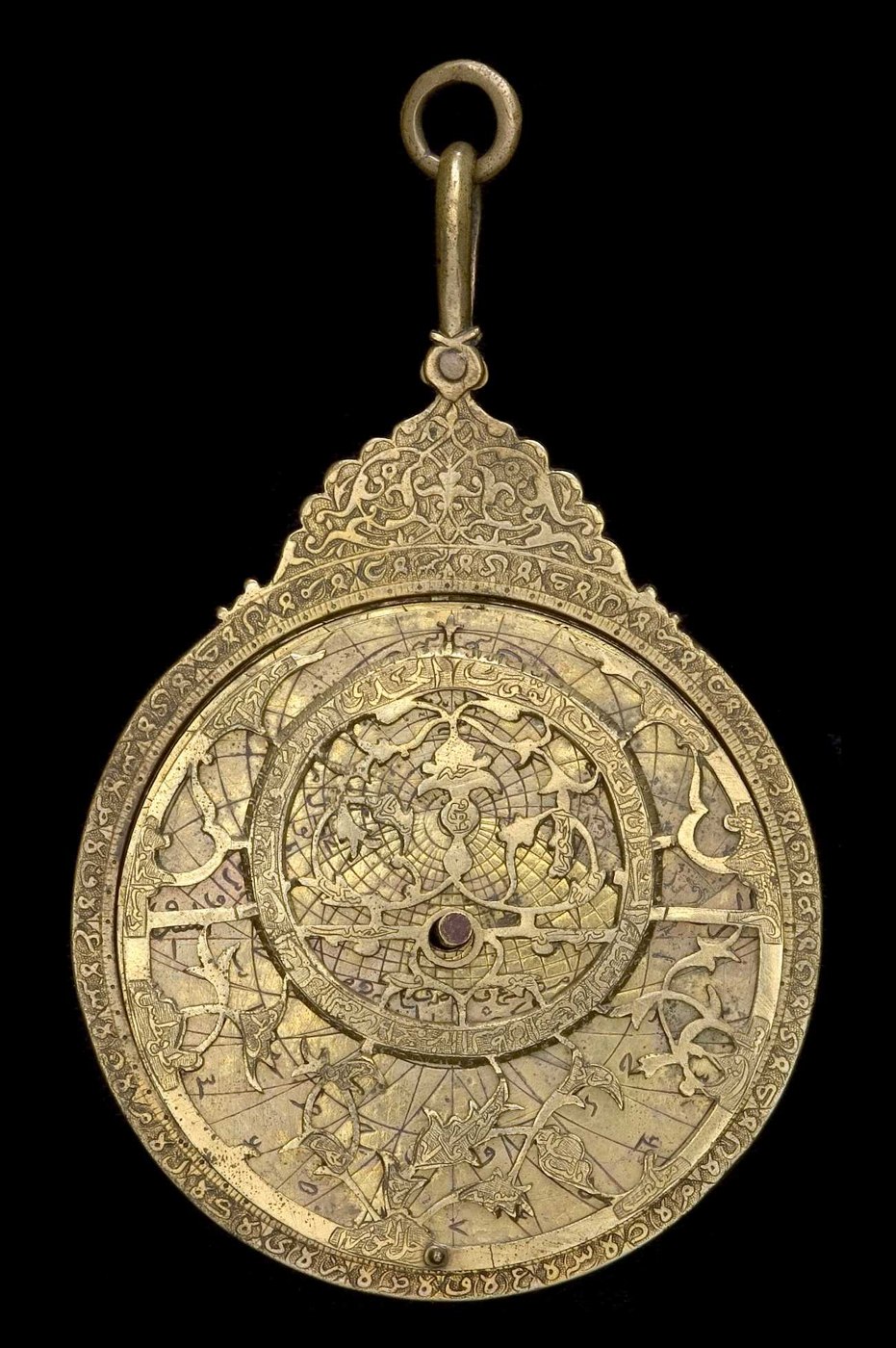
This planispheric astrolabe, designated inventory number 46836, is attributed to the maker Muḥammad Ṭāhir and dated to circa 1710. Originating from Iṣfahān, the instrument is constructed from brass. It features an engraved, Indo-Persian type throne attached to an integrated base, complemented by a simple round-section ring and an elongated, tear-drop shaped omega-type shackle. The mater and limb are of one-piece construction, with the plate-locking tab positioned at the bottom of the instrument. The back includes 15 distinct scales, including altitude, declination, and a shadow square. Inscriptions identify Muḥammad Ṭāhir as the maker and ʿAbd al-Aʾimmah as the embellisher. The instrument includes four plates with latitudes spanning 25° to 38°. The current rete is considered a potential replacement, as is the double-ended alidade. The piece was presented by Lewis Evans to the History of Science Museum in 1924, having been acquired from London dealer S. G. Fenton in 1920.

Front view of the brass astrolabe, inventory number 46836, showing the rete and throne.
Front view of the brass astrolabe, inventory number 46836, showing the rete and throne. — History of Science Museum, University of Oxford. Rights pending — permission not yet requested. Original source

Catalogue identity

Source
www.mhs.ox.ac.uk
Category
Tool · Arabic-inscribed astrolabe
Maker / attribution
Muḥammad Ṭāhir
Reference
46836
Catalogue / lot identifier
46836
Source-reported date
ca. 1710
Source-reported place
Iṣfahān

Source-reported attribution and specifications are not independent authentication. A listing does not establish present ownership, current display, availability or permission to reproduce.

Object description

Construction and Design

The astrolabe features an Indo-Persian engraved throne, which is secured to an integrated base. Both the front and the back surfaces of the throne are decorated with foliate patterns, indicating high-level metalwork. The suspension system consists of a ring with a simple, round cross-section connected to an omega-shaped shackle, which displays a notable elongation reaching a tear-drop geometry.

The mater and limb of the instrument are fashioned from a single piece of brass. The mechanism to secure the plates is located at the 180° mark relative to the throne, positioned at the bottom of the instrument. The back of the astrolabe is highly complex, featuring 15 distinct scales that allow for a wide range of astronomical and mathematical calculations, including azimuth of the Qibla, sine/cosine functions, and zodiacal sign divisions.

Evidence for this section
  • “The throne is of the indo-persian, engraved type made of brass attached with integrated base”
  • “The mater and limb are of one-piece construction.”
  • “The back contains 15 scales of the following types”

Signatures and Inscriptions

The astrolabe carries two specific maker inscriptions, both housed in dedicated cartouches. The primary maker's mark, attributing the construction to Muḥammad Ṭāhir, is located below the shadow square on the reverse side of the instrument. A second inscription, identifying ʿAbd al-Aʾimmah as the individual responsible for the embellishment of the instrument, is situated within a cartouche at the bottom rim of the back.

These inscriptions appear clearly on the brass surface and reflect the collaborative nature of the instrument's finishing. The presence of these marks establishes both the primary fabrication and the subsequent decorative work attributed to the Iṣfahān workshop of the early 18th century.

Evidence for this section
  • “The back is inscribed: with a maker's signature marked as صنعه محمد طاهر (Made by Muḥammad Ṭāhir). In cartouche below shadow square.”
  • “with a maker's signature marked as نمقه عبد الائمة (Embellished by ʿAbd al-Aʾimmah). In cartouche at bottom rim.”

Provenance and Modifications

The instrument was acquired by Lewis Evans in 1920 from the London dealer S. G. Fenton and was subsequently donated to the History of Science Museum in 1924. Records from the initial acquisition state that the piece originated from Teheran, despite the scholarly attribution to Iṣfahān based on the maker's known history.

The current configuration of the astrolabe is not entirely original. The rete is believed to be a later replacement, as the engraving style and overall quality differ significantly from the body of the instrument. Additionally, the alidade is a double-ended replacement, and the current horse (the component securing the rete) has been identified as a modern substitute, with the original pin now missing.

Evidence for this section
  • “Evans bought it from S. G. Fenton, a London dealer, in 1920”
  • “This rete may, in fact, be a replacement.”
  • “The rule is not original.”
  • “The horse is a replacement.”

Open research questions

  • What is the definitive evidence linking the rete's style to a different period or maker compared to the rest of the astrolabe?
  • Does the 'Teheran' origin record from 1920 imply a later history of use or transit for this Iṣfahān-made object?

Source evidence

Recorded claims and source quotations for Astrolabe by Muḥammad Ṭāhir
FieldSource-reported valueSource quotation
MakerMuḥammad Ṭāhir“Made by Muḥammad Ṭāhir”
EmbellisherʿAbd al-Aʾimmah“Embellished by ʿAbd al-Aʾimmah”
MaterialBrass“Material Brass”
Dateca. 1710“Date ca. 1710”
Place of originIṣfahān“Place Iṣfahān”
AcquisitionPresented by Lewis Evans in 1924“Presented by Lewis Evans in 1924”
ProvenancePurchased from S. G. Fenton in 1920“Evans bought it from S. G. Fenton, a London dealer, in 1920”

Visible details

  • The throne and limb exhibit ornate foliate engravings.
  • The alidade is a double-ended, rigid, non-original replacement.
  • The shackle is elongated into a tear-drop shape.

Research qualifications

  • The rete is suspected to be a replacement, differing in workmanship and style from the main instrument.
  • The rule and the horse component are identified as replacements.

Photograph identity and source facts were screened before import; rights clearance remains pending.

Consulted source

Astrolabe, inventory 46836 (Iṣfahān, ca. 1710)

Reviewed 2026-10-26 · Record 55797b8fbc

Terms in this record

Glossary explanations for terms named in this object’s record.