
Skip to content
The Encyclopedia of Horology

Tool · Arabic-inscribed astrolabe

Silver astrolabe, inventory 41106

Partially verified

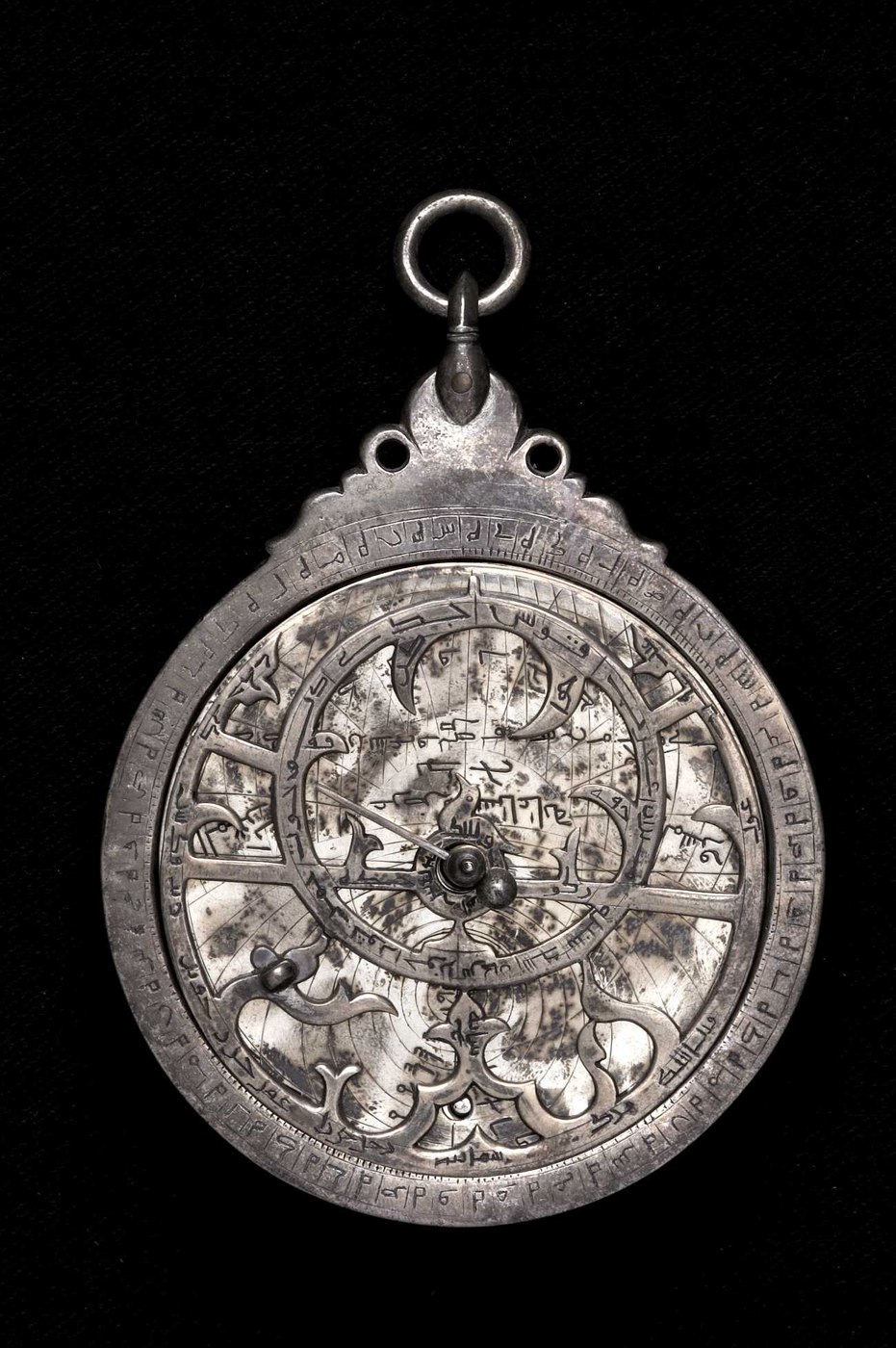
This silver astrolabe (inventory number 41106) is a celestial instrument acquired by the History of Science Museum, Oxford, from London bookseller Malcolm Gardner in 1955. It features a pierced, Indo-Persian style silver throne with an integrated base, a simple round-section ring, and an omega-type shackle. The mater and limb are constructed as a single piece. The rete, attached with a pin and wedge, includes 21 stars with foliate pointers and a bird-shaped pointer for Vega. Three plates provide coverage for latitudes between 20° and 32°. The back contains nine scales, including altitude, sine/cosine, shadow square, and zodiacal signs, featuring an inscription dated to 751 Hijra (1350/1).

View of the front of the silver astrolabe, showing the pierced Indo-Persian throne, the rete with foliate pointers, and the bird-shaped Vega pointer.
View of the front of the silver astrolabe, showing the pierced Indo-Persian throne, the rete with foliate pointers, and the bird-shaped Vega pointer. — History of Science Museum, University of Oxford. Rights pending — permission not yet requested. Original source

Catalogue identity

Source
www.mhs.ox.ac.uk
Category
Tool · Arabic-inscribed astrolabe
Maker / attribution
Not established
Reference
Not recorded
Catalogue / lot identifier
41106
Source-reported date
1350/1 (A.H. 751)
Source-reported place
Persia

Source-reported attribution and specifications are not independent authentication. A listing does not establish present ownership, current display, availability or permission to reproduce.

Object description

Construction and Design

The astrolabe is constructed primarily of silver, a material noted as highly unusual for this type of instrument. The design incorporates a one-piece mater and limb, with the post for securing the plates positioned in the lower portion of the womb. The throne follows the pierced, Indo-Persian aesthetic, featuring an integrated base and supporting a simple round-section ring and an omega-type shackle.

The rete displays foliate-style pointers for its 21 stars, with the pointer for Vega specifically shaped as a bird. It is fixed to the mater using a pin and wedge. Three plates are included with the instrument, providing latitude coverage ranging from 20° to 32°.

Evidence for this section
  • “The mater and limb are of one-piece construction.”
  • “The rete contains 21 stars.”
  • “The throne is of the indo-persian, pierced type made of silver”

Inscriptions and Scales

The back of the astrolabe is engraved with nine distinct scales. These include altitude, sine/cosine, shadow square, terms, cotangent, zodiacal signs, faces, and lunar mansions. The inscription on the back is read as 'In good fortune, 751 Hijra', though the museum records suggest the date could alternatively be interpreted as 711.

The museum identifies irregularities in the execution of the scales on the back, noting that while they appear to mimic traditional Islamic astrolabe designs, their arrangement and specific symbols are inconsistent with standard examples. The alidade, while double-ended and original, possesses graduations that are described as poorly engraved and effectively useless.

Evidence for this section
  • “The back contains 9 scales of the following types: Altitude; Sine/Cosine; Shadow square; Terms; Cotangent; Zodiacal signs; Faces; Lunar Mansions.”
  • “The scales on the alidade are irregularly graduated and poorly engraved to the point of being useless.”
  • “The back is inscribed: with a miscellaneous marked as في سعد الهجري ذنل (In good fortune, 751 Hijra).”

Provenance and Authenticity

The instrument was purchased by the History of Science Museum in 1955 from Malcolm Gardner, a London-based horological bookseller. Its presence in the collection is noted as a result of a 1950s initiative to expand the museum's holdings of astrolabes.

The museum provides a critique of the object's authenticity, stating that the use of silver is atypical for historically functional astrolabes, which were almost exclusively crafted from brass. Based on the material choice, the style of the engraving, and the irregularity of the scales, the museum characterizes the object as a modern production intended to resemble a medieval instrument.

Evidence for this section
  • “These conclusions, and other judgements about style and quality of workmanship, makes it likely that this silver astrolabe, the only one in the collection, is a modern fake”
  • “Gardner was a horological bookseller in London.”
  • “even the finest astrolabes, such as those made for princes, were almost invariably made of brass.”

Open research questions

  • Could technical analysis of the silver alloy reveal a specific metallurgical profile consistent with 20th-century production?
  • Do the specific errors in the scale inscriptions correspond to common patterns of 20th-century decorative forgeries?

Source evidence

Recorded claims and source quotations for Silver astrolabe, inventory 41106
FieldSource-reported valueSource quotation
Inventory number41106“Inventory no. 41106”
MaterialSilver“Material Silver”
AcquisitionPurchased from Malcolm Gardner in 1955“Purchased from Malcolm Gardner in 1955”
Date1350/1 (A.H. 751)“Date 1350/1 (A.H. 751)”
Number of plates3“There are 3 plates”
Latitude range20°0' to 32°0'“with latitudes ranging from 20°0' to 32°0'”
Rete star count21“The rete contains 21 stars.”
OriginPersia (?)“Place Persia (?)”

Visible details

  • The rete contains zoomorphic elements, including a bird-shaped pointer for the star Vega.
  • The throne is of the pierced, Indo-Persian type.
  • The back features an inscription translated as 'In good fortune, 751 Hijra'.
  • The alidade is double-ended with irregularly graduated, shallowly engraved scales.

Research qualifications

  • The auction description reports the object is likely a modern fake made in the belief that silver was a traditional material for astrolabes.
  • The date 751 Hijra (1350/1) on the back is noted to possibly read as 711.
  • The symbols and arrangement of the scales on the back of the instrument defy standard interpretation.

Photograph identity and source facts were screened before import; rights clearance remains pending.

Consulted source

Astrolabe, inventory 41106 (Persia (?), 1350/1 (A.H. 751))

Reviewed 2026-10-26 · Record db1264eddc

Terms in this record

Glossary explanations for terms named in this object’s record.