
Skip to content
The Encyclopedia of Horology

Tool · Arabic-inscribed astrolabe

Brass Astrolabe by Aḥmad and Muḥammad

Partially verified

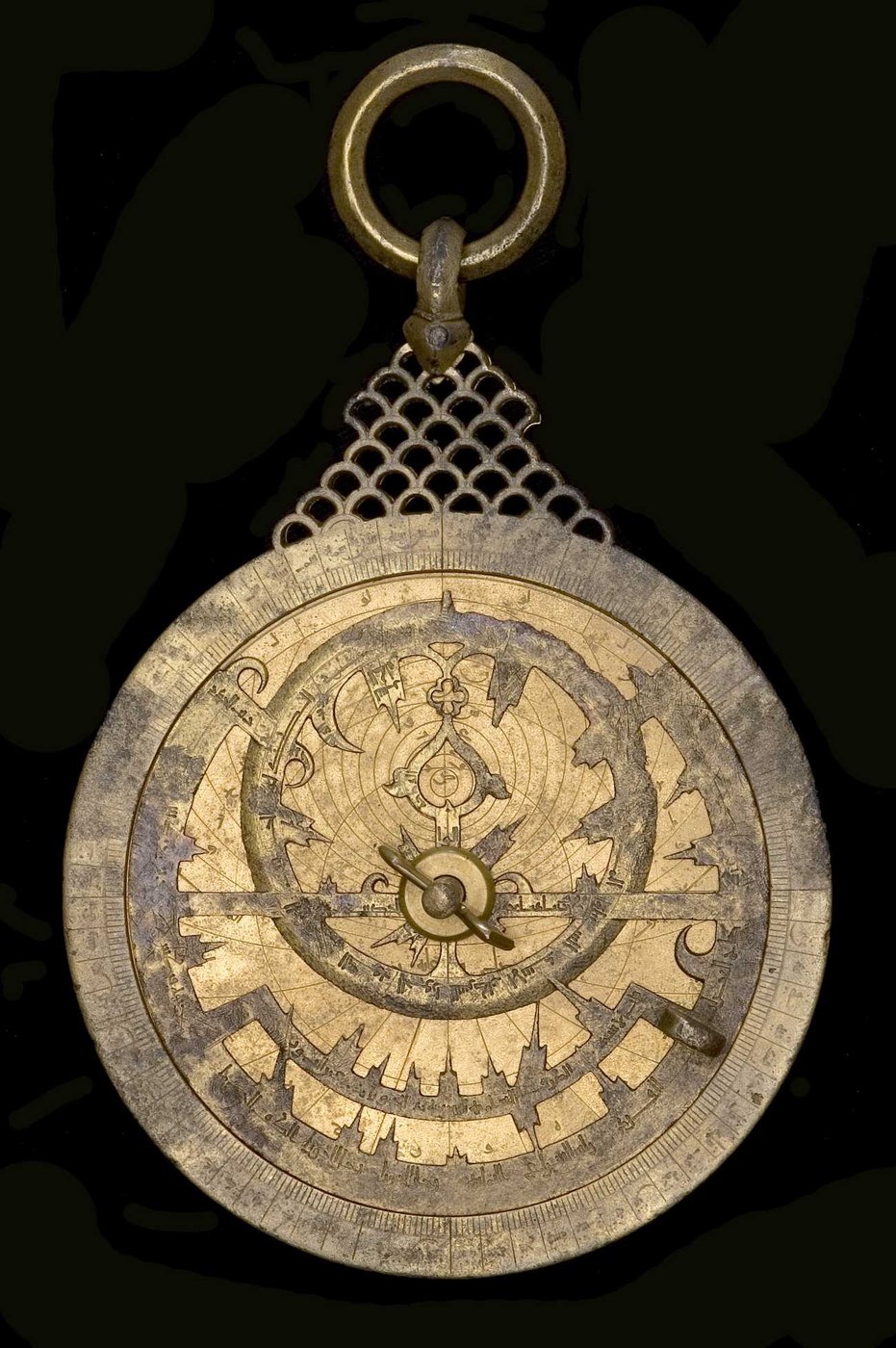
This early Persian brass astrolabe, identified as inventory number 33767, is attributed to Aḥmad and Muḥammad, sons of Ibrāhīm, and dated to either 984/5 or 1003/4 (A.H. 374 or 394). The instrument features an Indo-Persian, pierced-type throne with an integrated base and an omega-style shackle. Constructed in two pieces with soldered mater and limb, it includes three plates with latitudes from 30° to 37°. The back displays five scales including altitude, zodiacal signs, terms, and faces, featuring distinct planetary symbols derived from Greek origins rather than traditional letters. The instrument is equipped with a double-ended alidade and a simple indicator-line rete containing 38 stars. The piece was acquired by the History of Science Museum in 1924, following its presentation by Lewis Evans, who purchased it in 1919.

Full view of the front of the astrolabe showing the rete and the zodiacal labels.
Full view of the front of the astrolabe showing the rete and the zodiacal labels. — History of Science Museum, University of Oxford. Rights pending — permission not yet requested. Original source

Catalogue identity

Source
www.mhs.ox.ac.uk
Category
Tool · Arabic-inscribed astrolabe
Maker / attribution
Aḥmad and Muḥammad, sons of Ibrāhīm
Reference
33767
Catalogue / lot identifier
33767
Source-reported date
984/5 or 1003/4 (A.H. 374 or 394)
Source-reported place
Iṣfahān

Source-reported attribution and specifications are not independent authentication. A listing does not establish present ownership, current display, availability or permission to reproduce.

Object description

Construction and Design

The astrolabe is crafted from brass and features a two-piece soldered construction comprising the mater and the limb. A pierced throne of the Indo-Persian type is attached to an integrated base, supporting a squared cross-section ring and an omega-type shackle. The instrument is designed with three plates, offering latitudes ranging from 30° to 37°.

The rete, of the simple indicator-line type, is noted to be in a state of advanced corrosion. It includes a total of 38 star pointers. An alidade, described as double-ended and original to the piece, is provided for observations. The plates are secured within the mater by a post located on the meridian line near the bottom of the instrument.

Evidence for this section
  • “The mater and limb are of two pieces, soldered construction.”
  • “The throne is of the indo-persian, pierced type”
  • “The rete is of the indicator-line (simple) type. The rete is badly corroded.”

Inscriptions and Planetary Tables

The back of the instrument contains five scales: altitude, the Dastūr circle, zodiacal signs, terms, and faces. An inscription across the middle of the back provides the signature of the makers, Aḥmad and Muḥammad, sons of Ibrāhīm, and identifies the place of origin as Isfahan.

A distinguishing feature of the instrument is the arrangement of tables for astrological terms and faces, which occupy three-quarters of the back. These tables utilize specific planetary symbols derived from Greek prototypes rather than alphabetic shorthand. The zodiacal signs on the rete are inscribed in Arabic, and the degree scales are applied to the limb in 5-degree increments.

Evidence for this section
  • “The back contains 5 scales of the following types: Altitude; Dastūr Circle; Zodiacal signs; Terms; Faces.”
  • “the maker used symbols to denote the planets rather than the last letter of the name of the planet.”
  • “The back is inscribed: with a maker's signature marked as بسم الله وبعون الله”

Provenance and History

The astrolabe was presented to the History of Science Museum by Lewis Evans in 1924. Records indicate that Evans acquired the instrument from Professor Y. Daweed, through the London dealer Percy Webster, in 1919.

Some elements of the device suggest modifications over time. Specifically, the style of engraving found on the womb implies that the gazetteer may be a later addition to the instrument. Current research into the device continues to compare its table symbols with those of other catalogued astrolabes.

Evidence for this section
  • “Evans bought it from Professor Y. Daweed, per the London dealer Percy Webster, in 1919”
  • “The different style of engraving suggests that the gazetteer is a later addition.”

Open research questions

  • What specific chemical composition of the brass is present in this astrolabe compared to later Isfahan instruments?
  • Can the gazetteer addition be dated more precisely through stylistic analysis of the engraving?

Source evidence

Recorded claims and source quotations for Brass Astrolabe by Aḥmad and Muḥammad
FieldSource-reported valueSource quotation
Inventory Number33767“Inventory no. 33767”
MakersAḥmad and Muḥammad, sons of Ibrāhīm“composed by Aḥmad and Muḥammad, sons of Ibrāhīm, maker of astrolabes from Isfahan”
MaterialBrass“Material Brass”
DateA.H. 374 or 394“984/5 or 1003/4 (A.H. 374 or 394)”
Star count38“The rete contains 38 stars.”
ProvenancePresented by Lewis Evans in 1924“Presented by Lewis Evans in 1924”
InscriptionMaker's signature on the back“بسم الله وبعون الله باليمن والدولة وباﻹقبال والسعادة ألف هذا الأصطرلاب أحمد ومحمد أبناء ٳبراهيم الأصطرلابي الأصفهاني سنة أربع وتسعين وثلثمائةة”

Visible details

  • Pierced throne of Indo-Persian type
  • Planetary symbols on the back plate based on Greek characters
  • Separation of the limb from the back plate
  • Zodiacal labels on the rete in Arabic script

Research qualifications

  • The exact date of manufacture is uncertain between the two cited Hijri years
  • The gazetteer on the womb may be a later addition to the original instrument

Photograph identity and source facts were screened before import; rights clearance remains pending.

Consulted source

Astrolabe, inventory 33767 (Iṣfahān, 984/5 or 1003/4 (A.H. 374 or)

Reviewed 2026-10-26 · Record 32410c3ff5

Terms in this record

Glossary explanations for terms named in this object’s record.