
Skip to content
The Encyclopedia of Horology

Tool · Arabic-inscribed astrolabe

Ayyubid brass astrolabe

Partially verified

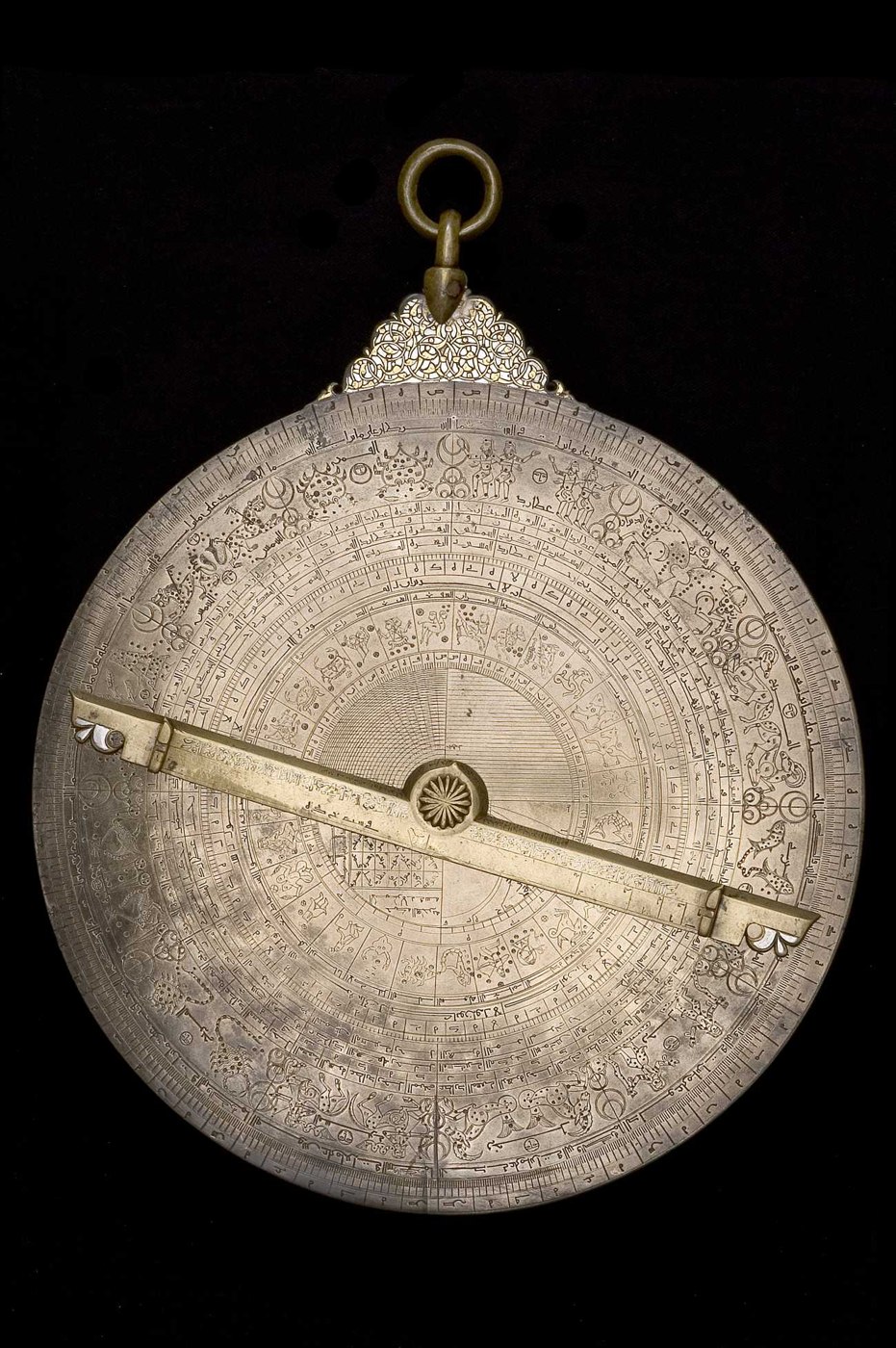
This brass astrolabe is attributed to the maker ‘Abd al-Karīm al-Miṣrī and dates to 1227/8 (A.H. 625). It was commissioned by the Ayyubid ruler al-Malik al-Ashraf Mūsā, nephew of Saladin. The instrument is distinguished by gold and silver damascene inlay, including an extensive honorific inscription for the sultan around the front rim. The back features thirteen scales, including a unique set of pictorial representations of the lunar mansions, which are linked to astral magic traditions. The instrument comprises a mater with an integrated base, an Indo-Persian type throne, a simple circular ring, and an omega-type shackle. It includes three plates covering various latitudes. The assembly is secured by a pin with a flower-shaped head and an accurate horse figure.

The back of the astrolabe (inventory 37148) showing the complex scales, pictorial lunar mansions, and the alidade.
The back of the astrolabe (inventory 37148) showing the complex scales, pictorial lunar mansions, and the alidade. — History of Science Museum, University of Oxford. Rights pending — permission not yet requested. Original source

Catalogue identity

Source
www.mhs.ox.ac.uk
Category
Tool · Arabic-inscribed astrolabe
Maker / attribution
‘Abd al-Karīm al-Miṣrī
Reference
Not recorded
Catalogue / lot identifier
37148
Source-reported date
1227/8 (A.H. 625)
Source-reported place
Cairo (?)
Source-reported serial
37148

Source-reported attribution and specifications are not independent authentication. A listing does not establish present ownership, current display, availability or permission to reproduce.

Object description

Construction and Decoration

The astrolabe is constructed of brass and is finished with extensive gold and silver damascene work. The throne, described as an Indo-Persian type, is attached to the mater via an integrated base and features foliate damascene decoration. The suspension system consists of a simple ring with a round cross-section and an omega-shaped shackle with triangular tabs.

The front of the instrument is dominated by the mater and a limb of one-piece construction. A long inscription naming the patron, the Ayyubid ruler al-Malik al-Ashraf Mūsā, is inlaid in gold around the front rim. The alidade is double-ended and original to the instrument, featuring silver inlay at both tips and scales measuring feet and fingers on the fiducial edge.

Evidence for this section
  • “The throne is of the indo-persian type made of brass attached with integrated base made of brass”
  • “An inscription rehearsing about thirty honorific titles and terms of praise for him is minutely inlaid in gold around the entire front rim.”

Scales and Technical Features

The back of the astrolabe is complex, containing 13 distinct scales including zodiacal signs, terms, faces, triplicities, and calendar markings. It also incorporates altitude scales, a cotangent scale, and a shadow square. A notable feature is the set of pictorial lunar mansions found on the back. These representations are considered unique and are associated with astral magic traditions of the period.

The instrument includes three plates that accommodate various latitudes ranging from 30° to 66°. The rete is of a foliate design and currently contains 29 stars, although some of its original material is missing. The central pin and horse are present, with the pin head shaped to resemble a flower and the horse rendered with high detail.

Evidence for this section
  • “The back contains 13 scales of the following types: Degree; Zodiacal signs; Terms; Faces; Triplicities; Calendar; Lunar Mansions; Altitude; Cotangent; Unequal hours; Shadow square.”
  • “These pictograms link the lunar mansions and this astrolabe to a rich astral magic tradition.”

Provenance and Modifications

The astrolabe was presented to the History of Science Museum by Lewis Evans in 1924. Documentation indicates that the instrument underwent modifications or repairs to the rete in the early 15th century, possibly while in Persia.

The original commission is linked to the Ayyubid sultan al-Malik al-Ashraf Mūsā. While the maker is identified as Egyptian (al-Miṣrī), the source notes the possibility that he may have been working in Damascus, a center known for the specific metal-inlaying techniques observed on this instrument.

Evidence for this section
  • “Presented by Lewis Evans in 1924”
  • “Evans bought it from the Comtesse de l'Espinasse in 1911”
  • “The maker was an Egyptian (al-Miṣrī), but being called so may probably have been working in another Arabian city, such as Damascus”

Open research questions

  • What is the specific nature of the rete's 15th-century modification?
  • Is the current rete configuration missing other elements beyond the small portion within the ecliptic?

Source evidence

Recorded claims and source quotations for Ayyubid brass astrolabe
FieldSource-reported valueSource quotation
Maker‘Abd al-Karīm al-Miṣrī“Made by the astrolabist ʿAbd al-Karīm al-Miṣrī”
Commissioned forAl-Malik al-Ashraf Mūsā“made to the order of the sultan Abū-l-Fātih Mūsā, Saladin's nephew”
Inventory number37148“Inventory no. 37148”
Date1227/8 (A.H. 625)“1227/8 (A.H. 625)”
MaterialBrass“Material Brass”
ProvenanceLewis Evans“Presented by Lewis Evans in 1924”
Modifications15th-century rete repair“The horizontal bar bears an inscription and date that suggests it was modified (or replaced) in the early 15th century.”

Visible details

  • Front rim features an inlaid gold inscription containing thirty honorific titles.
  • Back of the instrument contains 13 distinct circular and quadrant scales.
  • Rete is of the foliate type with 29 stars represented by pointers.
  • Alidade is double-ended with silver-inlaid decorative tips.

Research qualifications

  • The exact place of manufacture is listed as Cairo (?), indicating uncertainty.
  • The rete horizontal bar bears a date suggesting it may have been modified or replaced in the 15th century.

Photograph identity and source facts were screened before import; rights clearance remains pending.

Consulted source

Astrolabe, inventory 37148 (Cairo (?), 1227/8 (A.H. 625))

Reviewed 2026-10-26 · Record 6339a9790c

Terms in this record

Glossary explanations for terms named in this object’s record.