
Skip to content
The Encyclopedia of Horology

Tool · Persian-inscribed astrolabe

Brass Astrolabe by Khalīl Muḥammad ibn Ḥasan ‘Alī

Partially verified

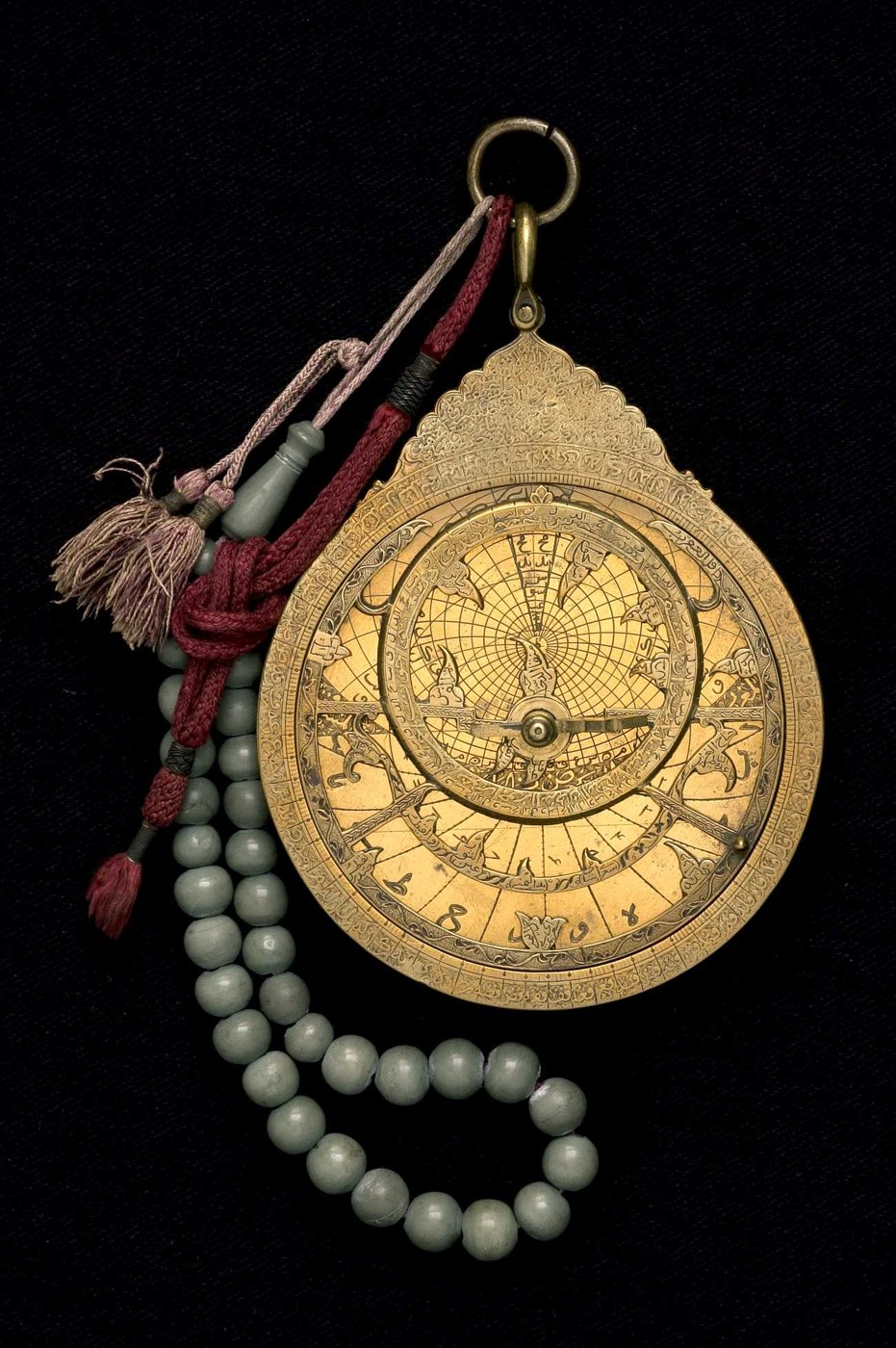
This brass planispheric astrolabe, dating to approximately 1700, was crafted in Iṣfahān by Khalīl Muḥammad ibn Ḥasan ‘Alī. The instrument features a one-piece mater and limb construction with an integrated plate-tab. The throne is of an engraved, Indo-Persian type, attached via an integrated base, and includes an omega-shaped shackle and a simple circular ring. The instrument is equipped with five plates for latitudes ranging from 22° to 45°. The rete is of the foliate single-knob type, featuring 22 bulb-pointer stars and an ecliptic scale. The back side contains nine distinct astronomical scales, including altitude, unequal hours, sine/cosine, cotangent, and a shadow square. The maker's signature is located within a cartouche in the shadow square. The astrolabe was purchased by the museum from Major C. E. Ross in 1925, whose father had originally acquired it in Persia.

Full view of the brass astrolabe with rete, alidade, and attached decorative cord.
Full view of the brass astrolabe with rete, alidade, and attached decorative cord. — History of Science Museum, University of Oxford. Rights pending — permission not yet requested. Original source

Catalogue identity

Source
www.mhs.ox.ac.uk
Category
Tool · Persian-inscribed astrolabe
Maker / attribution
Khalīl Muḥammad ibn Ḥasan ‘Alī
Reference
42649
Catalogue / lot identifier
42649
Source-reported date
ca. 1700
Source-reported place
Iṣfahān

Source-reported attribution and specifications are not independent authentication. A listing does not establish present ownership, current display, availability or permission to reproduce.

Object description

Construction and Design

The astrolabe is constructed primarily of brass and exhibits a one-piece design for the mater and limb, incorporating an integrated tab to secure the plates. The throne features an engraved Indo-Persian aesthetic, mounted on an integrated base, and serves as the mounting point for an omega-shaped shackle and a plain, circular-section suspension ring.

The instrument includes five plates providing latitude settings from 22° to 45°. The foliate-type rete is equipped with 22 stars indicated by bulb pointers and features an ecliptic scale. The back of the instrument hosts nine specific astronomical scales, including altitude, unequal hours, sine/cosine, cotangent, and a shadow square.

Evidence for this section
  • “The mater and limb are of one-piece construction.”
  • “The throne is of the indo-persian, engraved type made of brass attached with integrated base made of brass and has a simple, round cross-section ring made of brass and omega type shackle made of brass .”
  • “The back contains 9 scales of the following types: Altitude; Unequal hours; Sine/Cosine; Cotangent; Shadow square.”

Signatures and Inscriptions

The instrument bears a clear maker's signature identifying Khalīl Muḥammad ibn Ḥasan ʿAlī, rendered in Arabic and housed within a cartouche situated inside the shadow square on the back.

Additionally, the front of the throne is inscribed with a substantial Qur'anic quotation. This text, written in small, precise lettering, is identified as a well-known passage (the Throne Verse), which provides a formal, decorative element to the upper suspension component of the astrolabe.

Evidence for this section
  • “The back is inscribed: with a maker's signature marked as صنعه خليل محمد بن حسن علي الحقير الفقير إلى الله الجليل (Made by the contemptible Khalīl Muḥammad ibn Ḥasan ʿAlī who is in need of God the Sublime.). In a cartouche within the shadow square.”
  • “The front is filled with a Qur'anic quotation in small lettering.”

Provenance and History

The history of this astrolabe is documented through institutional correspondence dating to 1925, confirming its purchase by the museum from Major C. E. Ross. The instrument was the first of its kind acquired by the museum to supplement the existing collection.

Documentation indicates that the piece was obtained by Major Ross's father during his long tenure as the British government representative in Persia. The provenance is explicitly linked to the Victorian era, during which time it was taken from the region before its eventual entry into the museum's holdings.

Evidence for this section
  • “Museum correspondence shows that it was purchased from Major C. E. Ross in February 1925”
  • “Major Ross's father, 'who was many years in Persia as Resident in the Gulf' (that is, the British government's representative), acquired it in Persia in Victorian times.”

Open research questions

  • What is the specific intended use or origin of the attached beaded string assembly visible in the photography?
  • Are there similar instruments signed by Khalīl Muḥammad ibn Ḥasan ʿAlī in other public collections to help map the maker's output?

Source evidence

Recorded claims and source quotations for Brass Astrolabe by Khalīl Muḥammad ibn Ḥasan ‘Alī
FieldSource-reported valueSource quotation
MakerKhalīl Muḥammad ibn Ḥasan ‘Alī“Made by the contemptible Khalīl Muḥammad ibn Ḥasan ʿAlī who is in need of God the Sublime.”
Place of originIṣfahān“Place Iṣfahān”
Dateca. 1700“Date ca. 1700”
MaterialBrass“Material Brass”
Inventory number42649“Inventory number: 42649”
ProvenancePurchased from Major C. E. Ross in 1925“Museum correspondence shows that it was purchased from Major C. E. Ross in February 1925”
Rete typeFoliate (single knob)“The rete is of the foliate (single knob) type.”

Visible details

  • Foliate-style rete with 22 bulb-shaped pointers for star positions
  • Qur'anic inscription present on the front of the throne
  • Integrated base and omega-shaped shackle for suspension
  • Double-ended alidade with rigid, simple ends

Research qualifications

  • The exact provenance of acquisition in Persia by Major Ross's father during Victorian times remains unverified beyond museum correspondence
  • The precise function of the beaded cord and tassel attachment, while visible, is not explicitly detailed in the source documentation

Photograph identity and source facts were screened before import; rights clearance remains pending.

Consulted source

Astrolabe, inventory 42649 (Iṣfahān, ca. 1700)

Reviewed 2026-10-26 · Record 9c0826314d

Terms in this record

Glossary explanations for terms named in this object’s record.