
Skip to content
The Encyclopedia of Horology

Tool · Persian-inscribed astrolabe

Astrolabe by 'Abd al-A'imma

Partially verified

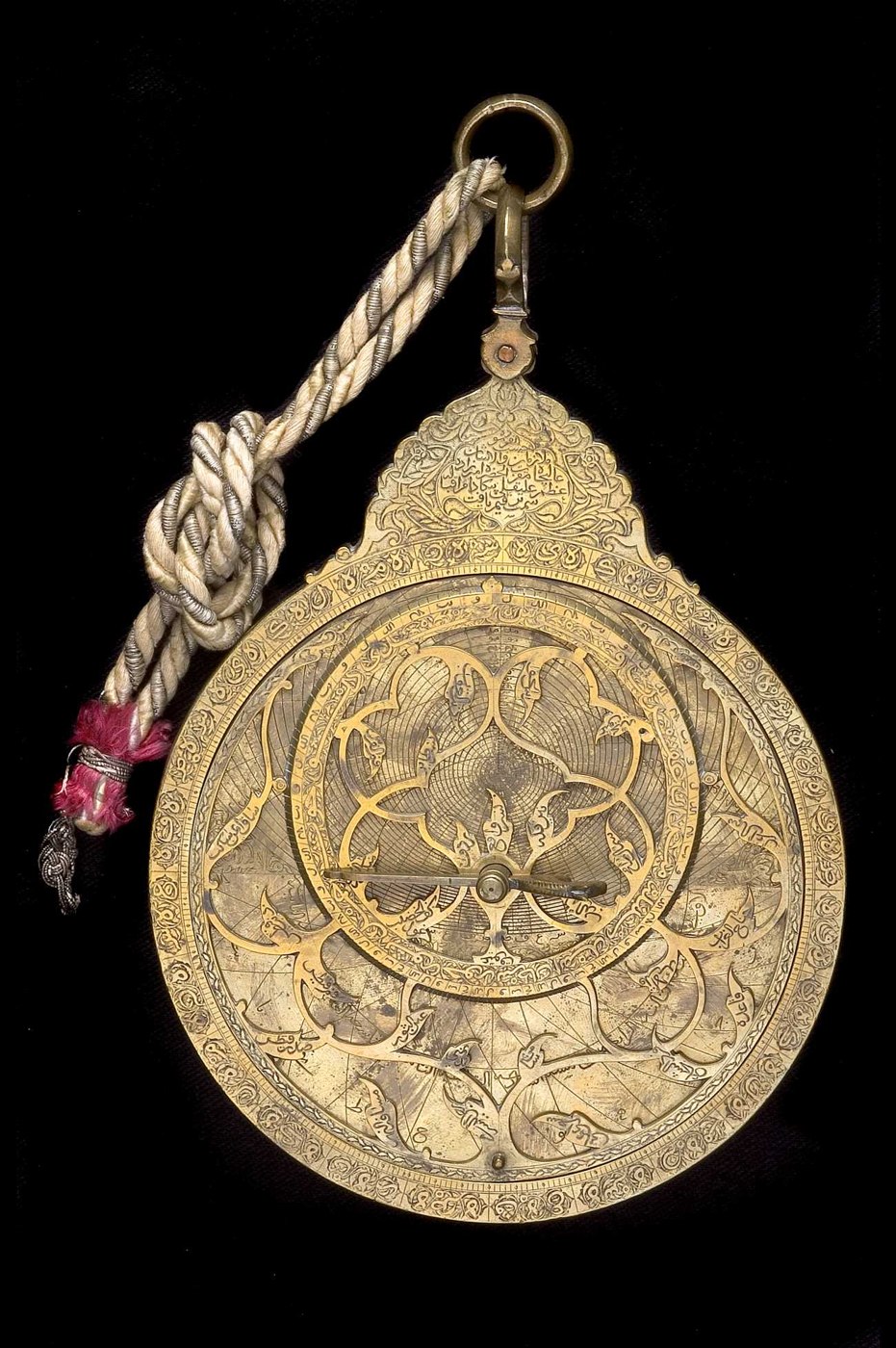
This brass astrolabe, inventory number 46681, was produced in Iṣfahān and dated 1132 A.H. (1719/20). The instrument is signed by the maker It was commissioned for ‘Alīqulī, a prince of the royal Safavid family. The device features an indo-persian style throne with an integrated base, an omega-type shackle, and a plain, double-ended alidade. The mater and limb are constructed as a single unit. The back surface accommodates 16 distinct scales, including altitude, sine/cosine, and cotangent, alongside a shadow square. A rete of the foliate type is attached via a pin and horse assembly. The instrument was donated to the History of Science Museum, Oxford, by J. A. Billmeir in 1957, following its acquisition from the Parisian dealer Nicolas Landau.

Astrolabe by 'Abd al-A'imma (1719/20) with foliate rete and engraved throne.
Astrolabe by 'Abd al-A'imma (1719/20) with foliate rete and engraved throne. — History of Science Museum, University of Oxford. Rights pending — permission not yet requested. Original source

Catalogue identity

Source
www.mhs.ox.ac.uk
Category
Tool · Persian-inscribed astrolabe
Maker / attribution
‘Abd al-A’imma
Reference
46681
Catalogue / lot identifier
1957-84/167
Source-reported date
1719/20 (A.H. 1132)
Source-reported place
Iṣfahān

Source-reported attribution and specifications are not independent authentication. A listing does not establish present ownership, current display, availability or permission to reproduce.

Object description

Construction and Design

The astrolabe is fabricated from brass, utilizing a one-piece construction for the mater and limb. It incorporates an indo-persian, engraved throne, which is secured by an integrated base and topped with a spade-shaped tab for the shackle connection. The shackle is of the omega style, characterized by ornate detailing. The instrument is held together with a pin and horse assembly; while the pin is plain, the horse is crafted with distinct features including eyes, nostrils, mouth, ears, and mane.

The foliate-type rete lacks star pointers. A simple, squared cross-section ring is used for carrying. The double-ended alidade remains in its original, plain form, specifically noted for the absence of scales or additional decorative engravings. The tab responsible for securing the tympans is positioned at 180 degrees from the throne.

Evidence for this section
  • “The throne is of the indo-persian, engraved type made of brass”
  • “The horse, by contrast, is rather nicely made and detailed, including eyes, nostrils, mouth, as well as mane and ears.”
  • “This alidade is plain, not having been decorated with either scales or decorative engravings.”

Scales and Inscriptions

The back of the astrolabe is densely inscribed with 16 functional scales, including those for altitude, declination, azimuth of Qibla, sine/cosine, cotangent, and a shadow square, among others. The shadow square is divided into feet and fingers. The back plate also carries the maker's signature and date, rendered as '‘Abd al-A’imma made and decorated this. 1132'.

The womb features a gazetteer with city names embossed against a patterned background, supplemented by data on longitude, latitude, inḥirāf, and the jihā. The limb features a degree scale ranging from 0 to 360, marked at five-degree intervals.

Evidence for this section
  • “The back contains 16 scales of the following types: Altitude; Declination; Azimuth of Qibla; Altitude of noon sun; Sine/Cosine; Cotangent; Terms; Zodiacal signs; Faces; Lunar Mansions; Shadow square; Triplicities.”
  • “‘Abd al-A’imma made and decorated this. 1132”
  • “The womb is engraved with a gazeteer.”

Provenance and History

This instrument is recorded in the collection of the History of Science Museum, Oxford, under accession number 1957-84/167, having been presented by J. A. Billmeir in 1957. Prior to this, the astrolabe was purchased from the Parisian dealer and collector Nicolas Landau between 1955 and 1957.

Documentation suggests the object was originally commissioned by ‘Alīqulī, a prince of the Safavid royal family.

Evidence for this section
  • “Presented by J. A. Billmeir in 1957”
  • “It was originally made for 'Alīqulī, a prince of the royal Safavid family.”
  • “Billmeir bought it from Nicolas Landau, a collector and dealer of Paris, during the period 1955-57.”

Open research questions

  • Are there other existing astrolabes from the same workshop that use identical gazetteer data?
  • What are the specific astronomical parameters encoded in the three plates?

Source evidence

Recorded claims and source quotations for Astrolabe by 'Abd al-A'imma
FieldSource-reported valueSource quotation
Maker‘Abd al-A’imma“‘Abd al-A’imma”
Date1719/20 (A.H. 1132)“1719/20 (A.H. 1132)”
PlaceIṣfahān“Iṣfahān”
Inventory Number46681“Inventory no. 46681”
Accession1957-84/167“1957-84/167”
SignatureSigned by the maker“‘Abd al-A’imma made and decorated this. 1132”

Visible details

  • Throne features decorative foliage engraving
  • Alidade is plain and lacks scales or engravings
  • The horse assembly depicts detailed facial features
  • The womb contains a gazetteer with city names

Research qualifications

  • The exact extent of the maker's workshop and his collaborators remains historical speculation
  • The historical purpose of the instrument as a royal commission is source-attributed but not independently verified

Photograph identity and source facts were screened before import; rights clearance remains pending.

Consulted source

Astrolabe, inventory 46681 (Iṣfahān, 1719/20 (A.H.)

Reviewed 2026-10-26 · Record 7f5f22cc81

Terms in this record

Glossary explanations for terms named in this object’s record.