
Skip to content
The Encyclopedia of Horology

Tool · Persian-inscribed astrolabe

Brass Astrolabe by Khalīl Muḥammad ibn Ḥasan ‘Alī

Partially verified

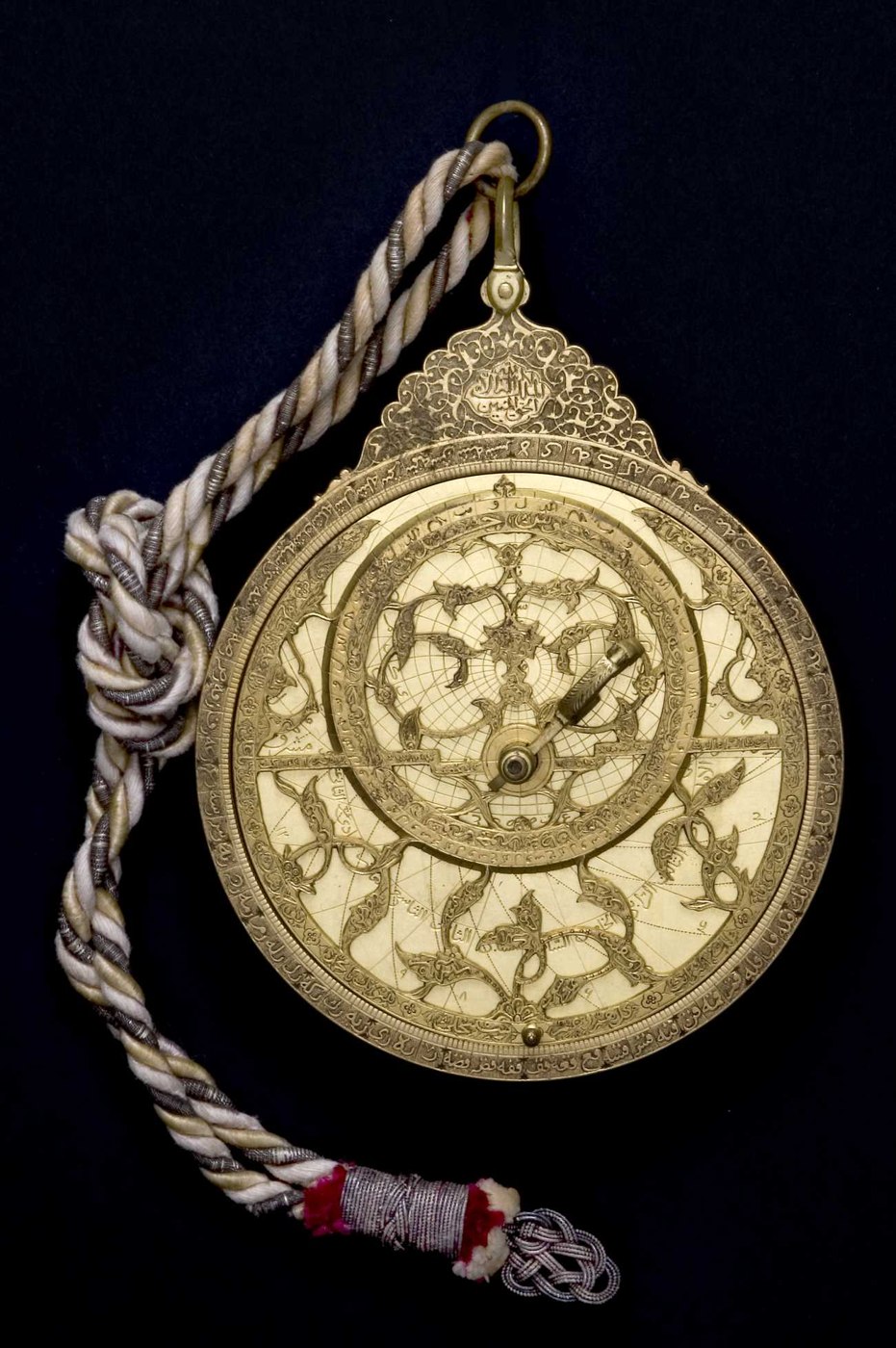
This brass astrolabe, attributed to the maker Khalīl Muḥammad ibn Ḥasan ‘Alī and dated to approximately 1700, originated in Iṣfahān. The instrument features a one-piece mater and limb construction with an integrated tab for plate alignment. It is equipped with an Indo-Persian engraved throne, a simple round-section ring, and an omega-type shackle. The rete is of the foliate type, incorporating 28 stars identified by foliate pointers and labeled with the zodiacal signs in the original script. The back of the instrument displays 16 diverse scales, including altitude, azimuth of Qibla, sine/cosine, cotangent, and a shadow square. Four plates are included, designed for latitudes ranging from 22°0' to 38°0'. The instrument was presented to the History of Science Museum, Oxford, by J. A. Billmeir in 1957, having been acquired from the collection of Henri Michel of Brussels.

Front view of the brass astrolabe (inventory 50987), showing the rete, throne, and suspension cord.
Front view of the brass astrolabe (inventory 50987), showing the rete, throne, and suspension cord. — History of Science Museum, University of Oxford. Rights pending — permission not yet requested. Original source

Catalogue identity

Source
www.mhs.ox.ac.uk
Category
Tool · Persian-inscribed astrolabe
Maker / attribution
Khalīl Muḥammad ibn Ḥasan ‘Alī
Reference
Not recorded
Catalogue / lot identifier
50987
Source-reported date
ca. 1700
Source-reported place
Iṣfahān

Source-reported attribution and specifications are not independent authentication. A listing does not establish present ownership, current display, availability or permission to reproduce.

Object description

Construction and Design

The astrolabe is constructed primarily of brass and exhibits a one-piece design for the mater and limb. An integrated tab located at the bottom of the limb serves to prevent the internal plates from rotating during use. The throne is of the Indo-Persian engraved type, secured by an integrated base.

The instrument is fitted with a simple round-section ring and an omega-shaped shackle, facilitating its suspension. The rete, identified as a foliate, single-knob type, contains 28 stars, each marked with a foliate pointer. The ecliptic scale is divided into 30-degree segments, and the zodiacal signs are engraved in their traditional order.

Evidence for this section
  • “The mater and limb are of one-piece construction.”
  • “The throne is of the indo-persian, engraved type”
  • “The rete is of the foliate (single knob) type.”

Scales and Gazetteer

The instrument’s back is dense with mathematical information, containing 16 distinct scales arranged in concentric and quadrant formats. These include standard altitude scales, trigonometric functions such as sine, cosine, and cotangent, as well as astrological data such as zodiacal signs, faces, lunar mansions, and triplicities. A shadow square is present in the lower quadrants to assist in surveying calculations.

The womb of the astrolabe houses a comprehensive gazetteer. This grid provides geographical coordinates including longitude, latitude, Inhiraf, and Jihat for 46 cities, ranging from Isfahan and Hamadan to more distant locations like Mecca, Medina, and Kashmir.

Evidence for this section
  • “The back contains 16 scales of the following types”
  • “The womb contains a gazetteer with coordinates for 46 cities”

Provenance and History

This astrolabe entered the collection of the History of Science Museum in Oxford in 1957, gifted by J. A. Billmeir. The object's recorded history prior to this donation indicates that Billmeir purchased the piece around 1950 as part of the private collection of Henri Michel of Brussels.

The instrument retains its original double-ended alidade and is secured by a pin and horse mechanism. It is listed in the museum's catalogue under the inventory number 50987, referencing its specific manufacture in Iṣfahān circa 1700.

Evidence for this section
  • “Presented by J. A. Billmeir in 1957”
  • “Billmeir acquired it with the collection of Henri Michel, of Brussels, which he purchased about 1950.”

Open research questions

  • What is the specific historical significance of the chosen city list in the gazetteer regarding the instrument's intended geographical use?
  • How does the degree of wear on the foliate pointers correlate with the potential frequency of use of the astrolabe during the 18th century?

Source evidence

Recorded claims and source quotations for Brass Astrolabe by Khalīl Muḥammad ibn Ḥasan ‘Alī
FieldSource-reported valueSource quotation
MakerKhalīl Muḥammad ibn Ḥasan ‘Alī“Maker Khalīl Muḥammad ibn Ḥasan ‘Alī”
MaterialBrass“Material Brass”
OriginIṣfahān“Place Iṣfahān”
Dateca. 1700“Date ca. 1700”
Inventory Number50987“Inventory number: 50987”
Rete Stars28“The rete contains 28 stars.”
Plates4“There are 4 plates”
ProvenancePresented by J. A. Billmeir in 1957, formerly from Henri Michel collection“Billmeir acquired it with the collection of Henri Michel, of Brussels, which he purchased about 1950.”

Visible details

  • The throne features engraved Indo-Persian style decoration.
  • The womb contains a detailed gazetteer listing the coordinates for 46 cities.
  • The back includes complex divisions for lunar mansions and triplicities.

Research qualifications

  • The exact modern star name for some listed entries remains unverified.
  • The precise original intended purpose for certain shadow square settings is not explicitly documented in the provided source.

Photograph identity and source facts were screened before import; rights clearance remains pending.

Consulted source

Astrolabe, inventory 50987 (Iṣfahān, ca. 1700)

Reviewed 2026-10-26 · Record 5b9c3e09f2

Terms in this record

Glossary explanations for terms named in this object’s record.