
Skip to content
The Encyclopedia of Horology

Tool · Persian-inscribed astrolabe

Brass Astrolabe by Ibn Muḥibb Ḥaqiqa

Partially verified

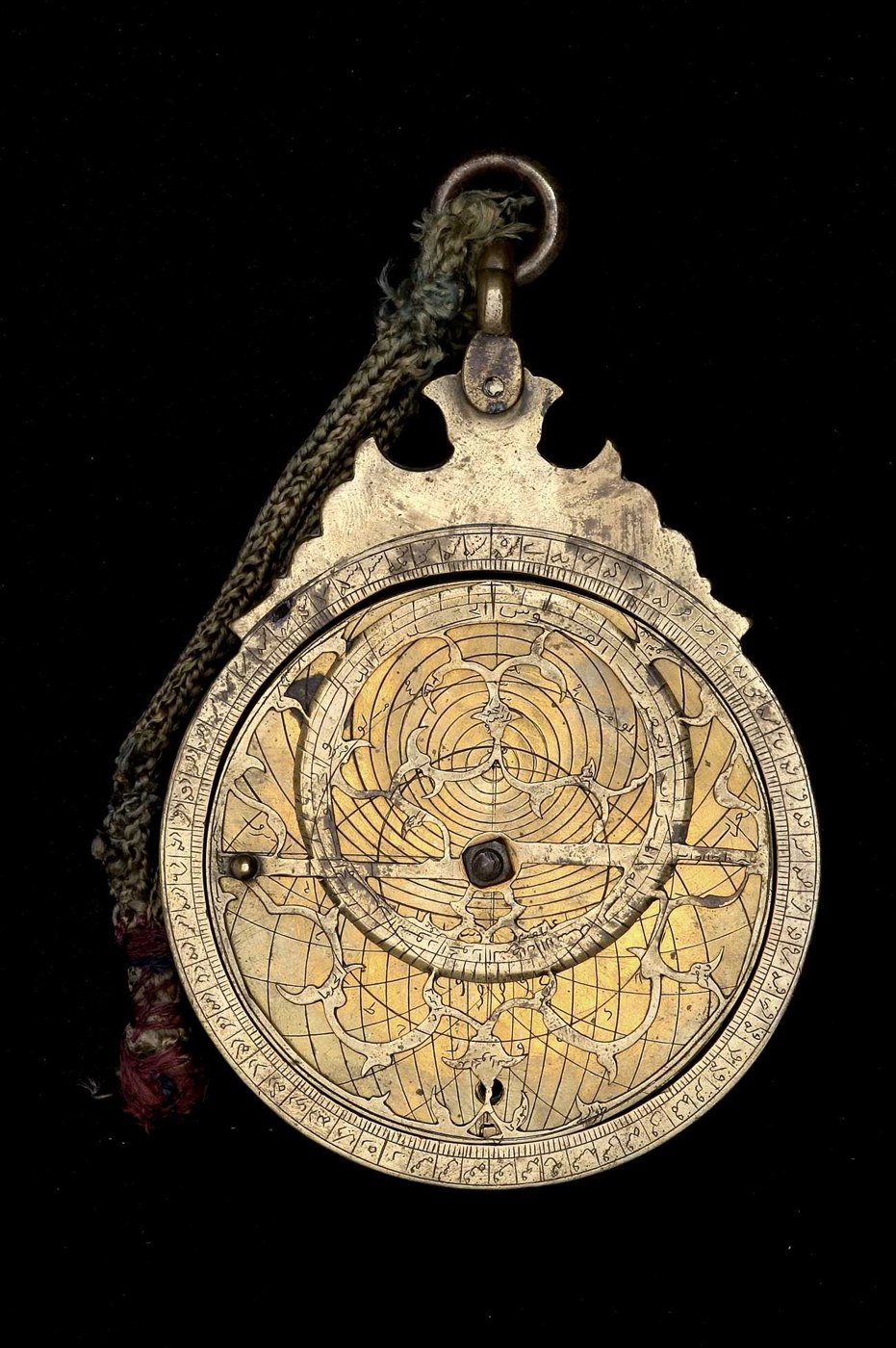
This brass astrolabe, bearing inventory number 52066, is attributed to the maker Ibn Muḥibb Ḥaqiqa and dated 1647/8 (A.H. 1057). It features an Indo-Persian broad-type throne with an integrated base, a simple round cross-section ring, and an omega-type shackle. The instrument is constructed with a two-piece, soldered mater and limb. The limb displays a degree scale numbered every five degrees. The womb contains a gazetteer with coordinates for 34 cities. The rete is of a foliate (single knob) type, containing five stars identified with foliate pointers. The alidade is double-ended and rigid. This instrument was presented to the History of Science Museum, University of Oxford, by Lewis Evans in 1924. The provenance indicates Evans acquired the piece in Paris prior to his donation. The assembly includes a central nut and bolt system.

The obverse of the brass astrolabe, showing the intricate rete, degree-scaled limb, and the central nut-and-bolt assembly.
The obverse of the brass astrolabe, showing the intricate rete, degree-scaled limb, and the central nut-and-bolt assembly. — History of Science Museum, University of Oxford. Rights pending — permission not yet requested. Original source

Catalogue identity

Source
www.mhs.ox.ac.uk
Category
Tool · Persian-inscribed astrolabe
Maker / attribution
Ibn Muḥibb Ḥaqiqa
Reference
Not recorded
Catalogue / lot identifier
52066
Source-reported date
1647/8 (A.H. 1057)
Source-reported place
India (?)

Source-reported attribution and specifications are not independent authentication. A listing does not establish present ownership, current display, availability or permission to reproduce.

Object description

Construction and Design

The astrolabe is constructed from brass and follows an Indo-Persian aesthetic. The throne is a defining feature, described as a broad type, which is attached to the main body via an integrated base. This structural integrity is further supported by the use of an omega-shaped shackle, which connects to a ring with a simple round cross-section.

The mater and limb, which form the primary housing for the instrument's plates, are manufactured using a two-piece soldered technique. The limb itself features a circular, concentric degree scale that spans 0 to 360 degrees, with numerical markers at five-degree intervals.

Evidence for this section
  • “The throne is of the indo-persian, broad type made of brass attached with integrated base”
  • “The mater and limb are of two pieces, soldered construction.”

The Rete and Alidade

The rete, the astronomical component used for star mapping, utilizes a foliate, single-knob design. It is populated with five specific stars, each indicated by a foliate pointer. These stars include identifiers such as Deneb Kaitos, Albireo, Altair, Enif, and Skat, each with recorded mediation and declination values. The rete is secured to the center of the instrument using a nut and bolt arrangement.

The alidade is a double-ended, rigid tool intended for sighting. It remains in its original state, devoid of additional pinholes or notches, functioning as a primary component for celestial observation aligned with the central pin system.

Evidence for this section
  • “The rete is of the foliate (single knob) type.”

Provenance and Documentation

The instrument carries the inventory number 52066 and was donated to the University of Oxford's History of Science Museum by Lewis Evans in 1924. Records confirm that the astrolabe was originally purchased in Paris by Evans prior to its entry into the collection.

The womb of the astrolabe is engraved with a comprehensive gazetteer, detailing the coordinates—specifically longitude, latitude, Inhiraf, and Jihat—for 34 major cities across the Islamic world, including Mecca, Baghdad, and Samarqand. This internal data set confirms the practical application of the instrument for determining direction and geographical location.

Evidence for this section
  • “Presented by Lewis Evans in 1924”
  • “Evans bought it in Paris.”
  • “The womb contains a gazetteer with coordinates for 34 cities”

Open research questions

  • What specific workshop or regional tradition does the attribution to Ibn Muḥibb Ḥaqiqa represent?
  • Do the specific star coordinates on the rete align with standard observational errors found in other 17th-century Indo-Persian instruments?

Source evidence

Recorded claims and source quotations for Brass Astrolabe by Ibn Muḥibb Ḥaqiqa
FieldSource-reported valueSource quotation
MakerIbn Muḥibb Ḥaqiqa“Maker Ibn Muḥibb Ḥaqiqa”
Date1647/8 (A.H. 1057)“Date 1647/8 (A.H. 1057)”
PlaceIndia (?)“Place India (?)”
MaterialBrass“Material Brass”
Throne TypeIndo-Persian, broad type“The throne is of the indo-persian, broad type”
Shackle TypeOmega type“Shackle of the omega type”
Rete Stars5“The rete contains 5 stars.”
ProvenancePurchased in Paris by Lewis Evans“Evans bought it in Paris.”

Visible details

  • The throne features an elaborate, broad-type silhouette with an integrated attachment base.
  • The rete is intricately pierced in a foliate design with specific star pointers.
  • The limb and mater show visible evidence of the two-piece soldered construction.

Research qualifications

  • The origin is only suggested as India (?) by the catalogue source.
  • The specific modern identity of some stars on the rete remains subject to ongoing verification.

Photograph identity and source facts were screened before import; rights clearance remains pending.

Consulted source

Astrolabe, inventory 52066 (India (?), 1647/8 (A.H. 1057))

Reviewed 2026-10-26 · Record 58d05c3d2e

Terms in this record

Glossary explanations for terms named in this object’s record.