
Skip to content
The Encyclopedia of Horology

Tool · Persian-inscribed astrolabe

Brass Astrolabe

Partially verified

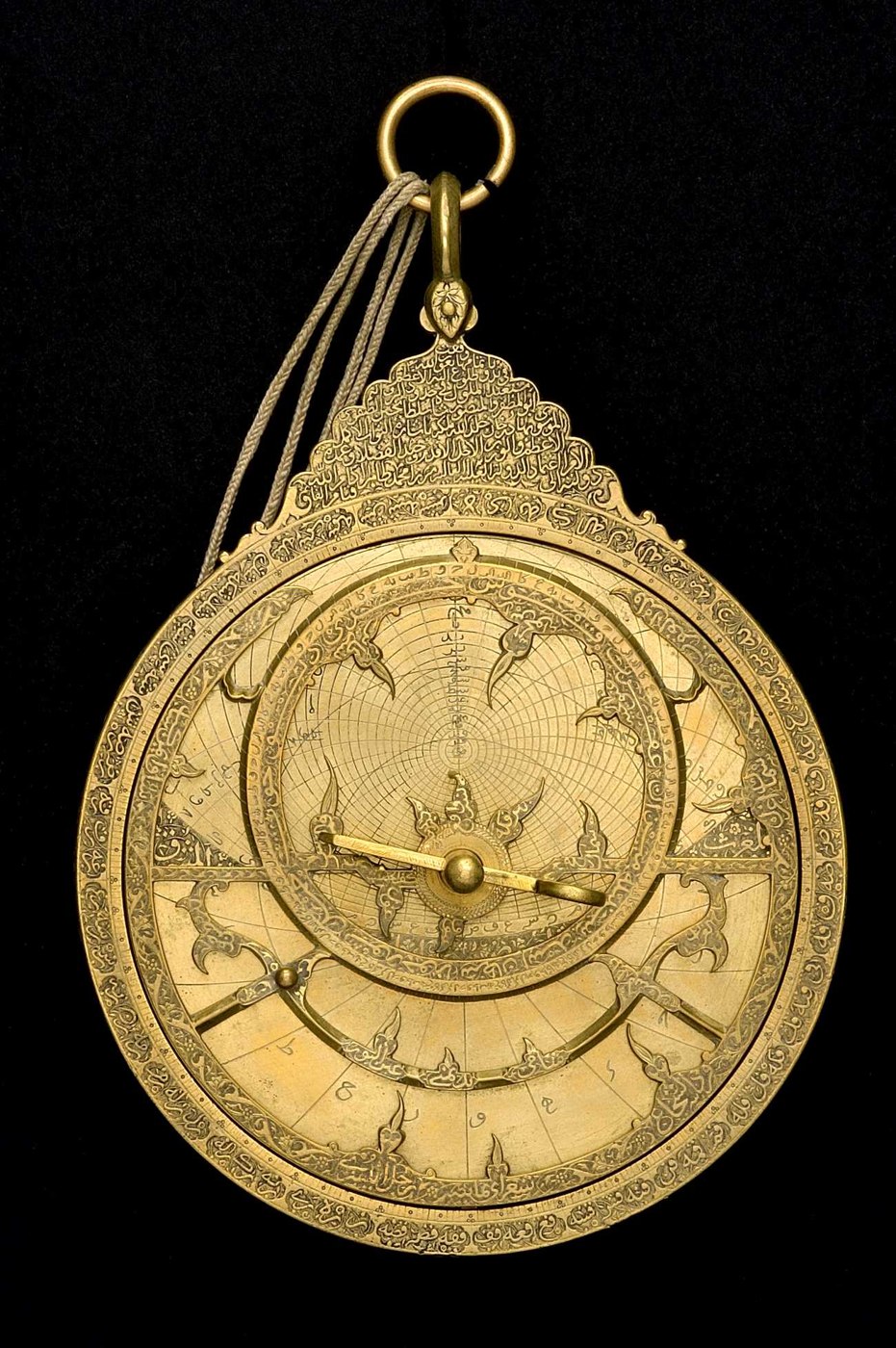
This brass astrolabe, attributed to the maker Khalīl Muḥammad ibn Ḥasan ‘Alī and dated circa 1710, originated in Iṣfahān. The object features a foliate-type rete with 26 stars and two plates covering latitudes from 29°0' to 36°0'. The back displays 17 scales, including those for altitude, declination, and zodiacal signs. Its construction includes an Indo-Persian style throne and an omega-type shackle. The womb contains a gazetteer listing coordinates for 46 cities. Presented to the History of Science Museum by J. A. Billmeir in 1957, the instrument was previously in the collection of Henri Michel. An inscription indicates it was created during the reign of Shah Husain for his vizier, Mirzā Muḥammad Ṭāhir.

Front view of the brass astrolabe (inventory 33739) showing the rete, throne, and degree scale.
Front view of the brass astrolabe (inventory 33739) showing the rete, throne, and degree scale. — History of Science Museum, University of Oxford. Rights pending — permission not yet requested. Original source

Catalogue identity

Source
www.mhs.ox.ac.uk
Category
Tool · Persian-inscribed astrolabe
Maker / attribution
Khalīl Muḥammad ibn Ḥasan ‘Alī
Reference
Not recorded
Catalogue / lot identifier
1957-84/7
Source-reported date
ca. 1710
Source-reported place
Iṣfahān
Source-reported serial
33739

Source-reported attribution and specifications are not independent authentication. A listing does not establish present ownership, current display, availability or permission to reproduce.

Object description

Construction and Design

The astrolabe is constructed primarily of brass and features an Indo-Persian style throne attached to an integrated base. The throne is scalloped, displaying five small lobes and simple scroll work at the base. The instrument utilizes a simple, round cross-section ring and an omega-type shackle, with the ring tabs decorated as leaves. The mater and limb are manufactured as a single-piece construction, with a short inscription located at the bottom of the limb.

Inside the mater, a tab is utilized to secure the tympans, diverging from the more common practice of using notches in the mater and tabs on the plates. The instrument is equipped with two plates providing latitude coverage from 29°0' to 36°0'. The double-ended alidade is original and rigid, designed with simple tips and pinholes.

Evidence for this section
  • “The throne is of the indo-persian, engraved type made of brass attached with integrated base”
  • “The mater and limb are of one-piece construction”
  • “This instrument has a tab on the limb, inside the mater, to hold the tympans in place”

Signature and Decoration

This instrument is recognized for an unusual division of labor between its maker and decorator, a trait associated with a group of Iṣfahān astrolabe makers active during the early 18th century. Separate signatures are present on the piece, attributing the construction to Khalīl Muḥammad ibn Ḥasan ‘Alī and the decorative engraving to ‘Abd al-A'imma.

The decoration is described as fine, covering the rim, the back, and the womb. The foliate design extends across these surfaces, surrounding inscriptions. The rete, which is of the foliate or single-knob type, exhibits numerous construction marks on its reverse side. While the rete is aesthetically complex, the east/west bar is described as poorly drawn with misaligned sides.

Evidence for this section
  • “It is unusual to see a 'division of labour' recorded on an astrolabe”
  • “the name of the maker - Khalīl Muḥammad ibn Ḥasan 'Alī - and of the man who 'decorated' the astrolabe - 'Abd al-A'imma”
  • “With such fine decorative engraving, especially on the back and the womb, and extending also to the rim”
  • “The rete is of the foliate (single knob) type. The east/west bar is poorly drawn”

Provenance and History

The astrolabe was presented to the collection by J. A. Billmeir in 1957. Billmeir had acquired the item through the collection of Henri Michel of Brussels, which was purchased around 1950. The instrument carries an inscription identifying its historical context, stating that it was made during the reign of Shah Husain (1694-1722).

The inscription specifically notes that the object was commissioned for the Shah's vizier, Mirzā Muḥammad Ṭāhir.

Evidence for this section
  • “Presented by J. A. Billmeir in 1957”
  • “Billmeir acquired it with the collection of Henri Michel, of Brussels”
  • “An inscription records that it was made during the reign of Shah Husain (1694-1722) for his vizier, Mirzā Muḥammad Ṭāhir.”

Open research questions

  • What specific historical event or occasion prompted the commission of this astrolabe for Vizier Mirzā Muḥammad Ṭāhir?
  • Are the construction marks on the back of the rete consistent with the documented working methods of Khalīl Muḥammad ibn Ḥasan ‘Alī's workshop?

Source evidence

Recorded claims and source quotations for Brass Astrolabe
FieldSource-reported valueSource quotation
MakerKhalīl Muḥammad ibn Ḥasan ‘Alī“Khalīl Muḥammad ibn Ḥasan ‘Alī”
Decorator‘Abd al-A'imma“the man who 'decorated' the astrolabe - 'Abd al-A'imma”
MaterialBrass“Material Brass”
Dateca. 1710“Date ca. 1710”
Place of originIṣfahān“Place Iṣfahān”
Inventory number33739“Inventory no. 33739”
ProvenancePresented by J. A. Billmeir in 1957“Presented by J. A. Billmeir in 1957”
Stars on rete26“The rete contains 26 stars.”

Visible details

  • Foliate-style rete with star pointers
  • Intricate foliate engraving on the back and womb
  • Indo-Persian style scalloped throne with five lobes
  • Omega-shaped shackle with leaf-decorated tabs

Research qualifications

  • Poor drawing and lack of alignment on the rete's east/west bar
  • The rete displays numerous construction marks on its reverse side
  • Pointers for two stars are reported as damaged

Photograph identity and source facts were screened before import; rights clearance remains pending.

Consulted source

Astrolabe, inventory 33739 (Iṣfahān, ca. 1710)

Reviewed 2026-10-26 · Record e82dfa4b00

Terms in this record

Glossary explanations for terms named in this object’s record.