
Skip to content
The Encyclopedia of Horology

Tool · Astrolabe

Brass Astrolabe

Partially verified

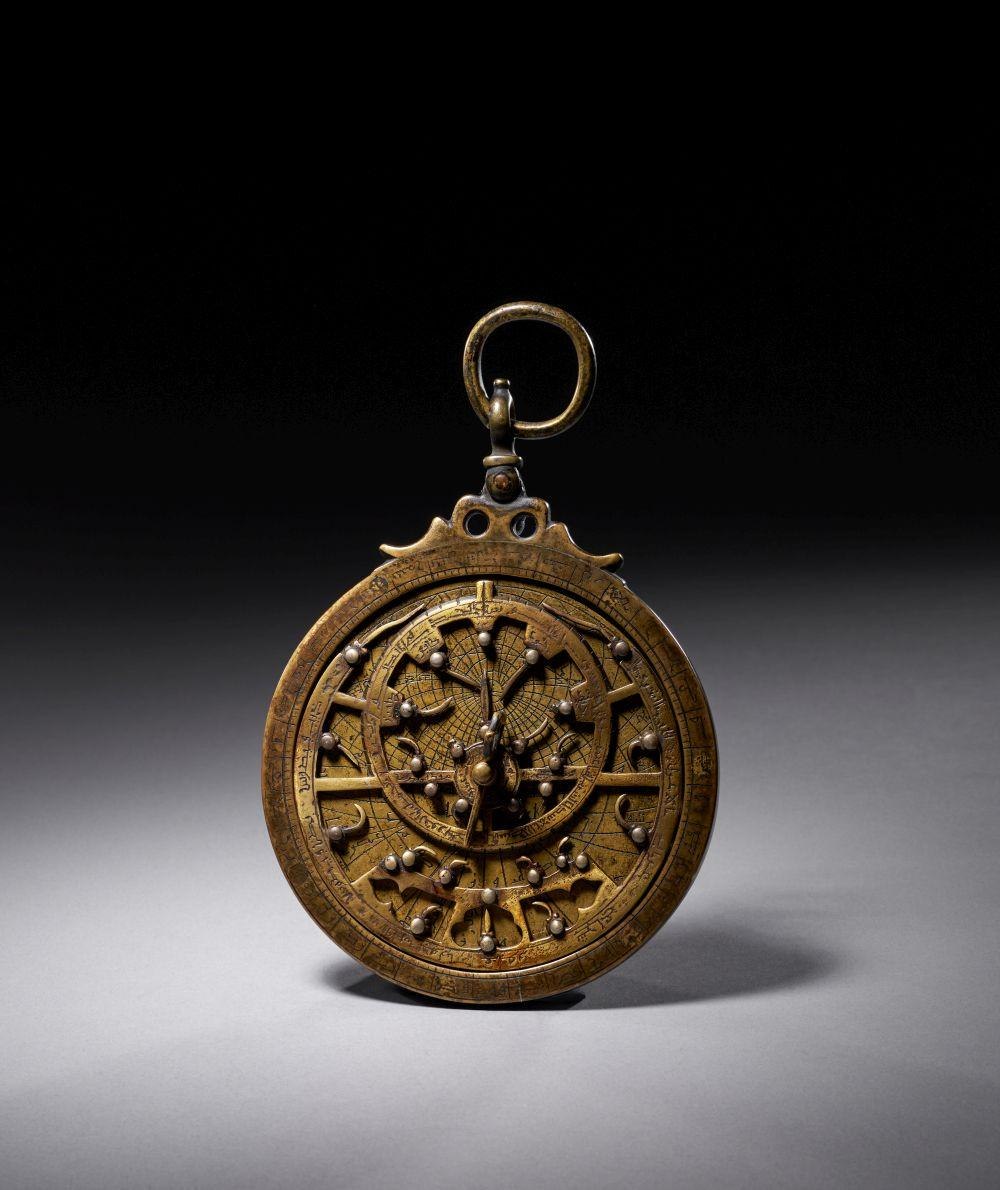
This 19th-century brass astrolabe originates from Qajar Iran. It is a scientific instrument featuring a circular body (mater) and an elaborately engraved rete with openwork tracery. The rete contains star maps, celestial coordinates, and Arabic inscriptions that identify zodiac divisions and principal stars. The instrument is equipped with several interchangeable latitude plates, or tympans, which are engraved with stereographic projections relevant to various cities in the Islamic world. The mater is marked with scales and Qibla calculations, while the reverse side of the instrument incorporates sine and tangent scales, which facilitate trigonometric and astronomical computations.

Full view of the brass astrolabe, showing the rete, throne, and suspension ring.
Full view of the brass astrolabe, showing the rete, throne, and suspension ring. — PLAKAS (via Invaluable). Rights pending — permission not yet requested. Original source

Catalogue identity

Source
www.invaluable.com
Category
Tool · Astrolabe
Maker / attribution
Not established
Reference
Not recorded
Catalogue / lot identifier
103
Source-reported date
19th century
Source-reported place
Iran

Source-reported attribution and specifications are not independent authentication. A listing does not establish present ownership, current display, availability or permission to reproduce.

Object description

Construction and Design

The astrolabe is constructed of brass and measures 18 cm in height with a weight of 630 grams. The structure comprises a central mater, which serves as the primary body, and a highly detailed rete that functions as a star map. The rete features intricate openwork tracery, incorporating celestial coordinates and Arabic inscriptions that denote the principal stars and the zodiac divisions.

The instrument includes multiple interchangeable tympans, or latitude plates, which are essential for its operation. These plates are engraved with stereographic projections intended for various cities. The overall assembly is held together with the original suspension ring and throne, with the alidade mounted to the instrument to assist with astronomical observation.

Evidence for this section
  • “This brass astrolabe is a refined scientific instrument from Qajar Iran”
  • “The piece features an elaborately engraved rete (star map) with openwork tracery”
  • “Beneath it are several interchangeable latitude plates (tympans)”
  • “The suspension ring, throne, and alidade are intact”

Scientific Utility

The instrument is designed for complex astronomical and trigonometric calculations. The reverse side of the mater is engraved with specific sine and tangent scales, allowing the user to perform measurements necessary for celestial positioning. Additionally, the mater includes scale markings and specific calculations for determining the Qibla, which indicates the direction toward Mecca.

By utilizing the interchangeable latitude plates, a user could adjust the instrument for different geographic locations within the Islamic world. This capability demonstrates the instrument's utility in providing accurate astronomical data for diverse cities, relying on the mathematical principles of stereographic projection to map celestial spheres onto a flat surface.

Evidence for this section
  • “The mater (body) bears scale markings and Qibla calculations”
  • “the reverse includes sine and tangent scales used for trigonometric and astronomical computation”
  • “engraved with stereographic projections for different cities within the Islamic world”

Historical Context

The level of detail in the engraving and the preservation of the mechanical components suggest the continued application of astronomical science.

The inscriptions provided on the instrument, written in Arabic, identify the various stars and zodiacal divisions.

Evidence for this section
  • “This instrument exemplifies the enduring scholarly traditions of Persian astronomers”
  • “maintained and elaborated upon classical Islamic astronomical science during the Qajar era”
  • “Arabic inscriptions identifying the principal stars and zodiac divisions”

Open research questions

  • Which specific cities are represented on the interchangeable latitude plates?
  • Are there any identifiable maker's marks or signatures hidden within the engravings?

Source evidence

Recorded claims and source quotations for Brass Astrolabe
FieldSource-reported valueSource quotation
MaterialBrass“A BRASS ASTROLABE”
OriginQajar Iran“QAJAR IRAN”
Dating19th century“19TH CENTURY”
Height18 cm“Height 18 cm”
Weight630 g“Weight: 630 g”
ComponentsSuspension ring, throne, alidade, rete, mater, and tympans“The suspension ring, throne, and alidade are intact, attesting to its preservation and technical integrity.”
FunctionsSine and tangent scales, Qibla calculations“the reverse includes sine and tangent scales used for trigonometric and astronomical computation.”

Visible details

  • Intricate openwork rete design
  • Arabic script visible on the rim and rete
  • Circular suspension ring at the top
  • Engraved alidade visible across the center

Research qualifications

  • Specific geographic cities for the latitude plates are not listed
  • Exact date within the 19th century is not specified

Photograph identity and source facts were screened before import; rights clearance remains pending.

Consulted source

A BRASS ASTROLABE QAJAR IRAN, 19TH CENTURY

Reviewed 2026-10-26 · Record b94135756a

Terms in this record

Glossary explanations for terms named in this object’s record.