
Skip to content
The Encyclopedia of Horology

Tool · Arabic-inscribed astrolabe

Brass Astrolabe

Partially verified

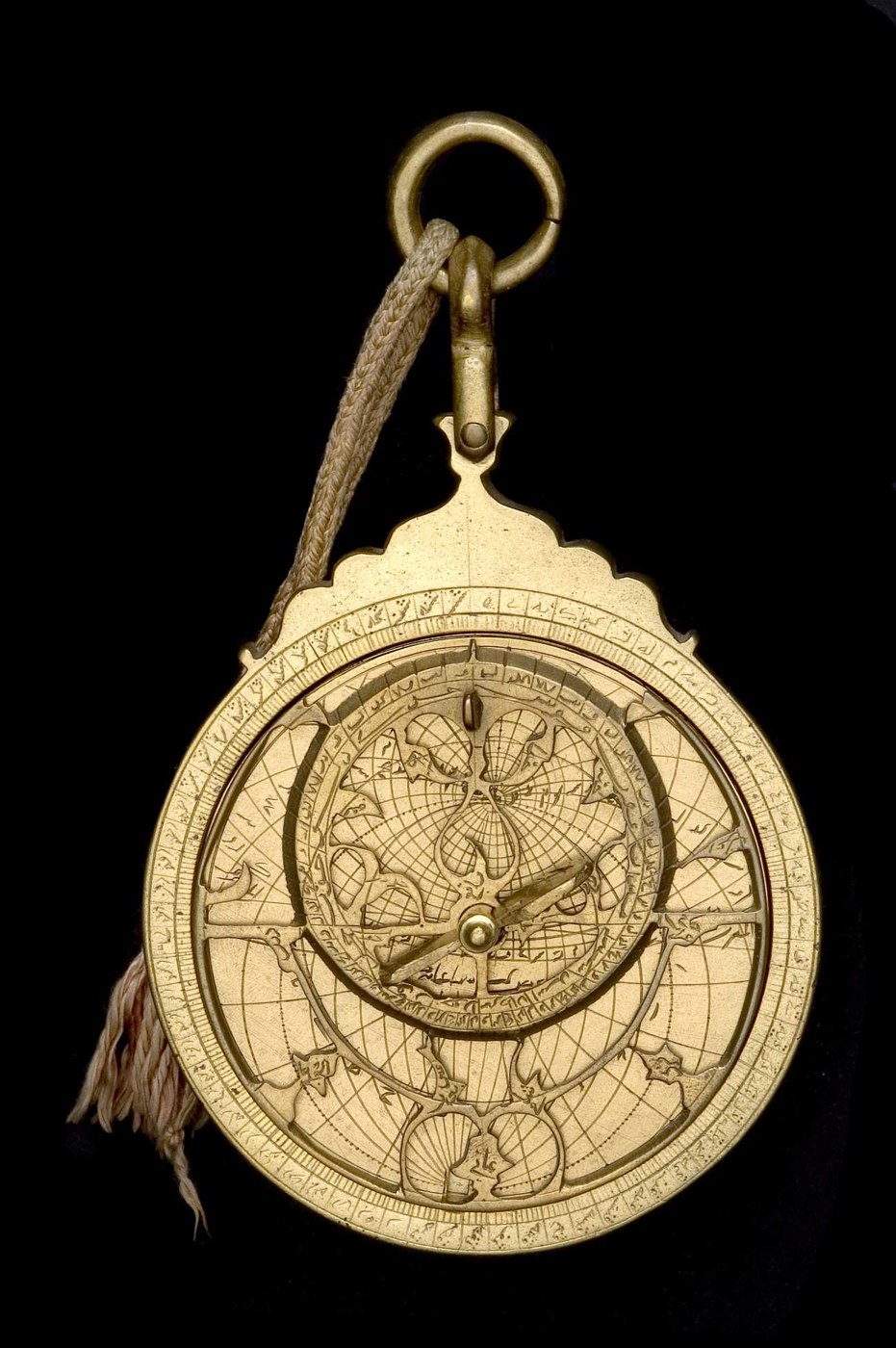
This 18th-century brass astrolabe is catalogued as inventory number 50180 in the History of Science Museum, University of Oxford. The instrument features a one-piece mater and limb construction, with a small internal tab at the bottom to prevent tympan rotation. It is fitted with an Indo-Persian style broad throne, an eye-bolt shackle, and a simple round cross-section ring. The rete is of the foliate type, featuring sixteen star pointers. Six plates are included, covering latitudes from 22° to 66°. The back of the instrument contains seven scales, including altitude, declination, sine/cosine, shadow squares, and cotangent scales. The instrument is secured with a plain pin and a crude horse-shaped wedge. It was acquired by the museum in 1957 as a gift from J. A. Billmeir, having previously been part of the Charles Chadenat collection sold in Paris in 1956.

Full view of the front of the astrolabe showing the rete, pin, and horse attachment.
Full view of the front of the astrolabe showing the rete, pin, and horse attachment. — History of Science Museum, University of Oxford. Rights pending — permission not yet requested. Original source

Catalogue identity

Source
www.mhs.ox.ac.uk
Category
Tool · Arabic-inscribed astrolabe
Maker / attribution
Not established
Reference
Not recorded
Catalogue / lot identifier
50180
Source-reported date
18th century
Source-reported place
Persia (?)

Source-reported attribution and specifications are not independent authentication. A listing does not establish present ownership, current display, availability or permission to reproduce.

Object description

Construction and Main Body

The astrolabe is constructed primarily of brass and features a one-piece mater and limb. The limb includes a degree scale numbered every 5 degrees, spanning 0 to 360 degrees. To ensure the correct orientation of the tympans, a small tab is situated at the bottom of the limb on the interior. The womb contains a gazetteer with coordinates for 22 specific cities.

The throne follows the Indo-Persian broad style and includes an integrated support and base. A tulip-shaped point serves as the attachment point for the shackle. The shackle consists of two parts: an eye-hole at the top for the suspension ring and a box-shaped section that fixes to the throne.

Evidence for this section
  • “The mater and limb are of one-piece construction.”
  • “The throne is of the indo-persian, broad type”
  • “It culminates in a tulip-shaped point to which the shackle attaches.”

Rete and Alidade

The rete, of the foliate type, displays sixteen stars marked with foliate pointers. The zodiac labels are etched onto the ecliptic ring. Various construction marks, such as circles for the equator and tropics, are visible on the reverse side of the rete. The rete is fixed to the mater using a plain pin and a crude, horse-shaped wedge.

The alidade is double-ended and rigid, featuring single sights and pinholes. It is entirely plain and contains no decorative engravings or additional markings.

Evidence for this section
  • “The rete is of the foliate (single knob) type.”
  • “The rete contains 16 stars.”
  • “This rule is plain and unmarked by any engravings..”

Back Scales and Provenance

The back of the instrument is engraved with seven distinct scales. These include concentric altitude scales for the upper quadrants, declination and sine/cosine arcs, and two types of shadow square boxes. Circular cotangent scales are also present in the lower quadrants of the outer edge.

The provenance records indicate that J. A. Billmeir purchased the astrolabe at the auction of the Chadenat collection, held at the Hôtel Drouot in Paris on May 24, 1956. The object was later presented to the History of Science Museum in 1957.

Evidence for this section
  • “The back contains 7 scales of the following types: Altitude; Declination; Sine/Cosine; Shadow square; Cotangent.”
  • “Billmeir bought it at the auction sale of the Chadenat collection at the Hotel Drouot, Paris, on 24 May 1956.”

Open research questions

  • What is the significance of the 22 cities listed in the womb's gazetteer regarding the geographical context of the instrument?
  • Could the specific star positions on the rete provide a more precise dating or regional attribution?

Source evidence

Recorded claims and source quotations for Brass Astrolabe
FieldSource-reported valueSource quotation
Inventory number50180“Inventory no. 50180”
Date18th century“Date 18th century”
Place of originPersia (?)“Place Persia (?)”
MaterialBrass“Material Brass”
ProvenancePresented by J. A. Billmeir in 1957“Presented by J. A. Billmeir in 1957”
Number of plates6“There are 6 plates”
Number of star pointers16“The rete contains 16 stars.”

Visible details

  • The throne culminates in a tulip-shaped point where the shackle attaches.
  • The rete contains 16 star pointers identified by foliate shapes.
  • The instrument includes a double-ended alidade which is plain and lacks decorative engravings.
  • The suspension ring is formed from an oval-shaped rod bent into a circle, with ends remaining unsoldered.

Research qualifications

  • The attribution to Persia is designated as tentative by the source.
  • The precise maker of the instrument is currently unknown.

Photograph identity and source facts were screened before import; rights clearance remains pending.

Consulted source

Astrolabe, inventory 50180 (Persia (?), 18th century)

Reviewed 2026-10-26 · Record 9a484ecd7d

Terms in this record

Glossary explanations for terms named in this object’s record.