
Skip to content
The Encyclopedia of Horology

Tool · Arabic-inscribed astrolabe, North Africa

Brass Astrolabe

Partially verified

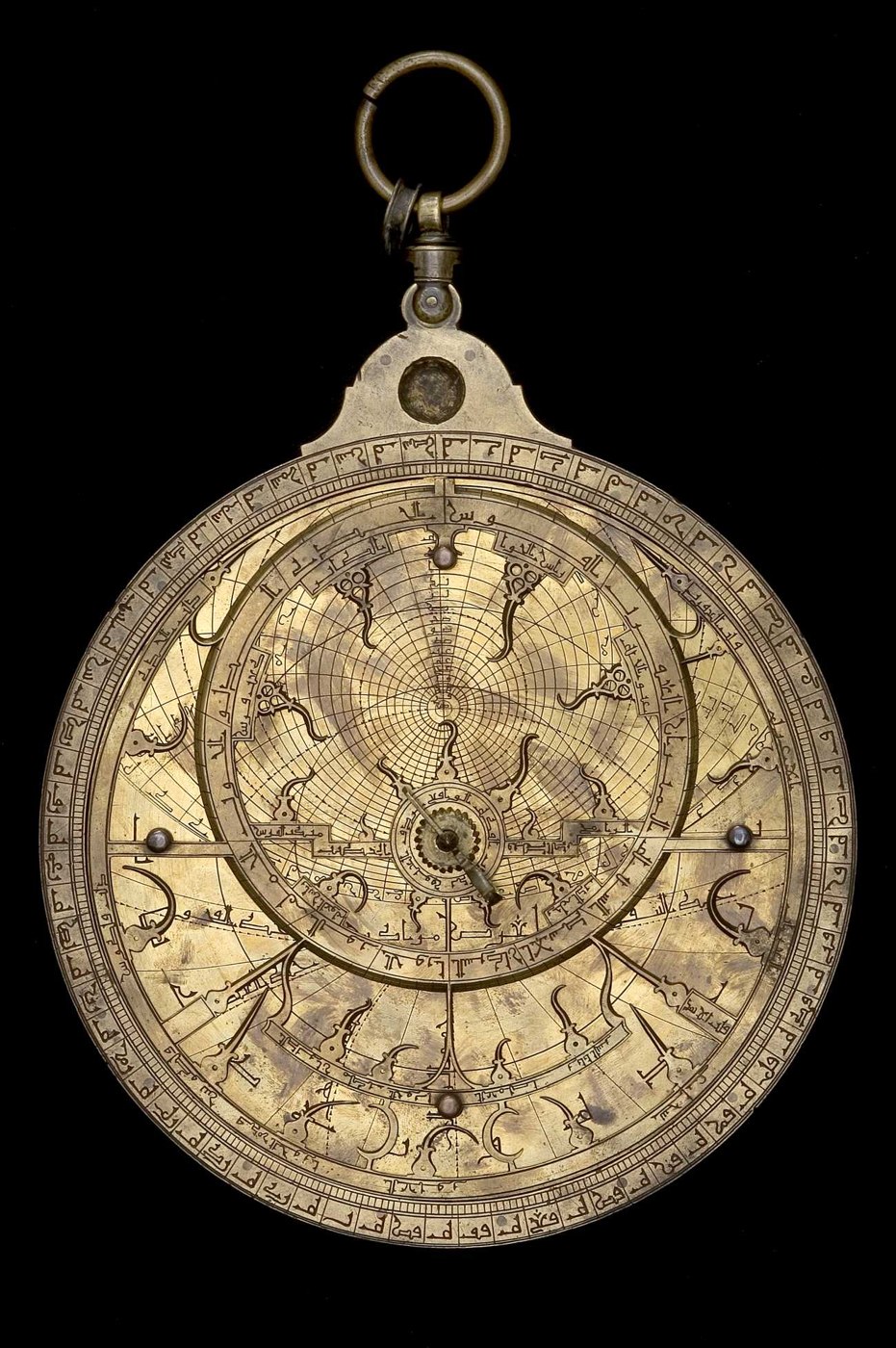
This 16th-century (?) brass planispheric astrolabe (inventory 37527) is of North African origin. It features a compass-bearing throne with an integrated base, a simple round-section ring, and an eye-bolt shackle. The mater and limb are constructed of two pieces, soldered and riveted together, with a degree scale on the limb. The instrument includes eight latitude plates, an alidade, and a rete of the simple indicator-line type with trefoil-based star pointers and four silver rotational knobs. The back of the instrument is engraved with seven distinct scales, including altitude, zodiacal signs, calendar, unequal hours, sine/cosine, and a shadow square. Acquired by the University of Oxford in 1952, the instrument was previously held in the collection of John Selden, who bequeathed it to the Bodleian Library in 1659.

Front view of the brass astrolabe showing the rete, throne, and limb scale.
Front view of the brass astrolabe showing the rete, throne, and limb scale. — History of Science Museum, University of Oxford. Rights pending — permission not yet requested. Original source

Catalogue identity

Source
www.mhs.ox.ac.uk
Category
Tool · Arabic-inscribed astrolabe, North Africa
Maker / attribution
Not established
Reference
Not recorded
Catalogue / lot identifier
37527
Source-reported date
16th century (?)
Source-reported place
North Africa

Source-reported attribution and specifications are not independent authentication. A listing does not establish present ownership, current display, availability or permission to reproduce.

Object description

Construction and Design

The astrolabe is constructed primarily of brass. Its main body comprises a mater and limb formed from two pieces, which are joined through a soldered and riveted construction. The throne follows a compass-bearing style and is secured to an integrated base; it remains otherwise undecorated. The suspension system consists of a plain ring with a circular cross-section, complemented by an eye-bolt shackle that pivots within a round bracket attached to the throne. A teardrop-shaped guide, intended for suspension, is positioned near the ring.

The instrument's rete is a simple indicator-line type. Its star pointers predominantly feature trefoil-shaped bases, and it is fitted with four silver rotational knobs. The accompanying alidade is double-ended, featuring original, rigid, single-pinhole sights. Eight plates are provided for the instrument, covering latitudes up to 45 degrees. The womb of the instrument remains blank.

Evidence for this section
  • “The mater and limb are of two pieces, soldered and riveted construction.”
  • “The throne is of the compass bearing type made of brass attached with integrated base made of brass”
  • “The rete is of the indicator-line (simple) type.”
  • “There are 8 plates with latitudes ranging from to 45°0' .”

Back Scales and Layout

The back of the astrolabe is engraved with seven distinct scales used for astronomical and timekeeping calculations. These include circular, concentric scales for altitude, zodiacal signs, and the calendar, which are arranged in the outer circular areas. The zodiacal signs are labeled in Arabic script. Additional functions include unequal hour scales, sine/cosine calculations, and a shadow square.

The unequal hours are located in the upper left quadrant. The sine/cosine scale is found in the upper right quadrant, while the shadow square occupies the lower sections, with specific divisions marked in fingers for each face of the square.

Evidence for this section
  • “The back contains 7 scales of the following types: Altitude; Zodiacal signs; Calendar; Unequal hours; Sine/Cosine; Shadow square.”
  • “The back contains 7 scales of the following types”
  • “The zodiac on the rete is labelled: الحمل , الثور , الجوزا , السرطان , الاسد , السنبله , الميزان , العقرب , القوس , الجدي , الدلو , الحوت .”

Provenance and History

The astrolabe entered the Bodleian Library in 1659 as part of the manuscript collection bequeathed by the jurist, antiquary, and Member of Parliament for Oxford University, John Selden (1584–1654). The object remained with the library until it was transferred to the History of Science Museum in 1952.

The records note an inventory number of 37527 and an accession number of 1952-76.

Evidence for this section
  • “It came to the Bodleian Library in 1659 along with the huge collection of manuscripts bequeathed by John Selden”
  • “Acquisition Lent by the Bodleian Library, Oxford, in 1952”

Open research questions

  • Does the throne's hollow recess indicate the specific type of compass originally fitted?
  • Can the Arabic labels on the zodiacal scale provide further insight into the specific regional workshops of North Africa during the 16th century?

Source evidence

Recorded claims and source quotations for Brass Astrolabe
FieldSource-reported valueSource quotation
Inventory Number37527“Inventory no. 37527”
MaterialBrass“Material Brass”
Date16th century (?)“Date 16th century (?)”
Place of OriginNorth Africa“Place North Africa”
Throne TypeCompass bearing“The throne is of the compass bearing type”
Rete TypeIndicator-line“The rete is of the indicator-line (simple) type.”
ProvenanceJohn Selden collection“It came to the Bodleian Library in 1659 along with the huge collection of manuscripts bequeathed by John Selden”

Visible details

  • Rete features trefoil-shaped bases for star pointers
  • Four silver rotational knobs on the rete
  • Double-ended alidade with rigid, simple, single-pinhale sights
  • Teardrop-shaped guide near the suspension ring

Research qualifications

  • The exact dating remains uncertain as indicated by the 16th-century (?) classification
  • The hole in the throne is missing its original compass

Photograph identity and source facts were screened before import; rights clearance remains pending.

Consulted source

Astrolabe, inventory 37527 (North Africa, 16th century (?))

Reviewed 2026-10-26 · Record 6089cc6117

Terms in this record

Glossary explanations for terms named in this object’s record.