
Skip to content
The Encyclopedia of Horology

Tool · Arabic-inscribed astrolabe, Indian subcontinent

Brass Astrolabe, 17th Century India

Partially verified

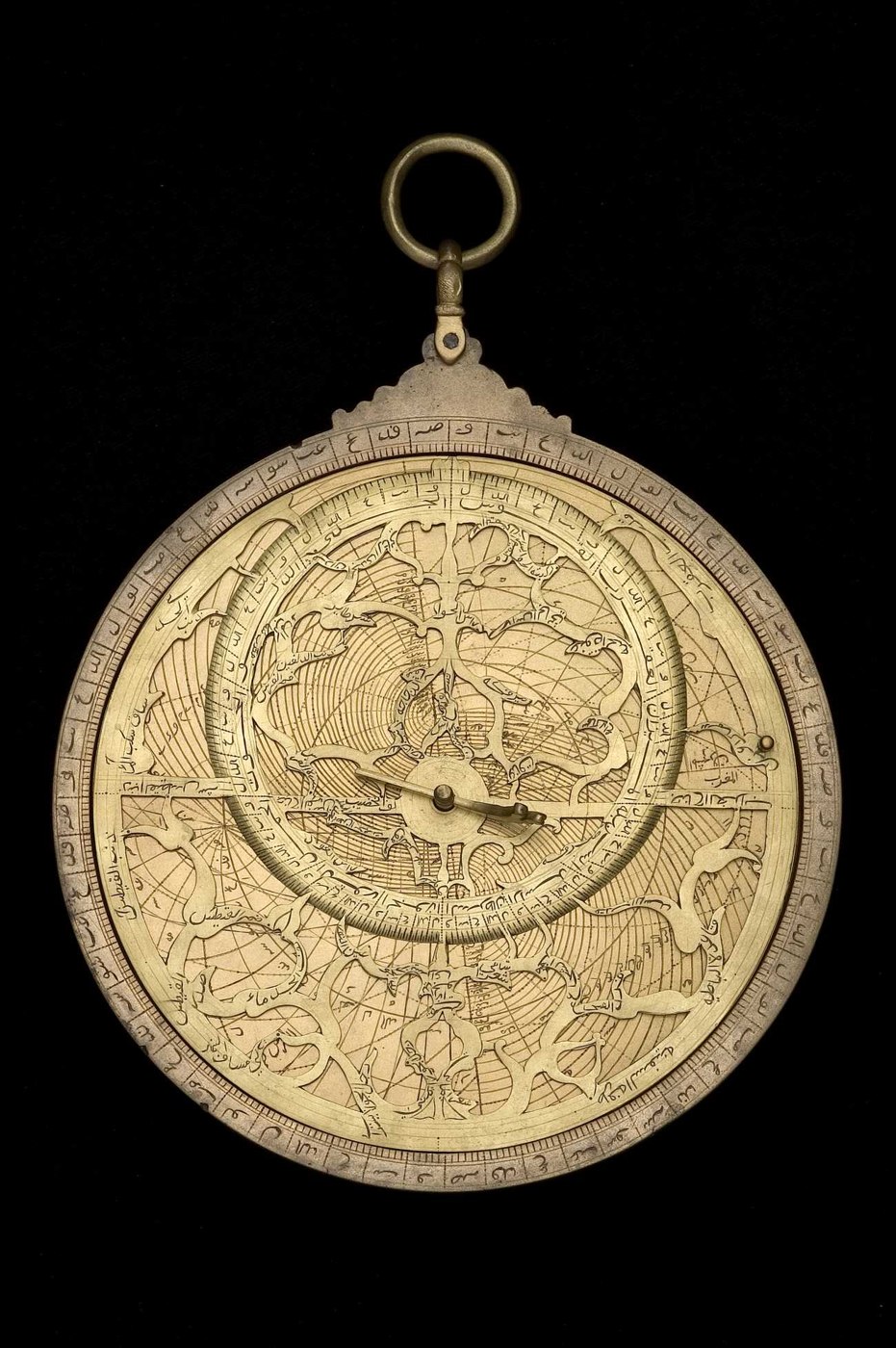
This 17th-century brass astrolabe (inventory 33411) from India, now in the History of Science Museum, Oxford, features an indo-persian broad-type throne, a round-section ring, and a trefoil shackle. The mater and limb are constructed in one piece with a tab located at the bottom to secure the plates. The rete is of a foliate type, incorporating 46 stars marked with foliate pointers and a labelled ecliptic zodiac. The back displays 15 distinct scales, including altitude, sine/cosine, and zodiacal projections. The alidade is double-ended and contains a sighting rule, though the source notes the metal suggests it might be a later replacement. The instrument was presented to the museum by A.E. Gunther in 1986.

Full front view of the 17th-century Indian brass astrolabe, showing the foliate rete and limb scales.
Full front view of the 17th-century Indian brass astrolabe, showing the foliate rete and limb scales. — History of Science Museum, University of Oxford. Rights pending — permission not yet requested. Original source

Catalogue identity

Source
www.mhs.ox.ac.uk
Category
Tool · Arabic-inscribed astrolabe, Indian subcontinent
Maker / attribution
Not established
Reference
Not recorded
Catalogue / lot identifier
194
Source-reported date
17th century
Source-reported place
India
Source-reported serial
33411

Source-reported attribution and specifications are not independent authentication. A listing does not establish present ownership, current display, availability or permission to reproduce.

Object description

Construction and Design

The astrolabe is manufactured from brass, featuring a one-piece mater and limb construction. The instrument's primary suspension point is a trefoil-type shackle connected to a simple, round cross-section ring. The throne is identified as the broad, Indo-Persian type and is attached via an integrated base, with no decoration other than a vertical line engraved on the back.

The plates are secured against rotation by a tab positioned at the bottom of the mater, 180 degrees from the throne. There are seven plates in total, offering a range of latitudes from 18 degrees to 90 degrees. One specific plate is designed for the North Pole, a feature highlighting the instrument's instructional capacity for demonstrating astronomical phenomena such as the sun's behavior at extreme latitudes.

Evidence for this section
  • “The mater and limb are of one-piece construction.”
  • “The tab that holds the plates from rotating is located at the bottom of the instrument, i.e., 180° from the throne.”
  • “The inclusion of a latitude plate for 90 degrees - the North Pole - indicates that this instrument was intended for instruction as well as use.”

Rete and Instrumentation

The rete is designed with a foliate pattern and features a single knob. It incorporates an ecliptic scale and is populated with 46 stars, each indicated by a foliate pointer. The zodiacal signs are engraved in Arabic script. The rete is secured to the main body using a central pin and horse mechanism.

The back of the astrolabe is densely inscribed with 15 different scales, covering various functions including altitude, sine/cosine, declination, prayer lines, lunar mansions, and shadow squares. The double-ended alidade includes a sighting rule, consistent with other instruments originating from India, although the metal composition suggests it may have been replaced at a later time.

Evidence for this section
  • “The rete is of the foliate (single knob) type.”
  • “The rete contains 46 stars.”
  • “The back contains 15 scales of the following types: Altitude; Sine/Cosine; Declination; Prayer lines; Cotangent; Lunar Mansions; Zodiacal signs; Terms; Faces; Shadow square; Triplicities.”
  • “The alidade might be a later replacement; the metal is distinctly different.”

Provenance and Accession

The instrument is recorded as part of the Gunther Collection, which was initially deposited on loan to the museum in 1940 by the executors of the founding curator, R. T. Gunther (1869-1940). The collection was described as miscellaneous in nature and contained several astrolabes.

Documentation regarding the specific history or original acquisition of this astrolabe by R. T. Gunther remains unknown, and it was notably absent from his 1932 publication, The Astrolabes of the World. The item was formally acquired by the institution through a presentation by A.E. Gunther in 1986.

Evidence for this section
  • “The Gunther Collection, initially deposited on loan in 1940 by the executors of R. T. Gunther (1869-1940), the Museum's founding Curator, was a very miscellaneous collection”
  • “Unfortunately Gunther does not record how he acquired this astrolabe. It is not included in his book The Astrolabes of the World (1932).”

Open research questions

  • What specific evidence differentiates the metal of the alidade from the main body of the astrolabe?
  • Are there contemporary 17th-century Indian astrolabes that share the same configuration of the 15 scales on the back?

Source evidence

Recorded claims and source quotations for Brass Astrolabe, 17th Century India
FieldSource-reported valueSource quotation
Inventory Number33411“Inventory no. 33411”
MaterialBrass“Material Brass”
Date17th century“Date 17th century”
Place of originIndia“Place India”
Throne styleIndo-Persian, broad type“The throne is of the indo-persian, broad type”
Plate capacity7 plates“There are 7 plates with latitudes ranging from 18°0' to 90°0'”
ProvenancePresented by A.E. Gunther in 1986“Presented by A.E. Gunther in 1986”

Visible details

  • Foliate star pointers on the rete
  • Double-ended sighting alidade
  • Trefoil-type shackle and Indo-Persian style throne
  • 15 scales on the reverse including shadow squares

Research qualifications

  • The alidade might be a later replacement because the metal is distinctly different
  • The exact acquisition method used by R.T. Gunther is not recorded

Photograph identity and source facts were screened before import; rights clearance remains pending.

Consulted source

Astrolabe, inventory 33411 (India, 17th century)

Reviewed 2026-10-26 · Record f746977668

Terms in this record

Glossary explanations for terms named in this object’s record.