
Skip to content
The Encyclopedia of Horology

Clock · Bracket clock

Bracket clock by Eardley Norton

Partially verified

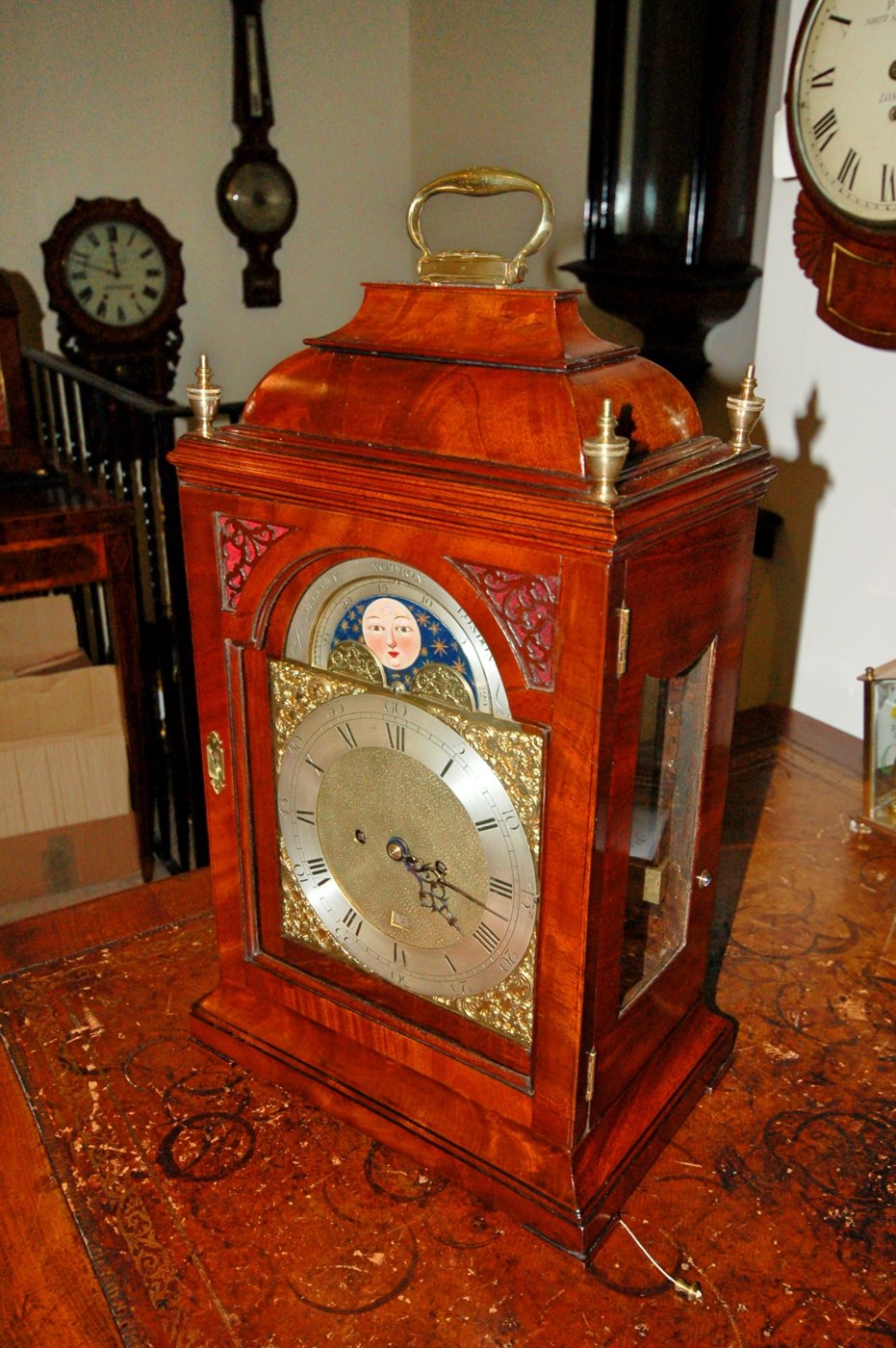
This twin fusee striking bracket clock is attributed to the London-based clockmaker Eardley Norton and dated to circa 1790. The timepiece is housed in a mahogany cabinet with glazed sides and a pediment top featuring a carrying handle. The arched brass dial includes a chapter ring, spandrels, and a matted center incorporating a subsidiary calendar feature and a strike-silent selector positioned at 3 o'clock. An arched aperture at the top of the dial displays a moon phase feature. The clock operates via a twin fusee movement with an hour bell strike mechanism and a repeat function. The brass backplate is decorated with detailed engraving and incorporates a verge escapement. The dial is signed "Yedrae Notron," a variation noted as being employed by the maker on clocks intended for export markets.

Front view of the mahogany bracket clock by Eardley Norton, showing the dial and moon phase aperture.
Front view of the mahogany bracket clock by Eardley Norton, showing the dial and moon phase aperture. — Pendulum of Mayfair. Rights pending — permission not yet requested. Original source

Catalogue identity

Source
www.pendulumofmayfair.co.uk
Category
Clock · Bracket clock
Maker / attribution
Eardley Norton
Reference
Not recorded
Catalogue / lot identifier
Source URL identifies the listing
Source-reported date
circa 1790
Source-reported place
London

Source-reported attribution and specifications are not independent authentication. A listing does not establish present ownership, current display, availability or permission to reproduce.

Object description

Dial and Timekeeping Functions

The timepiece is characterized by an arched brass dial, which incorporates decorative spandrels at the corners and a matted central panel. The primary chapter ring indicates the hours, while a subsidiary calendar function is integrated into the center of the dial. Positioned at the 3 o'clock mark is a strike-silent selector, allowing for the regulation of the bell strike function.

The dial's arch contains a moon phase complication, featuring a painted disc depicting lunar cycles. The signature is inscribed as "Yedrae Notron," a stylistic choice that the auction description reports was utilized by Eardley Norton specifically for export-oriented timepieces. These elements reflect common 18th-century English clock construction.

Evidence for this section
  • “The arched brass dial with chapter ring and spandrels and finely matted centre.”
  • “The rare moon feature to the arch on this clock.”
  • “The dial is signed here Yedrae Notron which was what the maker used on his clocks for export.”

Movement and Escapement

Power is delivered to the clock through a twin fusee movement, a configuration designed to maintain consistent force throughout the winding cycle. The mechanism supports an hour strike on a bell, accompanied by a repeat function. The backplate is constructed from brass and is decorated with intricate floral engravings.

The visual evidence shows the escapement components visible on the backplate, which is consistent with the auction house's description of the movement's technical profile.

Evidence for this section
  • “The twin fusee movement with hour bell strike and repeat function and finely engraved backplate with verge escapement.”

Case Construction

The clock is enclosed in a mahogany cabinet, described by the source as having fine color and patination. The case design incorporates glazed panels on the sides, allowing for visibility of the internal movement. The top of the case is finished with a pediment, accented by four brass finials at the corners and a carrying handle.

The case exhibits proportions and design elements associated with London-made clocks of the late 18th century. The construction utilizes high-quality woodwork, maintained in a configuration intended for tabletop placement.

Evidence for this section
  • “The lovely mahogany cabinet of fine colour and patination and showing high quality London case features.”

Open research questions

  • Are there any internal movement numbers that correspond to known Eardley Norton records?
  • Is there evidence of historical modifications to the moon phase mechanism or dial plate?

Source evidence

Recorded claims and source quotations for Bracket clock by Eardley Norton
FieldSource-reported valueSource quotation
MakerEardley Norton“Antique Bracket Clock by Eardley Norton”
SignatureYedrae Notron“The dial is signed here Yedrae Notron”
MovementTwin fusee with verge escapement“The twin fusee movement with hour bell strike and repeat function and finely engraved backplate with verge escapement.”
MaterialMahogany“The lovely mahogany cabinet”
Dial featuresSubsidiary calendar and moon phase“The arched brass dial with chapter ring and spandrels and finely matted centre. The rare moon feature to the arch on this clock. The finely matted centre with subsidiary calendar feature”
Strike/SilenceStrike silent selector at 3 o'clock“strike silent to the 3 o clock position.”

Visible details

  • The moon phase display in the arch of the dial features a hand-painted face.
  • The backplate engraving depicts scrolling floral and foliate motifs.
  • The mahogany case features a shallow pediment with four brass finials.
  • A strike-silent indicator is located on the dial at the 3 o'clock position.

Research qualifications

  • The source attributes the signature 'Yedrae Notron' specifically to export-market clocks without external verification.
  • The 'circa 1790' dating is an assessment provided by the seller and is not confirmed by archival documentation.

Photograph identity and source facts were screened before import; rights clearance remains pending.

Consulted source

Antique Bracket Clock by Eardley Norton – London C1790

Reviewed 2026-11-02 · Record 774ece1148

Terms in this record

Glossary explanations for terms named in this object’s record.