
Skip to content
The Encyclopedia of Horology

Pocket watch · Verge calendar watch

Benjamin Lisle silver-cased verge calendar watch

Partially verified

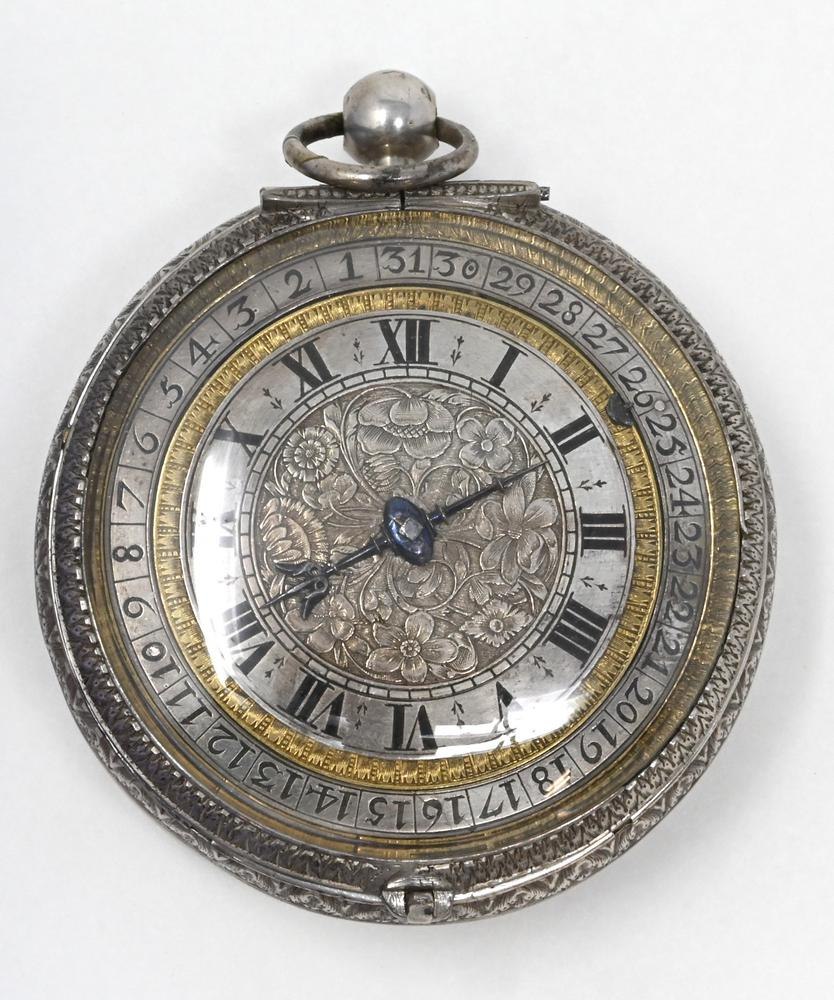
This mid-seventeenth-century silver-cased verge pocket watch with date indicator is attributed by the source to maker Benjamin Lisle in Rotterdam, dated circa 1645 to 1655. The dial features a pinned-on blued-steel hand, an engraved central floral composition, and a silver chapter ring marked with Roman numerals and foliate half-hour divisions. An outer silver ring calibrated 1 to 31 indicates the date via a revolving gilt-brass ring bearing a steel pointer. According to museum documentation, the pre-balance spring movement possesses gilt-brass plates with pierced Egyptian pillars, a fusee with chain, and a 30-hour duration, housed within an engraved silver case depicting the surrender of a town or city.

Dial view of the silver-cased verge calendar watch showing Roman numeral chapter ring, central floral engraving, and outer 1-31 date ring
Dial view of the silver-cased verge calendar watch showing Roman numeral chapter ring, central floral engraving, and outer 1-31 date ring — British Museum. Rights pending — permission not yet requested. Original source

Catalogue identity

Source
www.britishmuseum.org
Category
Pocket watch · Verge calendar watch
Maker / attribution
Benjamin Lisle
Reference
Not recorded
Catalogue / lot identifier
1888,1201.212
Source-reported date
1645-1655
Country
Netherlands

Source-reported attribution and specifications are not independent authentication. A listing does not establish present ownership, current display, availability or permission to reproduce.

Object description

Construction and Case Features

This silver-cased watch measures 50.30 mm in diameter and 22.20 mm in thickness. The case features an integral back and a hinged, glazed bezel, with both the band and bezel decorated by engraved gadroon borders. The case back is engraved with a depiction of a town or city surrender.

The case closure does not utilize a standard catch, instead employing a brass stud at the VI position to facilitate lifting the dial and movement. The silver pendant includes a loose ring and features an indistinct punch-mark.

Evidence for this section
  • “Silver case with integral back and hinged, glazed bezel.”
  • “The band and bezel engraved with gadroon borders. The main back is engraved with a scene showing the surrender of a town or city.”
  • “Diameter: 50.30 millimetres (case)”
  • “Thickness: 22.20 millimetres”
  • “There is no case catch. Only a brass stud at VI for lifting the dial and movement.”
  • “Silver pendant with loose ring, the pendant marked with an indistinct punch-mark.”

Dial and Calendar Mechanism

The dial consists of a gilt-brass plate with a riveted silver dial displaying Roman numerals I-XII and foliate half-hour marks. The central area is engraved with a realistic floral design, and the time is indicated by a single pinned-on blued-steel hand.

A calendar function is provided by an outer hatched border containing a riveted silver ring engraved 1-31. A revolving gilt-brass ring, also featuring hatched decoration and a steel pointer, indicates the date.

Evidence for this section
  • “Riveted silver dial with Roman hours I-XII and foliate half-hour marks”
  • “In the middle the dial is engraved with a design of realistic flowers.”
  • “Single pinned-on blued-steel hand.”
  • “Within an outer hatched border, a riveted silver ring is engraved 1-31 for the date. Within this a revolving gilt-brass ring, with hatched decoration and a steel pointer, shows the date.”

Movement and Technical Observations

The movement features circular gilt-brass plates and four pierced Egyptian pillars. It is a 30-hour duration, pre-balance spring verge watch. The escapement has been modified, with the crown wheel arbor shortened to run in a long plug within the counter-potence; both the verge and balance are identified as likely replacements.

The gear train shows evidence of non-original components. The second and contrate wheels are noted as potentially replaced; specifically, the contrate wheel has been dished to mesh with the crown wheel pinion, and the second wheel is positioned out of upright to mesh with the great wheel.

Evidence for this section
  • “Circular gilt-brass plates with four pierced Egyptian pillars.”
  • “Escapement pre-balance spring verge”
  • “the crown wheel arbor shortened and running in a later, very long plug in the counter-potence. Verge and balance probably replaced.”
  • “the second and contrate wheels possibly not original. The contrate has been dished to mesh with the crown wheel pinion and the second wheel is planted out of upright to mesh with the great wheel.”

Open research questions

  • What is the significance of the indistinct punch-mark found on the silver pendant?
  • Does the surrender scene on the case back confirm a specific regional provenance for the case manufacture?

Source evidence

Recorded claims and source quotations for Benjamin Lisle silver-cased verge calendar watch
FieldSource-reported valueSource quotation
MakerBenjamin Lisle“Made by: Benjamin Lisle”
Production PlaceRotterdam“Made in: Rotterdam”
Production Date1645-1655“Production date 1645-1655”
EscapementPre-balance spring verge“Escapement pre-balance spring verge”
Case Diameter50.30 mm“Diameter: 50.30 millimetres (case)”
Case Thickness22.20 mm“Thickness: 22.20 millimetres”
MakerBenjamin Lisle“Made by: Benjamin Lisle”
Production PlaceRotterdam“Made in: Rotterdam”
Production Date1645-1655“Production date 1645-1655”

Visible details

  • Silver chapter ring marked with black Roman hour numerals and foliate half-hour divisions
  • Engraved floral scene filling the central portion of the dial
  • Outer perimeter calendar track calibrated with numerals 1 through 31
  • Revolving gilt-brass ring with textured border and a small steel indicator pointing to the outer calendar track
  • Hinged silver case bezel with gadrooned patterning and pendant ring at the top

Research qualifications

  • Movement condition is not visible in the provided image; the source notes the second and contrate wheels are possibly not original, with the contrate dished and the second wheel planted out of upright
  • The verge and balance are recorded by the museum as probably replaced
  • The engraved case back depicting the surrender scene is described in source text but not visible in the provided dial view

Photograph identity and source facts were screened before import; rights clearance remains pending.

Consulted source

calendar watch; watch-case | British Museum

Reviewed 2026-10-25 · Record e17e506932

Terms in this record

Glossary explanations for terms named in this object’s record.