
Skip to content
The Encyclopedia of Horology

Tool · Augsburg astronomical compendium

Astronomical Compendium by Christoph Schissler

Partially verified

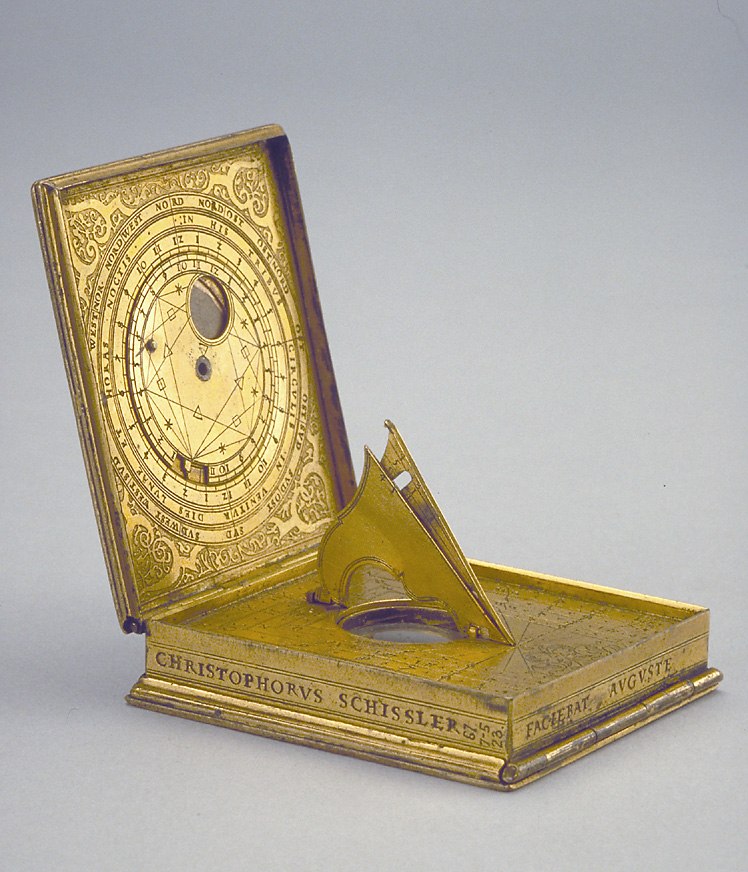
This gilt brass astronomical compendium, measuring 60 x 66 x 14 mm, was produced in 1563 by the instrument maker Christoph Schissler in Augsburg. The object is a multi-functional timekeeping and navigational instrument featuring a folding construction. It incorporates a nocturnal, a perpetual calendar, solar and lunar hour dials, and a polar gnomon horizontal dial capable of adjustment for latitudes 45, 48, 51, and 54 degrees. The interior contains a compass and a rotating degree-scaled arm, while other surfaces are engraved with a list of 32 European cities and their respective latitudes, zodiac signs, and conversion tables for unequal and common hours. The instrument is densely decorated with engraved strapwork and foliage in the spandrel areas. The signature of the maker is prominently inscribed on the exterior edge of the box. The item is part of the collection held at the British Museum.

Side view of the astronomical compendium showing the open leaves and the adjustable polar gnomon.
Side view of the astronomical compendium showing the open leaves and the adjustable polar gnomon. — © British Museum, London. Rights pending — permission not yet requested. Original source

Catalogue identity

Source
www.mhs.ox.ac.uk
Category
Tool · Augsburg astronomical compendium
Maker / attribution
Christoph Schissler
Reference
MLA 1867, 7-5.23
Catalogue / lot identifier
MLA 1867, 7-5.23
Source-reported date
1563
Source-reported place
Germany

Source-reported attribution and specifications are not independent authentication. A listing does not establish present ownership, current display, availability or permission to reproduce.

Object description

Case and External Features

The compendium is constructed from gilt brass, with dimensions of 60 x 66 x 14 mm. The exterior of the upper leaf features a nocturnal and a perpetual calendar surrounding a rotating volvelle, with month names inscribed in Latin. The edges of the box carry the signature and date of the maker, Christoph Schissler, identifying the place of manufacture as Augsburg.

The instrument includes complex engravings of strapwork and foliage that fill the spandrel spaces. Certain elements, such as the arm for the nocturnal and a central vane, are noted as missing from the object in its current state.

Evidence for this section
  • “Gilt brass; 60 x 66 x 14 mm”
  • “The outer side of the upper leaf has a nocturnal (missing the arm)”
  • “On the sides of the box is the signature and date 'CHRISTOPHORVS SCHISSLER FACIEBAT AVGVSTE VINDELICORVM ANNO DOMINI ? 15 ? 63 ?'.”

Dials and Astronomical Functions

The interior of the main box houses a horizontal dial with a polar gnomon, featuring a sliding edge that permits adjustment for four distinct latitudes: 45, 48, 51, and 54 degrees. The dial includes standard hour markings alongside additional lines for specific latitude-based timekeeping.

The inside of the upper leaf contains a pierced volvelle with an aspectarium, engraved with lunar and solar hours. A list of 32 cities, including locations such as Amsterdam, Antwerp, and Vienna, is engraved with corresponding latitudes on the base plate. A compass is integrated into the second leaf, surrounded by a rotating arm on a degree scale.

Evidence for this section
  • “The inside of the main box has a polar gnomon horizontal dial”
  • “The edge of the style of the gnomon is sliding and can be adjusted for the above mentioned latitudes.”
  • “The other side of the plate in the main box is engraved with a list of 32 cities and latitudes”

Provenance and Documentation

The object is part of the collection of the British Museum, London, assigned registration number MLA 1867, 7-5.23. The instrument was presented to the museum by A.W. Franks in 1867.

It is documented in academic literature regarding European scientific instruments, specifically appearing in the catalogue compiled by F. A. B. Ward.

Evidence for this section
  • “The instrument was presented by A.W. Franks in 1867”
  • “Registration no. MLA 1867, 7-5.23”
  • “described in F. A. B. Ward, A Catalogue of European Scientific Instruments in the Department of Medieval and Later Antiquities of the British Museum (London, 1981), p. 121, no.349.”

Open research questions

  • What was the original intended function of the missing nocturnal arm?
  • How was the specific order of the 32 cities listed on the plate determined?

Source evidence

Recorded claims and source quotations for Astronomical Compendium by Christoph Schissler
FieldSource-reported valueSource quotation
MakerChristoph Schissler“Signed by Christoph Schissler”
Date1563“Dated 1563”
LocationAugsburg“Augsburg”
MaterialGilt brass“Gilt brass”
Dimensions60 x 66 x 14 mm“60 x 66 x 14 mm”
Registration NumberMLA 1867, 7-5.23“MLA 1867, 7-5.23”
SignatureCHRISTOPHORVS SCHISSLER FACIEBAT AVGVSTE VINDELICORVM ANNO DOMINI 1563“CHRISTOPHORVS SCHISSLER FACIEBAT AVGVSTE VINDELICORVM ANNO DOMINI ? 15 ? 63 ?”

Visible details

  • Engraved strapwork and foliage motifs in spandrels
  • Folding polar gnomon with adjustable style
  • Signature and date inscribed on the box side
  • Compass set into the base plate

Research qualifications

  • Nocturnal arm is missing
  • Vane for the central hole is missing
  • Volvelle and arm on the leaf underside are missing

Photograph identity and source facts were screened before import; rights clearance remains pending.

Consulted source

Astronomical Compendium

Reviewed 2026-10-26 · Record 18f6da729d

Terms in this record

Glossary explanations for terms named in this object’s record.