Instrument Construction and Exterior
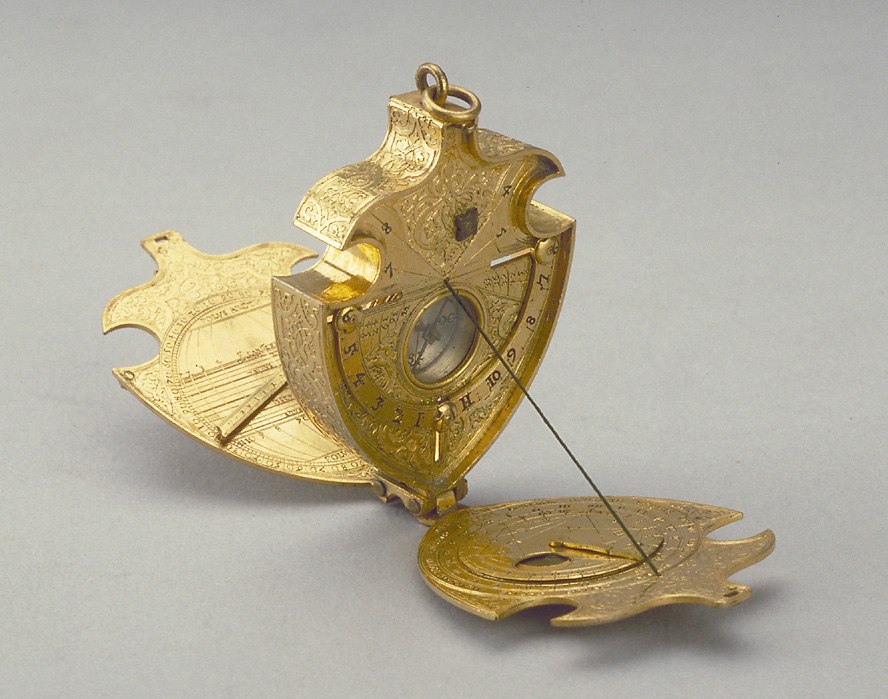
The compendium is constructed of gilt brass and possesses a distinctive spade shape. It is designed with multiple folding leaves to accommodate various astronomical functions and is secured by catches on both lids. The exterior surfaces, including the limb, are decorated with elaborate engraved strapwork and foliage. The instrument is intended for portability, evidenced by a ring mounted on the top for suspension and three bun feet that provide stability when placed on a flat surface.
The upper leaf exterior houses a nocturnal with a calendar scale on the limb, featuring month names in Latin. Although the nocturnal arm is currently detached, it remains part of the assembly and is engraved with the text 'REGVLA NOCTIS'. The lower lid exterior incorporates a complex volvelle for planetary hour conversion, featuring concentric rings for both planetary and common hours, along with a secondary calendar scale.
Evidence for these features is derived from the item description, which notes the nocturnal function, the engraved decorations, and the specific mechanism for closure and suspension. The physical dimensions are also recorded.
Evidence for this section
- “The outside of the upper leaf of this brass spade shaped compendium has a nocturnal”
- “The instrument rests on three bun feet, and a catch on both lids keeps them closed when not in use.”
- “The limb of the compendium is decorated with strapwork and foliate motive as the rest of the instrument. On the top is a ring for suspension.”
Internal Astronomical Functions
The internal mechanisms are varied and complex. The inside of the upper leaf features a rotating pierced volvelle and aspectarium with arms designed to convert lunar and solar hours. This section is framed by a list of the twelve primary winds, labeled in Latin. The box section contains a compass with cardinal points abbreviated in Latin, and a string gnomon dial. The hour lines for this dial are positioned on two curved bands that slide within grooves, enabling the user to set the instrument for specific latitudes ranging from 33 to 57 degrees.
The inside of the lower lid displays a Rojas projection of the sphere. This section includes a degree scale divided into four quadrants, with poles and zodiacal signs clearly indicated. An alidade, engraved with the text 'LINAE FIDUTZIAE', is present for taking measurements. The central section also houses the mechanism for securing the string gnomon, reflecting the integrated nature of the device's design.
All internal engravings and markings serve specific astronomical or timekeeping purposes, as described in the catalogue record.
Evidence for this section
- “The dial can be adjusted for latitude with a very ingenious device, consisting of two curved bands sliding in grooves; a very unusual, if not unique, design.”
- “The inside of the opposite lid has a Rojas projection of the sphere.”
- “The inside of the box has a compass with the cardinal points abbreviated 'SE', 'OR', 'ME', 'OC', and a string gnomon dial”
Provenance and Documentation
The compendium is documented in the British Museum's collection under the registration number MLA 1855, 12-1.227. Its historical ownership is confirmed by its presence in the Bernal Collection prior to its acquisition by the museum in 1855. The object is also referenced in academic literature regarding European scientific instruments.
The object is compared to another similar compendium within the same collection, identified as Epact 73378. These records serve as the primary source for the object's classification, dating, and attribution to the maker Christoph Schissler, though the source includes qualifiers regarding the dating and the attribution.
Evidence for this section
- “The instrument was purchased in 1855 and was formerly in the Bernal Collection.”
- “It is described in F. A. B. Ward, A Catalogue of European Scientific Instruments in the Department of Medieval and Later Antiquities of the British Museum (London, 1981), p.122, no. 353.”
- “It is very similar to another compendium in the collection of the British Museum: Epact 73378.”