
Skip to content
The Encyclopedia of Horology

Tool · Augsburg astronomical compendium

Astronomical Compendium

Partially verified

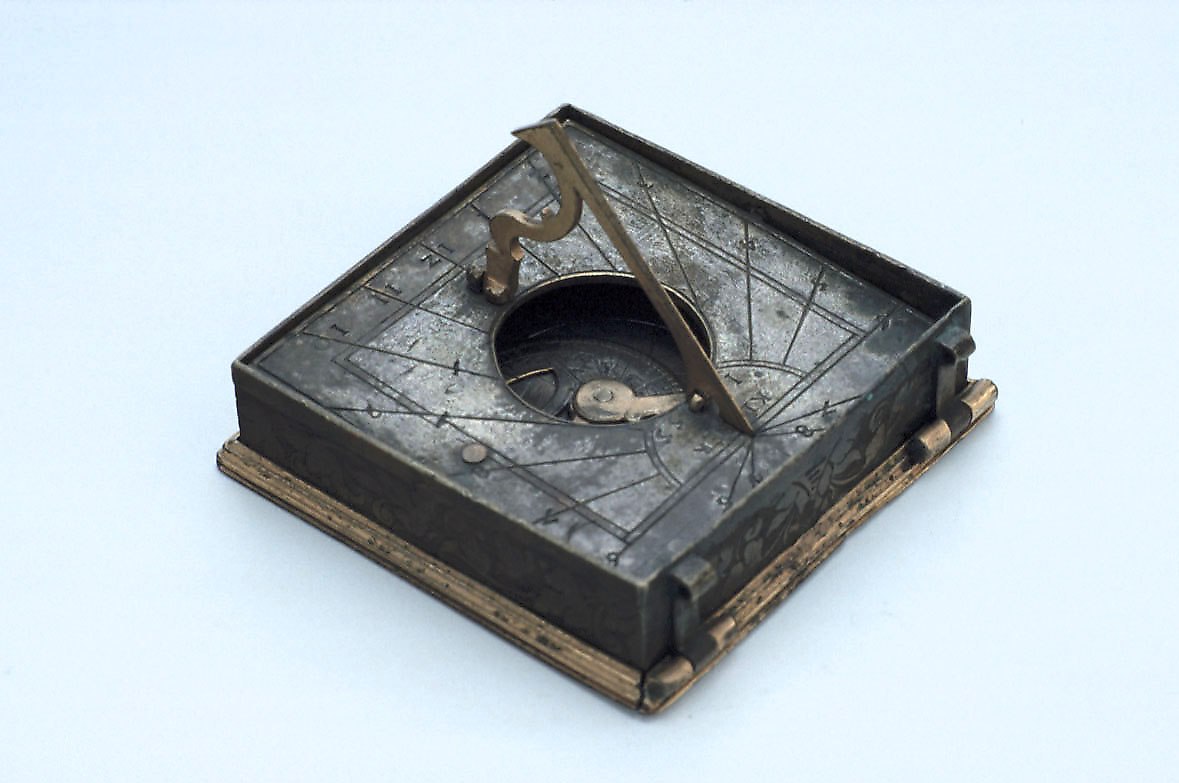
This astronomical compendium is an instrument signed by Ulrich Klieber and dated 1555. Constructed of gilt and silvered brass, it measures 59 x 59 x 15 mm and was produced in Augsburg. The object is square in section and was originally designed with two folding cover leaves to enclose the central box, though one cover is currently lost. The central section includes an inclining sundial with a folding gnomon, adjustable for latitudes between 35 and 55 degrees. A silvered hour plate features a central circular hole that formerly housed a compass. The instrument includes a lunar volvelle, an aspectarium, and a table of latitudes for 28 locations. Additionally, the set is accompanied by a loose plate containing a simplified astrolabe. The instrument is signed in two locations, including a signature on the sundial plate and a longer inscription on the table of latitudes.

The central section of the astronomical compendium, showing the sundial and folding gnomon.
The central section of the astronomical compendium, showing the sundial and folding gnomon. — Museum of the History of Science, Oxford. Rights pending — permission not yet requested. Original source

Catalogue identity

Source
www.mhs.ox.ac.uk
Category
Tool · Augsburg astronomical compendium
Maker / attribution
Ulrich Klieber
Reference
Not recorded
Catalogue / lot identifier
54402
Source-reported date
1555
Source-reported place
Germany

Source-reported attribution and specifications are not independent authentication. A listing does not establish present ownership, current display, availability or permission to reproduce.

Object description

Construction and Design

The astronomical compendium is a square-sectioned instrument manufactured from gilt and silvered brass. Measuring 59 x 59 x 15 mm, the device was originally intended to feature two folding cover leaves, though the upper cover has been lost. The exterior sides of the central box are decorated with foliate engraving.

The central portion of the instrument houses an inclining sundial equipped with a folding gnomon. The dial is adjustable for latitudes between 35 and 55 degrees at 2-degree intervals. The silvered hour plate features a central circular aperture with a diameter of 22 mm, which previously held a compass. Beneath the hour plate, there is a compass and wind rose containing the eight principal directions and wind names in German.

Evidence for this section
  • “The compendium is square in section and would originally have comprised two hinged leaves acting as covers for a central portion.”
  • “The central box has foliate engraving on its outer sides and holds an inclining dial, with folding gnomon.”
  • “The underside of the hour plate has a compass and wind rose with the 8 principal directions and winds named in German.”

Signatures and Inscriptions

Ulrich Klieber, a maker based in Augsburg, signed the instrument in two distinct locations. The first signature, reading 'KLEBER 1555', is positioned around the origin point of the gnomon on the sundial plate. A second, more detailed signature is located on the table of latitudes, which lists 28 places.

A notable detail of the engraving is the reversal of the letter 'N' throughout the instrument's inscriptions. The signature on the table of latitudes reads 'GEMACHT . ULRICH KLIBER . ZVO . AVGSPVRG . HAT 48 . GRAT'. This plate is further embellished with foliate engraving surrounding the text.

Evidence for this section
  • “Ulrich Klieber is a well-known Augsburg maker and the instrument is signed by him in two places”
  • “One striking feature of the lettering is that each 'N' on the instrument is reversed.”
  • “'GEMACHT . ULRICH KLIBER . ZVO . AVGSPVRG . HAT 48 . GRAT'.”

Components and Auxiliary Features

The inner face of the lower cover contains a lunar volvelle and an aspectarium. The volvelle includes a fixed outer scale of hours and an aperture displaying the age of the moon, labeled 'DIES ETATIS LVNAE'. The aspectarium features polygons and symbols for trine, quadrature, and sextile aspects.

The instrument is accompanied by a loose plate acting as a simplified astrolabe. This plate features a projection of the equator and two tropics, with unequal hour lines representing the twelve astrological houses. The rete is limited to an ecliptic circle divided into zodiac symbols, and the center is fitted with two pivoting index rules with solar and lunar symbols.

Evidence for this section
  • “The inner face of the lower cover carries a lunar volvelle and aspectarium.”
  • “The instrument also has a loose plate with a simple astrolabe.”
  • “The rete consists only of the ecliptic circle in which each zodiac sign is represented by its symbol”

Open research questions

  • What is the specific historical significance of the reversed 'N' in Klieber's workshop practice?
  • Are there extant compendia by Klieber that retain the original, missing top cover for comparison?

Source evidence

Recorded claims and source quotations for Astronomical Compendium
FieldSource-reported valueSource quotation
MakerUlrich Klieber“Signed by Ulrich Klieber”
Date1555“Dated 1555”
LocationAugsburg“Augsburg”
Dimensions59 x 59 x 15 mm“59 x 59 x 15 mm”
MaterialGilt and silvered brass“Gilt and silvered brass”
SignatureKLEBER 1555“'KLEBER 1555'”
ProvenanceLewis Evans Collection“Provenance: Lewis Evans Collection G. 186”

Visible details

  • Foliate engraving on outer sides of the central box
  • Folding gnomon with a distinct cutout profile
  • Numbered hour scale on the silvered dial plate
  • Visible hinge mechanism for a missing cover

Research qualifications

  • One of the two original folding covers is missing
  • The compass originally located in the central box is missing

Photograph identity and source facts were screened before import; rights clearance remains pending.

Consulted source

Astronomical Compendium

Reviewed 2026-10-26 · Record 0a7c4f1a30

Terms in this record

Glossary explanations for terms named in this object’s record.