
Skip to content
The Encyclopedia of Horology

Tool · Augsburg astronomical compendium

Astronomical Compendium by Christoph Schissler

Partially verified

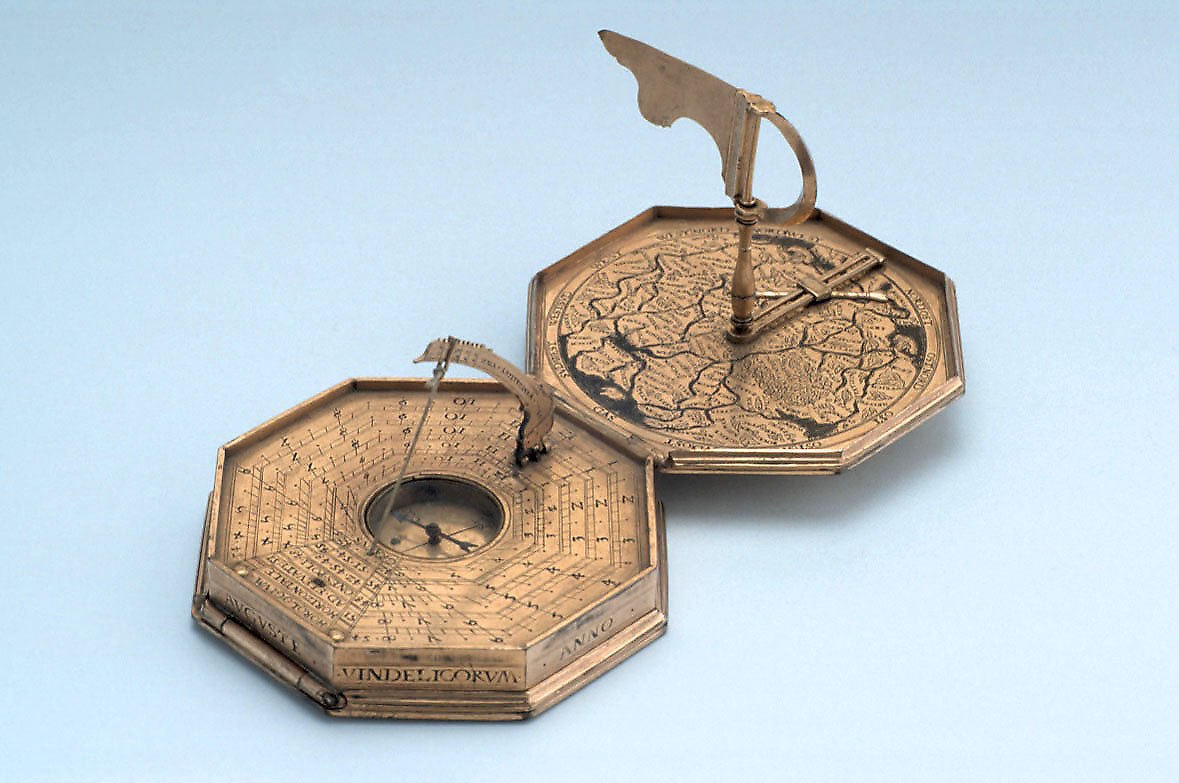
This octagonal gilt brass astronomical compendium, measuring 84 mm in maximum diameter, was signed and dated by Christoph Schissler in Augsburg in 1557. The device consists of a central box with two hinged covers, featuring an extensive array of astronomical and cartographic functions. These include a horizontal string-gnomon sundial, a lunar volvelle, a nocturnal, an orthographic projection of the sphere, a geographical astrolabe, and a map of central Europe. The instrument contains a central compass bowl and a catgut string gnomon tensioned by an internal watch spring. The object remains in the collection of the Museum of the History of Science, Oxford, where it is catalogued under inventory number 36175.

The internal layout of the Schissler astronomical compendium showing the horizontal string-gnomon dial with compass and the interior map of central Europe.
The internal layout of the Schissler astronomical compendium showing the horizontal string-gnomon dial with compass and the interior map of central Europe. — Museum of the History of Science, Oxford. Rights pending — permission not yet requested. Original source

Catalogue identity

Source
www.mhs.ox.ac.uk
Category
Tool · Augsburg astronomical compendium
Maker / attribution
Christoph Schissler
Reference
Not recorded
Catalogue / lot identifier
36175
Source-reported date
1557
Source-reported place
Augsburg

Source-reported attribution and specifications are not independent authentication. A listing does not establish present ownership, current display, availability or permission to reproduce.

Object description

Construction and Design

The compendium is constructed from gilt brass in an octagonal form, designed with a central box flanked by two hinged covers. The overall diameter reaches 84 mm, with a closed depth of 15 mm. The exterior sides of the central box feature the maker's signature and date in a double-lined border, confirming its creation in 1557 by Christoph Schissler in Augsburg.

The internal layout incorporates a complex arrangement of instruments. The dial plate features a horizontal string-gnomon sundial equipped with a catgut string maintained under tension by a barrel-mounted watch spring. A folding arc marked 'SCALA LATITVDINVM POLI' allows for latitude adjustment between 42 and 54 degrees. A compass, 22 mm in diameter, is recessed in the center of this plate, with its base decorated by a profiled warrior head.

Evidence for this section
  • “An octagonal compendium with two hinged covers attached at opposite edges of a central box.”
  • “The instrument is signed '.CHRISTOPHORVS. .SCHISSLER. .ME . FECIT. .AVGVSTE. .VINDELICORVM. .ANNO. .DOMINI. .15.57.'”
  • “In the centre of the dial plate is the compass (diameter of bowl 22 mm).”
  • “The 'string' gnomon is a piece of catgut, threaded through the plate and wound round a barrel on the underside.”

Astronomical and Cartographic Features

The device functions as a multi-purpose tool, combining timekeeping with cartography. The outer face of the top cover displays a geographical astrolabe, featuring a longitude scale and a polar projection of the earth to the Tropic of Capricorn. The interior of this cover contains an engraved map of central Europe, oriented by a series of wind directions and a radial index for town bearings.

The inside back cover houses a lunar volvelle with multiple hour scales and an aspectarium. This component allows for the correlation of moon age, moon phases, and the duration of day and night. Additionally, the exterior back cover is dedicated to a nocturnal and an orthographic projection of the celestial sphere, which serves to determine sunrise and sunset times throughout the year.

Evidence for this section
  • “The outer face of the top cover carries a geographical astrolabe.”
  • “The reverse of the cover carries an engraved map of central Europe surrounded by an equally divided ring of 12 winds”
  • “In the centre of the inside back cover is a lunar volvelle with a double scale of hours”
  • “The back cover carries a nocturnal combined with an orthographic projection of the celestial sphere.”

Provenance and Observations

The object is held within the Museum of the History of Science, Oxford, identified by inventory number 36175. The instrument is documented as having features consistent with other works by Schissler, though specific modifications and additions are noted. A hole in the center of the map appears designed to house a wind vane, though the source suggests this might be a replacement component borrowed from another source.

The lettering 'LINEA FIDUCIAE' on the geographical astrolabe is identified as a potential later addition. Furthermore, an inscription, 'W Burg', is noted as a scratch located on the underside of the compass bowl, though its relationship to the origin or history of the piece remains unconfirmed by the museum documentation.

Evidence for this section
  • “A central hole permits the insertion of a wind vane which, as it is too large to be comfortably housed in the body of the instrument, was perhaps borrowed from elsewhere as a replacement.”
  • “Above the rete is an index marked 'LINEA FIDUCIAE'; the lettering appears to be a later addition.”
  • “A name, perhaps 'W Burg', has been scratched beside the head.”

Open research questions

  • What is the historical significance of the 'W Burg' inscription found on the compass bowl?
  • Is the wind vane a period-appropriate replacement, or does it originate from a different type of instrument entirely?

Source evidence

Recorded claims and source quotations for Astronomical Compendium by Christoph Schissler
FieldSource-reported valueSource quotation
MakerChristoph Schissler“Signed by Christoph Schissler”
Date1557“Dated 1557; Augsburg”
MaterialGilt brass“Gilt brass; 84 mm in diameter (maximum)”
Inventory number36175“Inventory number 36175”
SignedCHRISTOPHORVS SCHISSLER ME FECIT AVGVSTE VINDELICORVM ANNO DOMINI 1557“.CHRISTOPHORVS. .SCHISSLER. .ME . FECIT. .AVGVSTE. .VINDELICORVM. .ANNO. .DOMINI. .15.57.”
Dial capacity42 to 54 degrees“horizontal string-gnomon dial adjustable for latitudes in the range 42 to 54?.”

Visible details

  • Octagonal gilt brass casing with a depth of 15 mm when closed.
  • Central compass bowl with a diameter of 22 mm displaying cardinal directions.
  • Integrated horizontal string-gnomon sundial featuring adjustable latitude scales.
  • Engraved map of central Europe on the interior of the top cover with a radial index.

Research qualifications

  • The wind vane central hole may be a later addition or a replacement component not original to the instrument.
  • The inscription 'LINEA FIDUCIAE' on the geographical plate appears to be a later addition.
  • A scratched name 'W Burg' on the base of the compass bowl remains unidentified.

Photograph identity and source facts were screened before import; rights clearance remains pending.

Consulted source

Astronomical Compendium

Reviewed 2026-10-26 · Record 13fa3f8724

Terms in this record

Glossary explanations for terms named in this object’s record.