
Skip to content
The Encyclopedia of Horology

Tool · Augsburg astronomical compendium

Astronomical Compendium

Partially verified

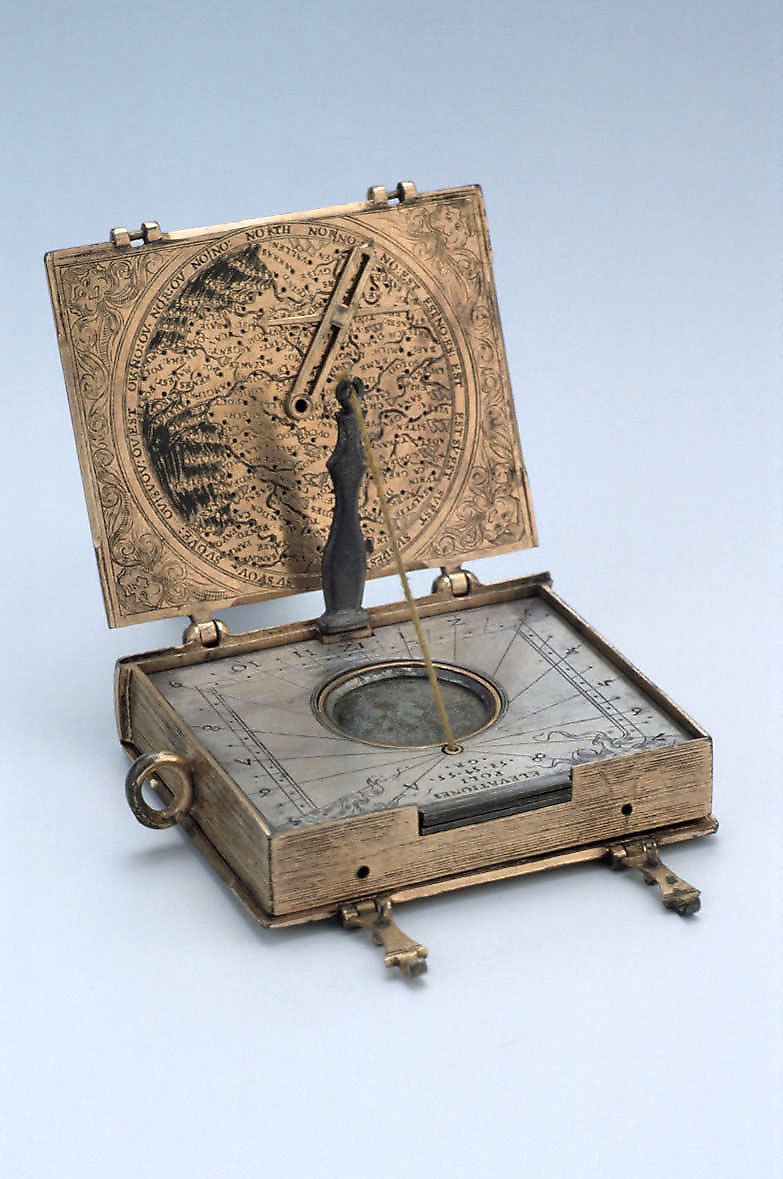
This astronomical compendium is constructed from gilt brass and silver in the form of a small book measuring 62 x 56 x 14 mm. It features a curved spine with decorative projections, book clasps, and engraved edge lines simulating pages. Attributed to Christoph Schissler, the instrument functions as an integrated set of scientific tools. The exterior top cover contains a geographical astrolabe with a rete and rotating longitude plate. The interior features a horizontal string-gnomon sundial equipped with three interchangeable silver plates for varying latitudes and a recessed compass. The underside of the cover includes a map of France surrounded by a 16-point compass rose, while the inner back cover displays a lunar volvelle for tracking moon phases and aspects. The exterior back cover features an orthographic Rojas projection of the sphere, enabling calculations for sunrise, sunset, dawn, and twilight.

The astronomical compendium shown open, displaying the sundial and the map on the inside of the top cover.
The astronomical compendium shown open, displaying the sundial and the map on the inside of the top cover. — Museum of the History of Science, Oxford. Rights pending — permission not yet requested. Original source

Catalogue identity

Source
www.mhs.ox.ac.uk
Category
Tool · Augsburg astronomical compendium
Maker / attribution
Attributed to Christoph Schissler
Reference
Not recorded
Catalogue / lot identifier
45366
Source-reported date
Later 16th century
Source-reported place
Augsburg

Source-reported attribution and specifications are not independent authentication. A listing does not establish present ownership, current display, availability or permission to reproduce.

Object description

Design and Construction

The object is crafted in the shape of a book, utilizing gilt brass and silver. The case incorporates a curved spine with two projections, and the edges of the central box are engraved to resemble page leaves. Two book clasps maintain the closed position, and a fixed ring is provided for suspension.

The interior layout is segmented into distinct working areas, including a horizontal sundial with interchangeable latitude plates, a compass with a silvered base plate, and a lunar volvelle. Foliate engraving decorates the various surfaces, and specific mechanical features include an integrated spring barrel to maintain tension on the sundial string.

Evidence for this section
  • “The compendium is in the form of a book, with two covers and a central box.”
  • “The spine is suitably curved and bears two projections representing the bindings”
  • “The surfaces are decorated with foliage engraving and there is a cockerel in the middle of the base of the compass bowl.”

Geographical and Astronomical Functions

The outer cover acts as a geographical astrolabe with a rete and a longitude scale for the earth. The geographical map, centered on France, uses circular indentations to represent towns and includes a radial index with a sliding cursor.

The Rojas projection on the back cover allows for complex calculations regarding solar events. It provides data for sunrise, sunset, dawn, and twilight. The lunar volvelle on the interior displays moon phases, lunar age, and aspect diagrams involving geometric symbols.

Evidence for this section
  • “The outer face of the top cover carries a geographical astrolabe.”
  • “The reverse carries a map surrounded by a circular compass rose marked in French for 16 directions”
  • “The back cover has an orthographic ('Rojas') projection of the sphere”
  • “The inner face of the back cover carries a lunar volvelle.”

Compass and Sundial Components

The central sundial utilizes three loose silver plates, each covering a three-degree latitude range between 38 and 55 degrees. The string gnomon passes through a small cylinder and is held taut by a spring barrel located underneath the plate.

The 18 mm diameter compass is viewed through circular apertures in the sundial plates. It is decorated with enamel-colored pointers and is marked in abbreviated French. The north needle ends in a T-shape, and the compass bowl base features an engraved cockerel.

Evidence for this section
  • “The central box holds a horizontal string-gnomon sundial adjustable for latitude in the range 38 to 55?.”
  • “The plates are all pierced with a circular aperture through which the compass is viewed.”
  • “The compass bowl is 18 mm in diameter and the silvered base plate has a direction cross marked 'SE', 'ORT', 'ME', 'OCC'.”

Open research questions

  • What is the specific historical significance of the French-focused map in an Augsburg-made instrument?
  • Did the detached index originally contain a missing part that would have allowed for more precise latitude readings?

Source evidence

Recorded claims and source quotations for Astronomical Compendium
FieldSource-reported valueSource quotation
Inventory Number45366“Inventory number: 45366”
Dimensions62 x 56 x 14 mm“62 x 56 x 14 mm”
MaterialsGilt brass and silver“Gilt brass and silver”
Place of OriginAugsburg“Augsburg”
Maker AttributionChristoph Schissler“attributed to Christoph Schissler”
Compass Directions16 directions“compass rose marked in French for 16 directions”
Sundial Latitude Range38 to 55 degrees“adjustable for latitude in the range 38 to 55?.”

Visible details

  • The book-shaped case features two functional metal clasps.
  • A fixed suspension ring is mounted on the upper edge of the device.
  • The compass needle terminates in a T-shape at the north point.
  • The sundial uses a string gnomon held by a central support.

Research qualifications

  • The string-gnomon support is considered a possible replacement.
  • The index for the geographical astrolabe is detached.

Photograph identity and source facts were screened before import; rights clearance remains pending.

Consulted source

Astronomical Compendium

Reviewed 2026-10-26 · Record 86af0ae4c9

Terms in this record

Glossary explanations for terms named in this object’s record.