
Skip to content
The Encyclopedia of Horology

Tool · Augsburg astronomical compendium

Astronomical Compendium

Partially verified

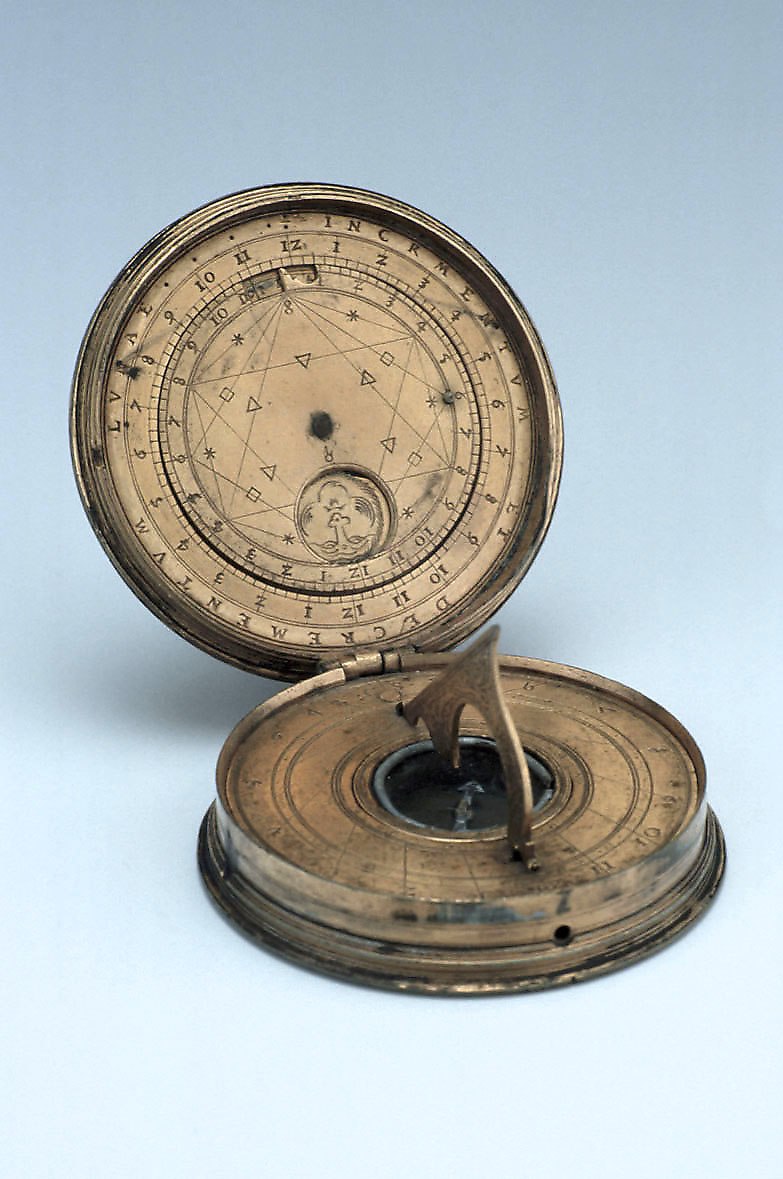
This circular astronomical compendium, measuring 66 mm in diameter, is constructed of gilt brass and signed with the initials 'C. S.', which are attributed to the Augsburg maker Christoph Schissler. The compendium functions as an inclining sundial and includes a lunar volvelle, a planetary hour conversion volvelle, and a compass. The base, gnomon, and reverse of the dial plate feature acid-etched strapwork and foliage ornament. The instrument includes a folding gnomon and a central compass bowl marked with cardinal points and a wind rose. A folding latitude scale that originally accompanied the device is now missing, although its reconstructed range has been estimated at 43 to 60 degrees. The device is part of the collection of the Museum of the History of Science, Oxford, and features a variety of scales for calculating planetary, Italian, and common hours, as well as lunar phases and astrological information.

Astronomical compendium, signed C.S. (Christoph Schissler), Augsburg, later 16th century, shown open to reveal the dial and lunar volvelle.
Astronomical compendium, signed C.S. (Christoph Schissler), Augsburg, later 16th century, shown open to reveal the dial and lunar volvelle. — Museum of the History of Science, Oxford. Rights pending — permission not yet requested. Original source

Catalogue identity

Source
www.mhs.ox.ac.uk
Category
Tool · Augsburg astronomical compendium
Maker / attribution
Christoph Schissler
Reference
Not recorded
Catalogue / lot identifier
55301
Source-reported date
Later 16th century
Source-reported place
Germany

Source-reported attribution and specifications are not independent authentication. A listing does not establish present ownership, current display, availability or permission to reproduce.

Object description

Construction and Design

The astronomical compendium is a circular gilt brass instrument measuring 66 mm in diameter, comprising a box, a cover, and a hinged ring leaf. The base and gnomon are decorated with acid-etched strapwork and foliage. Inside the box, a compass with a 22 mm diameter bowl is fixed, featuring a wind rose with pointers identifying eight cardinal directions in Italian, with additional subdivisions.

The primary timekeeping element is an inclining sundial equipped with a folding gnomon. The dial plate, which includes a circular aperture for the compass, originally functioned with a folding latitude scale; however, this component is currently missing.

Evidence for this section
  • “Gilt brass; 66 mm in diameter”
  • “The base, gnomon and reverse of the dial plate carry acid-etched decoration of strapwork and foliage.”
  • “The folding latitude scale used to elevate the dial plate is now missing.”
  • “The compass bowl has an external diameter of 22 mm and is fixed in the base of the box compartment, surrounded by a wind rose with pointers to the Italian names of the eight winds.”

Astronomical and Astrological Functions

The cover of the compendium serves as a multifunctional plate. Its outer face features a volvelle for converting common, planetary, and Italian hours, utilizing a rotating index engraved with zodiac symbols. A central disc displays an astrological table determining planetary rule over the hours, arranged by the days of the week.

The reverse of the cover contains a lunar volvelle for tracking the age and phases of the moon. This component includes a circular aperture displaying a moon face and an engraved diagram of aspects, such as conjunction, opposition, and trine, to assist with astrological calculations. The internal dial plate is signed 'C S' in the night-time space.

Evidence for this section
  • “The outer face of the cover carries a volvelle for converting common hours into planetary (unequal) or Italian hours”
  • “The reverse of the cover carries a lunar volvelle.”
  • “At the centre of the rotating index is a circular disc engraved with an astrological table showing which planets rule the hours of the day.”
  • “The hour lines run 4 to 12 to 8 and in the night time space is the signature 'C S'.”

Provenance and Documentation

The compendium is held in the collection of the Museum of the History of Science, Oxford, under inventory number 55301. The instrument is attributed to the maker Christoph Schissler based on the initials 'C. S.' and consistent acid-etched decorative patterns found on his other known works.

A historical note included with the object documents a reconstruction of the missing latitude scale by collector Lewis Evans, providing evidence for the instrument's intended operational latitude range. This scrap of paper serves as primary documentation for the functional gaps and historical efforts to complete the device.

Evidence for this section
  • “Signed by Christoph Schissler”
  • “Although signed only with the initials 'C. S.', the instrument can be confidently attributed to Christoph Schissler”
  • “A folded scrap of paper kept in the box compartment records the collector Lewis Evans' reconstruction of this missing latitude scale”
  • “Holding museum: Museum of the History of Science, Oxford”

Open research questions

  • What is the specific provenance of the object prior to its entry into the Lewis Evans collection?
  • Are there remaining internal mechanisms under the dial plate that require further investigation?

Source evidence

Recorded claims and source quotations for Astronomical Compendium
FieldSource-reported valueSource quotation
MakerChristoph Schissler“Signed by Christoph Schissler”
DateLater 16th century“Later 16th century”
MaterialGilt brass“Gilt brass”
Diameter66 mm“66 mm in diameter”
Inventory Number55301“Inventory number: 55301”
Place of originAugsburg“Augsburg”
SignatureC S“the night time space is the signature 'C S'.”

Visible details

  • Acid-etched strapwork and foliage decoration on the dial plate
  • Folding gnomon with spring mechanism
  • Compass with wind rose and cardinal points
  • Integrated lunar volvelle with moon face aperture

Research qualifications

  • Original folding latitude scale is missing
  • Attribution to Christoph Schissler based on initials 'C.S.' and stylistic comparison

Photograph identity and source facts were screened before import; rights clearance remains pending.

Consulted source

Astronomical Compendium

Reviewed 2026-10-26 · Record afcf802710

Terms in this record

Glossary explanations for terms named in this object’s record.