
Skip to content
The Encyclopedia of Horology

Tool · German astronomical compendium

Astronomical Compendium

Partially verified

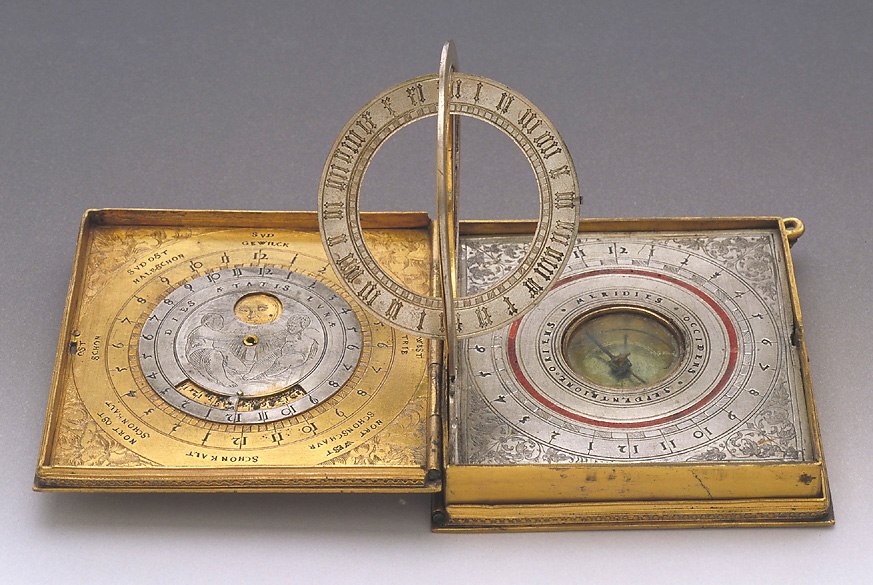
This 16th-century German astronomical compendium is constructed of gilt and silvered brass, measuring 90 x 90 mm when closed. The instrument features a box-like design with three primary compartments containing various horary and astronomical functions. Components include a stereographically projected astrolabe, a lunar calendar, a compass, a sundial, a time-calculating table, and a horary quadrant with a shadow square. The compendium is decorated with fine engraving, including figural representations, wind-rose motifs, cherub heads, and botanical forms. It features inscriptions in German and Latin, with planetary governors of the hours and zodiac scales. Formerly in the Medici collections, the instrument was documented in the 1595 wardrobe inventory of Grand Duke Ferdinand I. Its design and specific numeral punch styles suggest a relationship with other contemporary portable dials in the Florence collection, particularly those sharing identical figural depictions of seated figures.

The compendium in an open state, displaying the compass, lunar volvelle, and the raised equinoctial dial.
The compendium in an open state, displaying the compass, lunar volvelle, and the raised equinoctial dial. — Istituto e Museo di Storia della Scienza, Firenze. Rights pending — permission not yet requested. Original source

Catalogue identity

Source
www.mhs.ox.ac.uk
Category
Tool · German astronomical compendium
Maker / attribution
Not established
Reference
2478
Catalogue / lot identifier
2478
Source-reported date
16th century
Source-reported place
Germany

Source-reported attribution and specifications are not independent authentication. A listing does not establish present ownership, current display, availability or permission to reproduce.

Object description

Structural Composition

The astronomical compendium is designed as a box divided into three internal compartments, each dedicated to specific scientific functions. The exterior is crafted from gilt and silvered brass and measures 90 mm square. The instrument is highly complex, incorporating an astrolabe, lunar calendar, compass, and horary quadrant. A suspension ring is located at the apex to support the device when using the horary quadrant.

The faces are densely engraved with astronomical and decorative elements. Face Ia features a conversion diagram for hours and an ecliptic ring. Between faces Ib and IIa, an equinoctial dial is mounted, supported by a base of two monsters exhaling leaf forms. This dial is adjustable by a brass slip ring for use between 42 and 54 degrees latitude.

Evidence for this section
  • “This universal dial has the form of a box divided into three compartments.”
  • “Between faces Ib and IIa an equinoctial dial, which may be folded flat, is mounted on a base composed of two monsters belching forth leaf forms.”

Horary and Astronomical Functions

The instrument includes several specialized features for timekeeping and measurement. Face Ib contains a lunar volvelle for tracking the age and phase of the moon, alongside a 2 x 12 hour scale for lunar and solar time conversion. A compass is inset at Face IIa, surrounded by a ring filled with red paint and a division of 48 points.

Face IIIb presents a horary quadrant with a zodiac scale and a shadow square. This section features an engraving of a surveyor measuring a solar altitude. Below this, a table provides planetary governors for the hours of the day and night. The instrument includes inscriptions in both German and Latin.

Evidence for this section
  • “Within this is a lunar volvelle for the age and phase of the moon marked 'DIES ?TATIS LVN?'”
  • “Horary quadrant with undivided hours and zodiac scale with the signs named in German above a degree scale reading to 1? by alternating hatched and unhatched divisions numbered by groups of five.”

Provenance and Workshop Attribution

The compendium was documented in the 1595 inventory of the wardrobe of Grand Duke Ferdinand I de' Medici. Historical analysis identifies significant similarities between this piece and an inventory-registered polyhedral dial in the same collection.

Additionally, the numeral punches, specifically the style of the numbers 5, 2, and 1, indicate that these instruments may have originated from the same workshop.

Evidence for this section
  • “The dial appears as no 190 in the 1595 inventory of the wardrobe of the Grand-Duke Ferdinand I.”
  • “It seem therefore not unjustifiable to ascribe the two instruments to the same workshop.”

Open research questions

  • Can the specific workshop responsible for the shared punch marks and figural motifs be identified?
  • What is the full range of mathematical accuracy achievable with the provided conversion diagrams for equal and unequal hours?

Source evidence

Recorded claims and source quotations for Astronomical Compendium
FieldSource-reported valueSource quotation
MaterialGilt and silvered brass“Gilt and silvered brass; 90 x 90 mm closed”
Inventory Number2478“Inventory number: 2478”
Date16th century“16th century; German”
Dimensions90 x 90 mm“90 x 90 mm closed”
CompassInset central compass with cardinal points“Inset central compass with the cardinal points named in Latin and magnetic declination mark for approximately 5? east.”
ProvenanceMedici collections“It was the property of Grand Duke Ferdinand I de' Medici.”
SignatureUnsigned“Unsigned”

Visible details

  • Red paint filling the ring surrounding the compass
  • Foldable equinoctial dial mounted on a base of two monsters
  • Inscriptions in German naming wind directions
  • Gothic numeral scales on the summer side of the equinoctial dial

Research qualifications

  • The maker is currently unidentified, though it is linked to a workshop producing similar polyhedral dials
  • The attribution to a specific workshop is based on stylistic and punch-mark comparison

Photograph identity and source facts were screened before import; rights clearance remains pending.

Consulted source

Astronomical Compendium

Reviewed 2026-10-26 · Record afe19432b4

Terms in this record

Glossary explanations for terms named in this object’s record.