
Skip to content
The Encyclopedia of Horology

Tool · German astronomical compendium

Astronomical Compendium by Ulrich Schniep

Partially verified

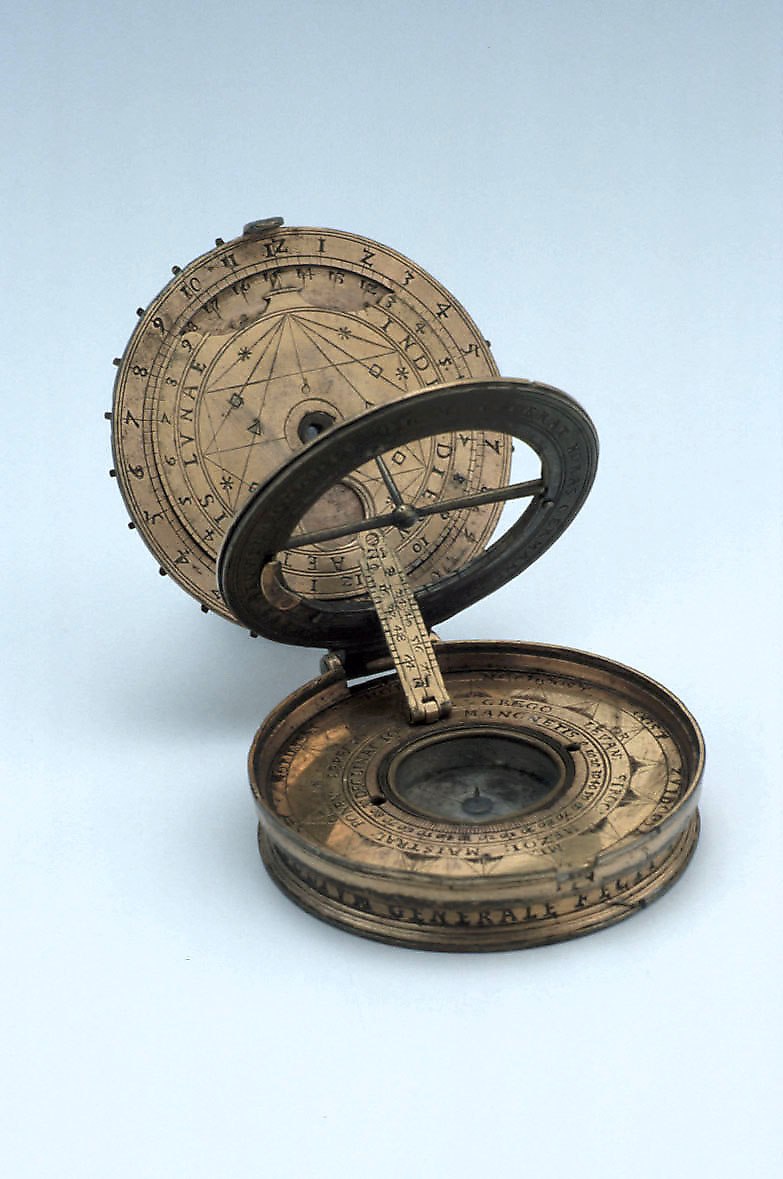
This circular astronomical compendium, signed by Ulrich Schniep of Munich and dated 1550-70, is constructed of gilt brass with a diameter of 53 mm and a depth of 12 mm. The device consists of a main drum containing a compass and a folding universal equinoctial sundial, with a cover that incorporates both a nocturnal and a lunar volvelle. The instrument integrates a variety of timekeeping and astronomical functions, including a calendar scale, an hour scale for length of day and night, moon phase representations, an aspectarium, and a table of latitudes for 32 locations. It features inscriptions in Latin, Italian, and Dutch. The instrument is equipped with a suspension ring for portability. The compass needle is currently missing from the central bowl, and the construction shows deliberate mechanical design for latitude adjustments and orientation for timekeeping across different geographical locations.

General view of the astronomical compendium in open position, showing the nocturnal, lunar volvelle, sundial, and compass.
General view of the astronomical compendium in open position, showing the nocturnal, lunar volvelle, sundial, and compass. — Museum of the History of Science, Oxford. Rights pending — permission not yet requested. Original source

Catalogue identity

Source
www.mhs.ox.ac.uk
Category
Tool · German astronomical compendium
Maker / attribution
Ulrich Schniep
Reference
52029
Catalogue / lot identifier
52029
Source-reported date
1550-70
Source-reported place
Munich

Source-reported attribution and specifications are not independent authentication. A listing does not establish present ownership, current display, availability or permission to reproduce.

Object description

Instrument Components and Functions

The compendium is a complex, multi-functional device contained within a 53 mm diameter gilt brass drum. The top cover functions as a nocturnal with an integrated lunar volvelle, which provides data on the age of the moon, its phases, and an aspectarium displaying symbols for conjunction, trine, quadrature, and sextile. The nocturnal mechanism includes a calendar scale and a rotating rule for nocturnal timekeeping.

Folding into the main body is a universal equinoctial sundial featuring both a 24-hour scale for Italian hours and a 12-hour scale for common hours. Orientation is supported by a compass bowl with a silvered base plate and a wind rose marked in Italian and Dutch.

Evidence for this section
  • “The top cover carries a nocturnal whose volvelle also gives the length of day and night throughout the year”
  • “The compass bowl is 21 mm in diameter and its silvered base plate has a single arrow line for orientation.”

Signature and Linguistic Features

The object is inscribed with the signature of its maker, Ulrich Schniep of Munich, located around the outer drum.

While the internal scales and calendar primarily utilize Latin, the wind roses incorporate Italian, and the cardinal directions are presented in Dutch.

Evidence for this section
  • “Around the outside of the drum is the signature 'HOC OPVS HOROLOGIVM GENERALE FECIT VLRICVS SCHNIEP DE MONACO'”
  • “the presence of Dutch for the directions of the compass might suggest that it was made for a Dutch client.”
  • “wind rose with the eight classical names in Italian.”

Mechanical Adjustments and Latitude

The instrument includes specialized features for geographical adjustment. A folding brass arm attached to the inside of the hour ring carries a double latitude scale for northern latitudes, allowing the device to be used as a universal sundial. The arm, when swiveled, secures into a notch at the midday point for stability during observation.

A table on the base of the instrument lists the latitudes of 32 distinct locations. Notably, the technical execution shows an error in the engraving of the latitude values, where maximum values were inadvertently applied to the minimum values for four of the five latitudes.

Evidence for this section
  • “the latitude scale is engraved on a short brass arm set on the inside of the hour ring.”
  • “the maximum values in minutes for the other four latitudes have mistakenly been used for the minimum values as well.”
  • “The base of the instrument has a table of the latitudes.”

Open research questions

  • Was this specific compendium commissioned by a documented Dutch patron?
  • Are there other known instances of Schniep instruments exhibiting the same latitude scale calculation error?

Source evidence

Recorded claims and source quotations for Astronomical Compendium by Ulrich Schniep
FieldSource-reported valueSource quotation
MakerUlrich Schniep“Signed by Ulrich Schniep”
Date1550-70“1550-70; Munich”
MaterialGilt brass“Gilt brass; 53 mm in diameter”
Compass diameter21 mm“The compass bowl is 21 mm in diameter”
Latitude coverage32 places“gives the latitudes of 32 places in approximately alphabetical order”

Visible details

  • Missing compass needle
  • Gilt brass construction
  • Engraved Latin and Dutch inscriptions
  • Incorporates lunar volvelle and nocturnal

Research qualifications

  • Presence of Dutch directions suggests a possible Dutch client but is unverified
  • Latitude scale maximum values in minutes were mistakenly reused for minimum values

Photograph identity and source facts were screened before import; rights clearance remains pending.

Consulted source

Astronomical Compendium

Reviewed 2026-10-26 · Record 2bf97c2afa

Terms in this record

Glossary explanations for terms named in this object’s record.