
Skip to content
The Encyclopedia of Horology

Tool · German astronomical compendium

Astronomical Compendium

Partially verified

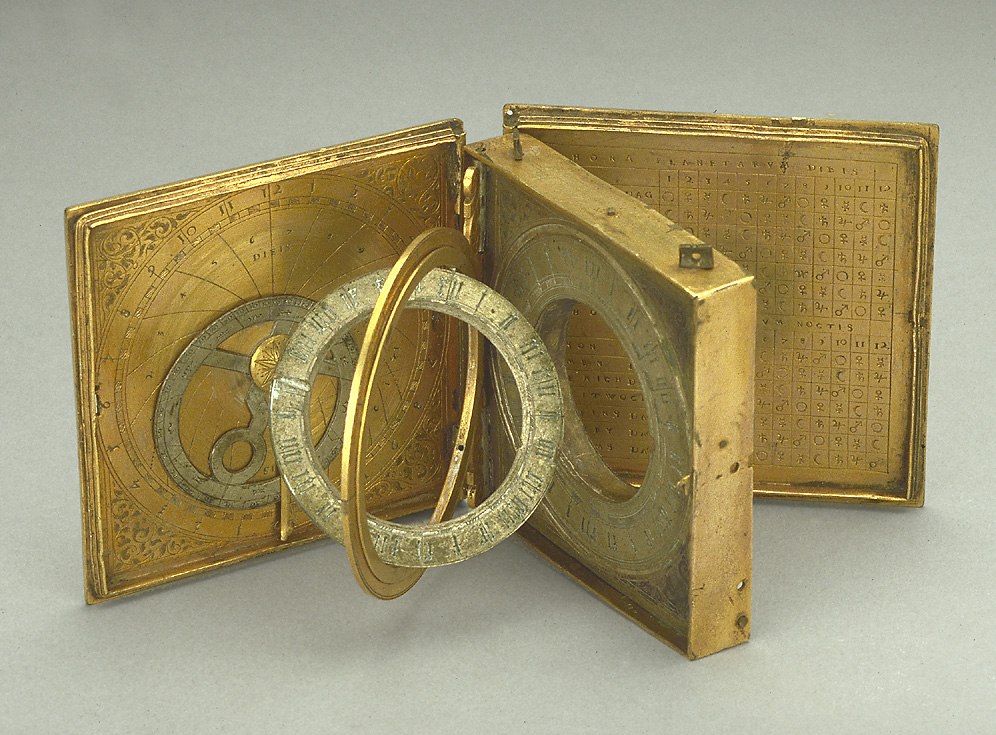
This unsigned astronomical compendium is constructed of gilt brass or copper and measures 90 x 90 x 19 mm. The instrument consists of two leaves and a main central box, featuring multiple astronomical and timekeeping functions. The upper leaf includes a lunar/solar volvelle on the outside and a table for converting unequal hours on the inside, alongside an eccentric zodiac band. The main box contains a universal equinoctial dial, a silver plate with a compass well, and engraved lists of cities and their latitudes. The lower leaf holds a table of ruling planets for hours of the day and night. The outside of the lower leaf serves as a quadrant with a degree scale and a shadow square, although the original plumb bob is currently missing. The instrument exhibits extensive decorative engravings, including putti, foliate scrolls, and various figures.

An overview of the open astronomical compendium, showing the interior leaves, the universal equinoctial dial, and the planetary table.
An overview of the open astronomical compendium, showing the interior leaves, the universal equinoctial dial, and the planetary table. — © British Museum, London. Rights pending — permission not yet requested. Original source

Catalogue identity

Source
www.mhs.ox.ac.uk
Category
Tool · German astronomical compendium
Maker / attribution
Not established
Reference
Not recorded
Catalogue / lot identifier
MLA 1888, 12-1.296
Source-reported date
Late 16th century
Source-reported place
Germany

Source-reported attribution and specifications are not independent authentication. A listing does not establish present ownership, current display, availability or permission to reproduce.

Object description

Construction and Layout

This astronomical compendium is designed as a portable folding instrument comprising an upper leaf, a lower leaf, and a central box. The gilt brass or copper body contains a complex arrangement of plates and rotating components. The upper leaf functions as a solar and lunar converter, featuring an exterior volvelle and an interior table for unequal hour conversion with an eccentric zodiac band. The central box houses a universal equinoctial dial mounted on a silver circle, with latitude markings for five locations engraved on the brass support.

The lower leaf contains a table of planetary rulers for the hours of the day and night, while its exterior serves as a quadrant with a degree scale and shadow square. The interior of the main box includes a silver plate with a central compass well and peripheral hour scales. Decoration is present throughout the surface, including foliate scrolls, putti, and figurative scenes, such as a man with a spade.

Evidence for this section
  • “Gilt brass or copper; 90 x 90 x 19 mm”
  • “The outside of the upper leaf of this compendium has a volvelle for converting lunar and solar time.”
  • “The outside face of the lower leaf is engraved in the manner of a quadrant.”

Timekeeping and Astronomical Features

The instrument includes several mechanisms for time determination. The upper leaf volvelle is inscribed for lunar and solar time conversion, and the central equinoctial dial is supported by a ring engraved with common hours and latitudes. The inner silver plate within the main box displays city-latitude pairs, providing geographical utility alongside its primary horological functions. These features allow for the calculation of solar time, lunar cycles, and the identification of ruling planets based on the day and hour.

The quadrant on the exterior of the lower leaf provides a scale for degrees and a shadow square for vertical measurements. The naming of specific days in a local dialect, alongside the planetary table, provides context for the instrument's intended regional use in Southern Germany. The inclusion of weather-related directions on the upper leaf exterior further expands the instrument's utility beyond standard timekeeping.

Evidence for this section
  • “The outside face of the lower leaf is engraved in the manner of a quadrant.”

Provenance and Documentation

The compendium is part of the collection at the British Museum, having been bequeathed to the institution by Octavius Morgan in 1888. It is catalogued as item MLA 1888, 12-1.296. The instrument is documented in the museum's internal records and was specifically detailed in F. A. B. Ward's 1981 work regarding European scientific instruments within the Department of Medieval and Later Antiquities.

The current catalogue entry notes that the compendium is unsigned but bears similarities to other known instruments, such as Epact 20713. Researchers have noted the absence of the plumb bob and one of the securing screws for the silver ring as specific conditions of the object. The identification of regional linguistic markers, such as the specific naming of days, supports the attribution to a Southern German maker from the late 16th century.

Evidence for this section
  • “The instrument was bequeathed in 1888 by Octavius Morgan”
  • “is described in F. A. B. Ward, A Catalogue of European Scientific Instruments in the Department of Medieval and Later Antiquities of the British Museum (London, 1981), p.121, no.351.”
  • “The plumb bob is now missing.”

Open research questions

  • What is the significance of the 'man with a spade and a severed head' iconography in the context of late 16th-century astronomical instruments?
  • How does the internal dial configuration specifically interact with the missing plumb bob mechanism to limit the functionality of the quadrant?

Source evidence

Recorded claims and source quotations for Astronomical Compendium
FieldSource-reported valueSource quotation
MaterialGilt brass or copper“Gilt brass or copper”
Dimensions90 x 90 x 19 mm“90 x 90 x 19 mm”
OriginSouthern German“The unusual names for Tuesday and Thursday, i.e. Erichdag and Pfinsdag on the table of planetary rulers for the hours of the day suggest a Southern German origin.”
Registration NumberMLA 1888, 12-1.296“MLA 1888, 12-1.296”
InscriptionsNames of days in German“The days of the week are named 'SONDAG', 'MENDAG', 'ERICHDAG', 'MITWOCH', 'PFINSDAG', 'FREYDAG', 'SAMSDAG'.”
ProvenanceBequeathed by Octavius Morgan in 1888“The instrument was bequeathed in 1888 by Octavius Morgan”

Visible details

  • The instrument is constructed as a multi-leaf folding case with a central box containing a dial and compass well.
  • The exterior of the lower leaf is engraved as a quadrant with a shadow square.
  • The planetary table for hours of the day lists 'Erichdag' and 'PFINSDAG' for Tuesday and Thursday.
  • Engraved details include a human figure with a spade and a severed head within the shadow square area.

Research qualifications

  • The date is qualified as a suggestion with a question mark.
  • The original plumb bob for the quadrant is missing.
  • One of the screws and nuts securing the silver ring is missing.

Photograph identity and source facts were screened before import; rights clearance remains pending.

Consulted source

Astronomical Compendium

Reviewed 2026-10-26 · Record bbc79df246

Terms in this record

Glossary explanations for terms named in this object’s record.