
Skip to content
The Encyclopedia of Horology

Tool · German astronomical compendium

Astronomical Compendium by Ulrich Schniep

Partially verified

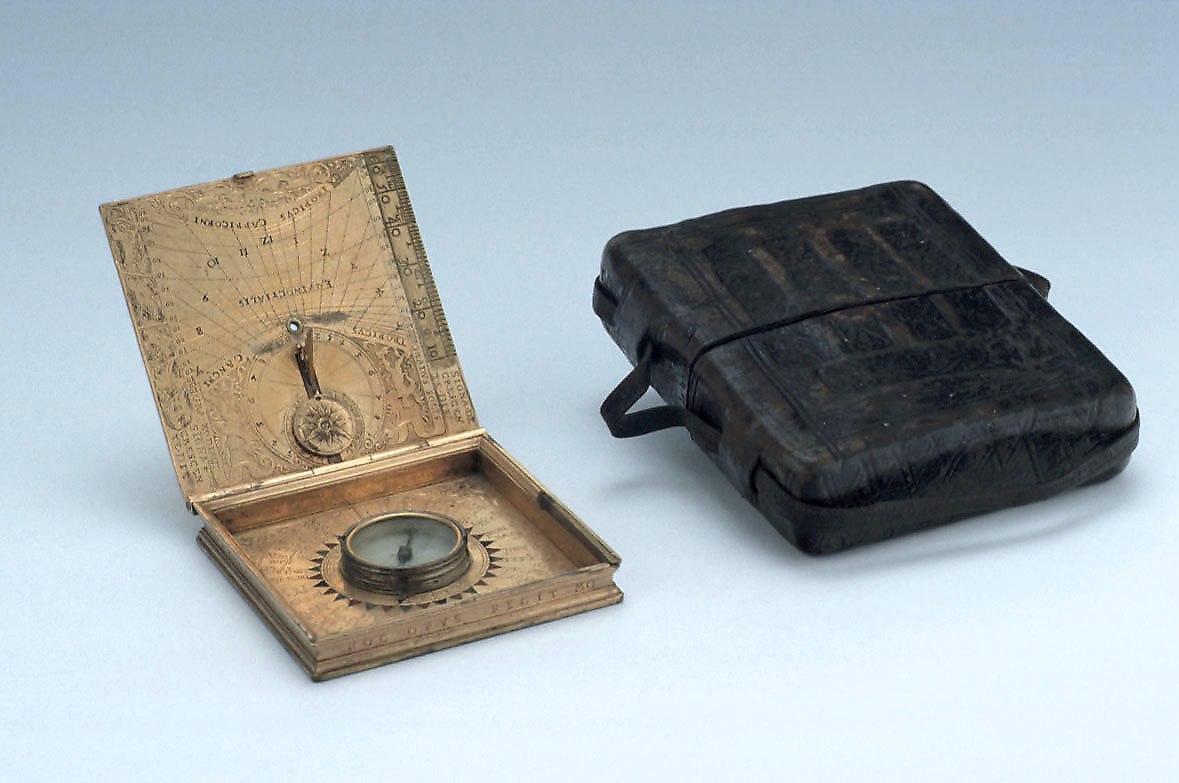
This 1563 astronomical compendium in gilt brass was created in Munich by Ulrich Schniep. Measuring 79 x 76 x 14 mm, the object is a multi-functional instrument comprising a nocturnal and horary volvelle, an inclining sundial with a folding gnomon, and an adjustable magnetic compass with an enamelled compass rose. The base of the device is inscribed with a table of latitudes covering 69 locations. At a later historical date, the compendium was modified to include an additional latitude scale and a folding strut, allowing it to function as a universal equinoctial sundial. The instrument is housed in a tooled leather pasteboard case, though this case is considered potentially oversized for the instrument.

Astronomical compendium by Ulrich Schniep (1563) alongside its leather case.
Astronomical compendium by Ulrich Schniep (1563) alongside its leather case. — Museum of the History of Science, Oxford. Rights pending — permission not yet requested. Original source

Catalogue identity

Source
www.mhs.ox.ac.uk
Category
Tool · German astronomical compendium
Maker / attribution
Ulrich Schniep
Reference
50108
Catalogue / lot identifier
50108
Source-reported date
1563
Source-reported place
Germany

Source-reported attribution and specifications are not independent authentication. A listing does not establish present ownership, current display, availability or permission to reproduce.

Object description

Structural Design and Signature

The compendium is constructed as a square gilt brass box featuring a hinged top cover. The exterior edges of the box are engraved with the maker's signature, identifying Ulrich Schniep of Munich and the date of completion, 1563. The decoration employs a combination of acid-etching and engraving, including foliate motifs in the corners of the box plates.

The instrument is accompanied by a tooled leather pasteboard case. The dimensions and fit of this case suggest it may not be original to the compendium, as it appears oversized for the primary object. The main housing incorporates a compass with a silvered base plate and an enamelled compass rose indicating 32 directional points.

Evidence for this section
  • “Around three of the sides of the main box is the signature: '[star] VLRICVS SCHNIEP HOC OPVS FECIT MONACHY [star] ANNO [star] 1563 [star]'.”
  • “The accompanying pasteboard case is covered with tooled leather; it may be 16th century in date but seems too large to have been the compendium's original case.”

Timekeeping and Astronomical Functions

The device contains a complex array of astronomical functions. The outer cover face includes a nocturnal and volvelle system for determining time through stellar observation. A silver subsidiary volvelle located within the center of the primary volvelle allows for the conversion between equal and Italian hours.

The reverse side of the cover functions as an inclining sundial. It is equipped with a small folding gnomon and features declination lines for solar positions. Adjustment to latitude is achieved through an internal mechanism that uses a brass bar to incline the dial plate according to a marked scale. Later modifications included the removal of certain zodiac images to accommodate a specific latitude scale and an additional folding arm, enabling universal equinoctial sundial functionality.

Evidence for this section
  • “The outer face of the cover carries a nocturnal and volvelle similar to those on other Schniep instruments”
  • “The reverse of the cover has an inclining dial.”
  • “At a later date, the images of the signs from Cancer to Sagittarius were removed and a latitude scale engraved in their place.”

Compass and Geographic Data

The internal compass features a 28 mm diameter bowl and is designed for adjustment relative to magnetic variation. The base plate includes two distinct scales: one measuring degrees and another consisting of equal parts. The compass rose, surrounding the base, uses a color-coded system of red, green, and black enamelled pointers to denote 32 directions, with German and Latin nomenclature.

The underside of the compendium box contains a 'TABVLA LATITVDINIS REGIONVM'. This reference table lists 69 locations in an approximately alphabetical format. It incorporates diverse geographic locations, including those beyond Europe, such as Antioch and Alexandria, demonstrating the scope of the instrument's intended geographical utility.

Evidence for this section
  • “The silvered compass base plate has a single line which aligns with two opposed external pointers.”
  • “The compass rose indicates 32 directions with alternating red and green enamelled triangular pointers”
  • “The base of the compendium carries a three-columned 'TABVLA LATITVDINIS REGIONVM' of 69 places.”

Open research questions

  • What is the original purpose of the scale of equal parts on the compass base plate?
  • Why were 'AVGVSTA', 'MONACHIVM' and 'SVTHGARDIA' uniquely positioned at the end of the latitude table?

Source evidence

Recorded claims and source quotations for Astronomical Compendium by Ulrich Schniep
FieldSource-reported valueSource quotation
MakerUlrich Schniep“Signed by Ulrich Schniep”
Date1563“Dated 1563; Munich”
MaterialGilt brass“Gilt brass; 79 x 76 x 14 mm”
Signature[star] VLRICVS SCHNIEP HOC OPVS FECIT MONACHY [star] ANNO [star] 1563 [star]“Around three of the sides of the main box is the signature: '[star] VLRICVS SCHNIEP HOC OPVS FECIT MONACHY [star] ANNO [star] 1563 [star]'.”
InscriptionsTable of latitudes on base“The base of the compendium carries a three-columned 'TABVLA LATITVDINIS REGIONVM' of 69 places.”
FunctionUniversal equinoctial sundial adaptation“At a later date the compendium has been adapted by the addition of a latitude scale and folding strut, so that it can serve as a universal equinoctial sundial”

Visible details

  • Gilt brass construction with foliate engraving in corners
  • Compass rose features green and red enamelled triangular indicators
  • Folding gnomon with spring mechanism for vertical deployment
  • Acid-etched zodiac signs and hour scales on the inner cover

Research qualifications

  • The included tooled leather case may be too large to be the original
  • The purpose of the scale of equal parts on the compass plate remains uncertain

Photograph identity and source facts were screened before import; rights clearance remains pending.

Consulted source

Astronomical Compendium

Reviewed 2026-10-26 · Record 8c8fa8e6c7

Terms in this record

Glossary explanations for terms named in this object’s record.