
Skip to content
The Encyclopedia of Horology

Tool · German astronomical compendium

Astronomical Compendium by Melchior Reichle

Partially verified

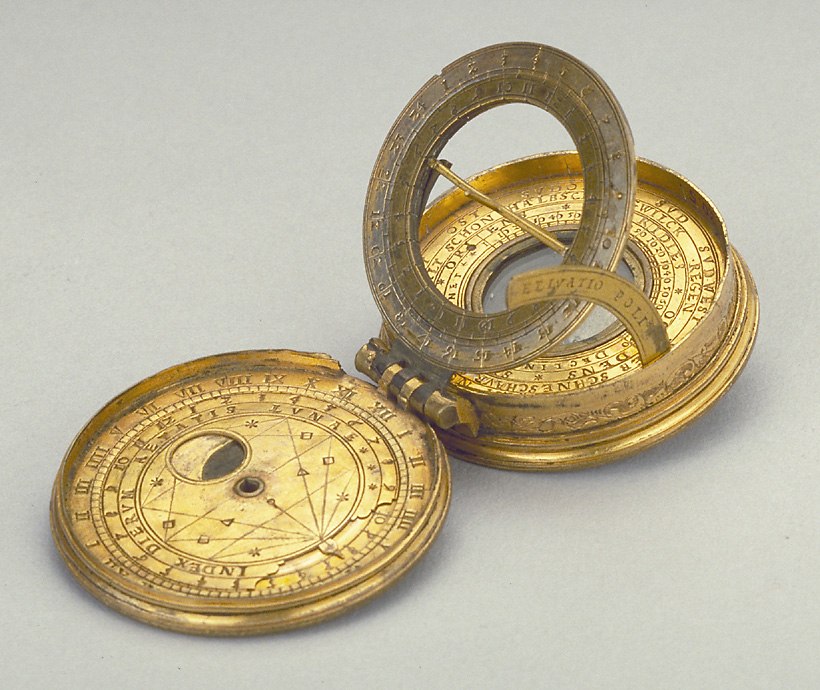
This astronomical compendium, measuring 55 x 15 mm, is crafted from gilt and silvered brass and dates to 1568. Signed by maker Melchior Reichle, it is a multi-functional instrument containing a nocturnal, a solar and lunar time converter, an equatorial pin gnomon dial, a magnetic compass, and a latitude list. The lid interior features a lunar volvelle with an aperture showing moon phases, while the nocturnal on the lid exterior includes scales and indices for star alignment. The base contains a central magnetic compass surrounded by cardinal directions and weather indicators in German and Latin, and the underside displays a list of 30 cities with their corresponding latitudes. A foldable equatorial dial sits between the lid and base, adjustable for latitude via a degree arc. The instrument’s exterior is decorated with foliate scrollwork.

Top view showing the lunar volvelle inside the lid, the foldable equatorial ring dial, and the base with compass and latitude list.
Top view showing the lunar volvelle inside the lid, the foldable equatorial ring dial, and the base with compass and latitude list. — British Museum, London. Rights pending — permission not yet requested. Original source

Catalogue identity

Source
www.mhs.ox.ac.uk
Category
Tool · German astronomical compendium
Maker / attribution
Melchior Reichle
Reference
Not recorded
Catalogue / lot identifier
MLA 1865,6-20.5
Source-reported date
1568
Source-reported place
Germany

Source-reported attribution and specifications are not independent authentication. A listing does not establish present ownership, current display, availability or permission to reproduce.

Object description

Lid and Nocturnal Functions

The lid of the compendium acts as a functional nocturnal, utilizing a rotating volvelle over a fixed disc. This mechanism is governed by an index arm, which is hinged. The disc is engraved with a calendrical scale showing month names and day counts. An instruction on the volvelle directs the user to align the index pointer with specific stars in the Great Bear.

The inside of the lid houses a lunar volvelle used to convert between solar and lunar time. This section incorporates three distinct scales, including two hour scales and a lunar age scale. An aperture allows the user to observe moon phases as represented on the disc beneath the volvelle, while the center features an aspectarium.

Evidence for this section
  • “The lid is laid out as a nocturnal with a volvelle rotating over a fixed disc”
  • “An aperture in the volvelle reveals the phases of the moon on the disc underneath”

Equatorial Dial and Compass

The central portion of the compendium, positioned between the lid and base, is an equatorial dial. This dial is constructed with a foldable pin gnomon and a double hour ring. The outer ring is movable against an inner fixed ring, facilitating the conversion of common hours to Italian or Babylonian time. The dial may be adjusted for latitude using a foldable degree arc.

The base of the instrument contains an inset magnetic compass. The plate surrounding the compass is engraved with the eight primary cardinal directions, accompanied by weather indicators in both German and Latin. Additionally, a degree scale for magnetic declination is engraved around the central compass, which is marked with a 10-degree West deviation.

Evidence for this section
  • “Hinged between the lid and the bottom of the box is an equatorial dial”
  • “The bottom plate has the eight main directions and the corresponding weather in German and Latin”

Provenance and Geographical Data

The underside of the base features a circular list of thirty geographical locations, each paired with its recorded latitude. This list includes cities such as Vienna, Prague, and Antwerp, among others. The exterior of the brass box is embellished with foliate scrollwork decoration throughout.

The compendium was acquired by the British Museum through a presentation by A.W. Franks in 1865. The instrument is documented in F. A. B. Ward's catalogue of European scientific instruments held within the Department of Medieval and Later Antiquities.

Evidence for this section
  • “The underside has a circular list of 30 places with their latitudes”
  • “The instrument was presented by A.W. Franks in 1865”

Open research questions

  • What was the specific intended function of the aspectarium indicated in the center of the lunar volvelle?
  • Are there surviving manuscripts or technical drawings from Reichle's workshop that explain the intended use of the missing nocturnal index 'B'?

Source evidence

Recorded claims and source quotations for Astronomical Compendium by Melchior Reichle
FieldSource-reported valueSource quotation
MakerMelchior Reichle“Signed by Melchior Reichle”
Date1568“Dated 1568”
MaterialGilt and silvered brass“Gilt and silvered brass; 55 x 15 mm”
Inventory NumberMLA 1865,6-20.5“Registration no. MLA 1865,6-20.5”
SignatureMELCHIOR REICHLE VECIT ANNO 1568“MELCHIOR REICHLE VECIT ANNO 1568”
OriginGerman“Dated 1568; German”

Visible details

  • Exterior case features foliate scrollwork engravings.
  • Lunar volvelle includes an aperture revealing lunar phases.
  • Equatorial dial includes a double hour ring and foldable pin gnomon.
  • Compass dial shows magnetic variation markers.

Research qualifications

  • The tip of the nocturnal index pointer is broken.
  • The nocturnal index is missing the indicator 'B'.

Photograph identity and source facts were screened before import; rights clearance remains pending.

Consulted source

Astronomical Compendium

Reviewed 2026-10-26 · Record fce518a101

Terms in this record

Glossary explanations for terms named in this object’s record.