
Skip to content
The Encyclopedia of Horology

Tool · Arabic-inscribed astrolabe, Iran

Astrolabe signed by 'Abd al-'Ali

Partially verified

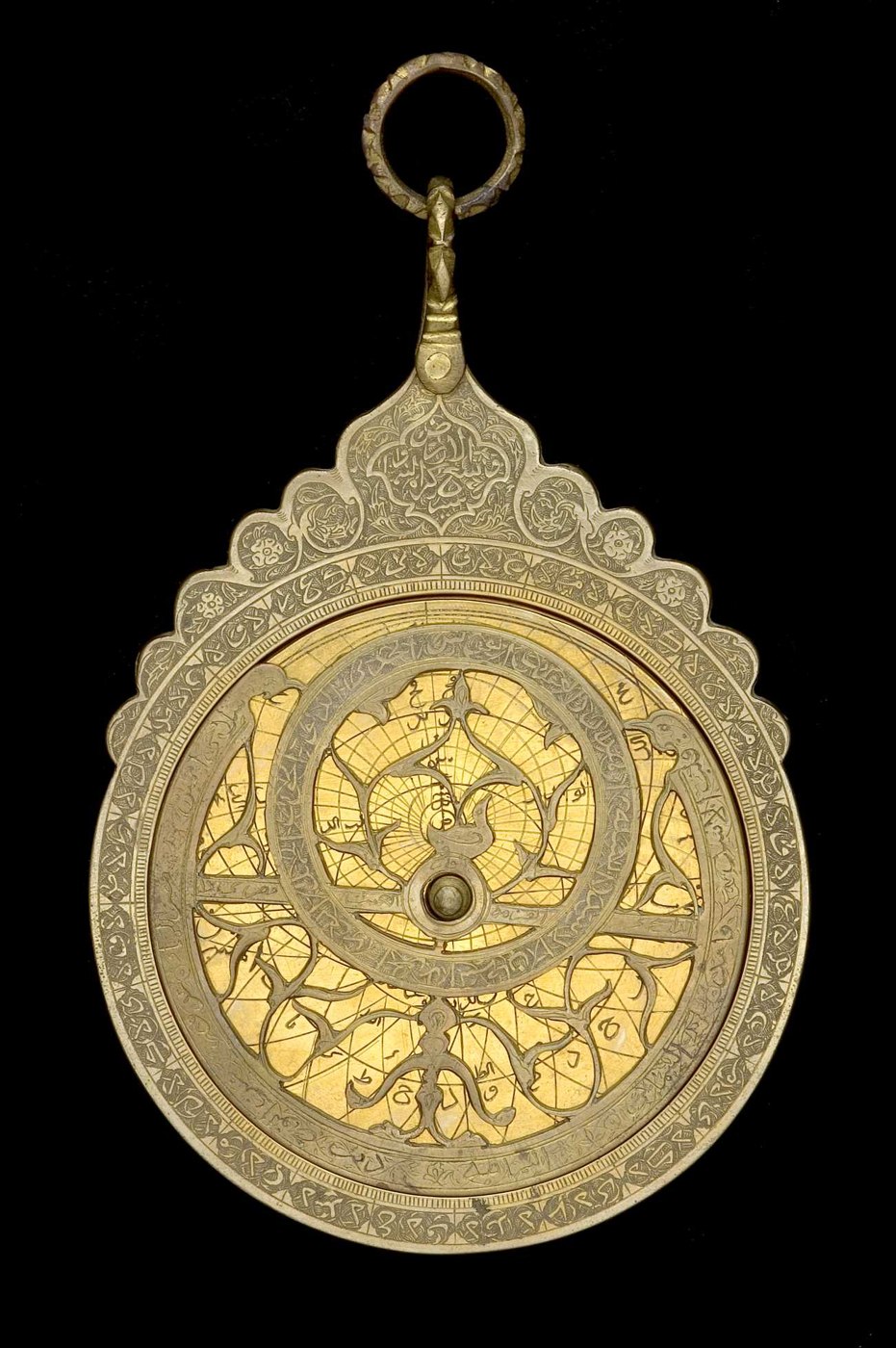
This brass astrolabe is identified by the inventory number 37940 and attributed to the maker 'Abd al-'Ali, an individual associated with the Isfahan group of instrument makers during the first decades of the 18th century. The instrument features a throne of the engraved Indo-Persian type and an omega-shaped shackle. The rete is of the foliate type and exhibits a symmetrical layout that deviates from actual astronomical star positions. The back of the instrument contains 11 scales, including altitude, sine/cosine, and zodiacal signs, which are described as incorrect. The piece includes three plates with latitudes between 32 and 38 degrees and a double-ended alidade featuring non-functional, engraved abdjad numerals. The astrolabe was presented to the History of Science Museum by J. A. Billmeir in 1957.

Full view of the astrolabe showing the rete, mater, and throne details.
Full view of the astrolabe showing the rete, mater, and throne details. — History of Science Museum, University of Oxford. Rights pending — permission not yet requested. Original source

Catalogue identity

Source
www.mhs.ox.ac.uk
Category
Tool · Arabic-inscribed astrolabe, Iran
Maker / attribution
'Abd al-'Ali
Reference
Not recorded
Catalogue / lot identifier
37940
Source-reported date
early 18th century
Source-reported place
Persia

Source-reported attribution and specifications are not independent authentication. A listing does not establish present ownership, current display, availability or permission to reproduce.

Object description

Construction and Design

The astrolabe is constructed of brass and features an engraved Indo-Persian style throne with an integrated base. Attached to the throne is an ornate ring and an omega-shaped shackle.

The rete is characterized as a foliate, plain type with a bird figure in the center of the ecliptic. The astronomical layout of the rete is symmetrical, which prevents it from functioning as a accurate map of real star positions. The ecliptic is not graduated, and the positions of the zodiacal signs are displaced by approximately 15 degrees.

Evidence for this section
  • “The throne is of the indo-persian, engraved type made of brass attached with integrated base made of brass and has a ornate ring made of brass and omega type shackle made of brass”
  • “The rete contains 0 stars. The rete contains zoomorphs: a bird in the center of the ecliptic”
  • “The most obvious clue is the almost totally symmetrical rete, which is an impossibility since it is meant to be a map of real star positions.”

Scales and Inscriptions

The back of the instrument displays 11 distinct scales, including altitude, sine/cosine, declination, cotangent, zodiacal signs, and lunar mansions. The institution reports that these scales are all inaccurate. Additionally, the instrument contains a signature, translated as 'Abd al-'Ali made this, and an embossed quotation from the Qur'an on the front throne.

The double-ended alidade is engraved with abdjad numerals designed to mimic the appearance of scales, though these numerals do not correspond to any recognizable scientific or mathematical scale. The womb of the instrument is engraved with text designed to resemble a gazetteer, but the entries do not represent actual cities or geographic coordinates.

Evidence for this section
  • “The back is inscribed: with a maker's signature marked as العلي عبد صنعه (‘Abd al-‘Ali made this).”
  • “The scales on the back are all incorrect.”
  • “This rule is extensively engraved with abdjad numerals, intended to resemble scales. They do not, however, correspond to any recognizable scale.”

Provenance and Attribution

This astrolabe, bearing inventory number 37940, was acquired by the History of Science Museum, Oxford, through a presentation by J. A. Billmeir in 1957. The institution records indicate that Billmeir acquired the object between 1955 and 1957.

The astrolabe is associated with the maker 'Abd al-'Ali, who is linked to the Isfahan group of instrument makers from the early 18th century. However, the cataloguing body notes that the piece is potentially an imitation or a forgery, citing its astronomical inaccuracies and the meaningless nature of its inscriptions as indicators of its deviation from genuine scientific instruments of that period.

Evidence for this section
  • “Presented by J. A. Billmeir in 1957”
  • “, an astrolabist maker associated with the Iṣfahān group of instrument makers of the first decades of the 18th century.”
  • “The highly decorative Persian astrolabes of the 17th and early 18th centuries achieved a great vogue and during the next two centuries were frequently imitated”

Open research questions

  • What specific chemical or metallurgical evidence exists to confirm the brass composition matches early 18th-century production?
  • Can the specific errors in the rete and back scales be traced to a known school of decorative imitations?

Source evidence

Recorded claims and source quotations for Astrolabe signed by 'Abd al-'Ali
FieldSource-reported valueSource quotation
Maker'Abd al-'Ali“‘Abd al-‘Ali made this”
PlacePersia“Place Persia”
MaterialBrass“Material Brass”
Inventory number37940“Inventory no. 37940”
AcquisitionPresented by J. A. Billmeir in 1957“Presented by J. A. Billmeir in 1957”
Dateearly 18th century“Date early 18th century”
Throne styleIndo-Persian, engraved“The throne is of the indo-persian, engraved type”

Visible details

  • The rete features a zoomorphic bird design at the center of the ecliptic.
  • The limb of the mater is of one-piece construction and lacks tabs or notches.
  • The back includes an inscription identified as a maker's signature.
  • The shackle is of the omega type (Ω-shaped).

Research qualifications

  • The accuracy of the astronomical content and functionality is questioned by the institution.
  • The rete design is described as an impossibility for a functional map of real star positions.

Photograph identity and source facts were screened before import; rights clearance remains pending.

Consulted source

Astrolabe, inventory 37940 (Persia, early 18th century)

Reviewed 2026-10-26 · Record 70085413ab

Terms in this record

Glossary explanations for terms named in this object’s record.