
Skip to content
The Encyclopedia of Horology

Tool · French astrolabe

Gothic Astrolabe

Partially verified

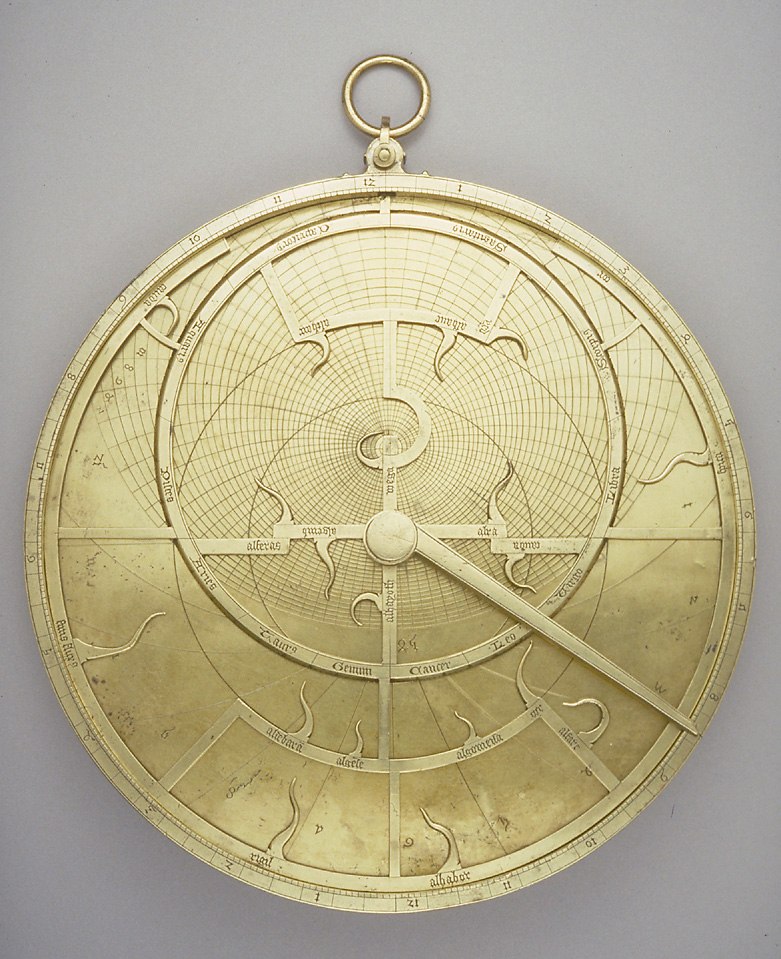
This unsigned brass astrolabe has a diameter of 280 mm and is attributed to the late 15th century and possibly France. The instrument features a barrel-shaped throne with an inset swivel pin and a mater with a rim soldered to the backplate. The rim is engraved with a 24-hour scale. The rete includes worm-shaped star pointers, while the mater and plates feature equatorial and tropical circles, azimuths, almucantars, and lines for unequal hours. The reverse of the instrument contains an altitude scale, a zodiacal scale, a Julian calendar, a shadow scale, and an horary quadrant. The engravings utilize Gothic numerals and letters. The astrolabe is associated with the Fusoris type of construction. It was acquired in 1857 and is currently held in the collection of the British Museum in London.

Front view of the unsigned Gothic astrolabe, showing the rete and the 24-hour scale on the rim.
Front view of the unsigned Gothic astrolabe, showing the rete and the 24-hour scale on the rim. — British Museum, London. Rights pending — permission not yet requested. Original source

Catalogue identity

Source
www.mhs.ox.ac.uk
Category
Tool · French astrolabe
Maker / attribution
Not established
Reference
Not recorded
Catalogue / lot identifier
MLA 1857,5-23.1
Source-reported date
late 15th century
Source-reported place
France

Source-reported attribution and specifications are not independent authentication. A listing does not establish present ownership, current display, availability or permission to reproduce.

Object description

Construction and Design

The astrolabe is constructed of brass and measures 280 mm in diameter. The main body consists of a mater with a rim soldered to the backplate, featuring an interior recess at 12 o'clock intended to secure the tongues of the plates. The instrument is equipped with a barrel-shaped throne containing an inset swivel pin.

The rete is characterized by worm-shaped star pointers, with 20 stars named in Latin. The ecliptic is divided into zodiacal signs, each subdivided into 30 degrees. The mater and plates are inscribed with coordinate systems, including circles for the equator and tropics, azimuths, and almucantars, alongside lines for unequal hours.

Evidence for this section
  • “Brass; 280 mm in diameter”
  • “The rim is soldered to the backplate.”
  • “The rete has worm-shaped starpointers”
  • “The mater and the two plates are marked with circles for the equator and the tropics, azimuths for every 5?, almucantars for every 2?, and the lines for the unequal hours”

Backplate Scales and Markings

The back of the astrolabe is engraved with multiple concentric circular scales. These include a 360-degree altitude scale, a zodiacal scale with Latin sign names, and a Julian calendar scale featuring month names and day divisions. The equinoxes are positioned at March 10 3/4 and September 13 3/4.

The lower portion of the backplate contains a shadow scale based on 12 and an horary quadrant for unequal hours, numbered 1 to 12. Both the one-armed rule and the counterchanged alidade appear to be blank, containing no markings or engravings.

Evidence for this section
  • “The back of the instrument has several concentric circular scales as follows (from the outside)”
  • “The equinoxes correspond to March 10 3/4 and September 13 3/4.”
  • “The one armed rule and the counterchanged alidade are void of markings.”

Provenance and Identification

The instrument is currently housed at the British Museum under registration number MLA 1857,5-23.1. It was acquired by the museum in 1857 through a purchase from A. Joseph. The astrolabe has been catalogued by F. A. B. Ward.

While the instrument is unsigned and undated, its stylistic features, specifically the letterforms and numerals, have been interpreted as being consistent with production in the latter half of the 15th century. It is identified as being of the Fusoris type, with the source noting a possible French origin.

Evidence for this section
  • “The instrument was purchased from A. Joseph in 1857”
  • “Registration no. MLA 1857,5-23.1”
  • “the shape of the letters and numerals suggest that it was made in the second half of the 15th century. It is of the Fusoris type and may have been made in France.”

Open research questions

  • How many plates are missing from the current assembly?
  • Are there specific technical inconsistencies that differentiate this from an original Jean Fusoris workshop production?

Source evidence

Recorded claims and source quotations for Gothic Astrolabe
FieldSource-reported valueSource quotation
Diameter280 mm“280 mm in diameter”
OriginPossibly French“may have been made in France”
DateLate 15th century“Late 15th century ?”
TypeFusoris type“It is of the Fusoris type”
Registration numberMLA 1857,5-23.1“Registration no. MLA 1857,5-23.1”
Engraving styleGothic“The markings are all engraved with Gothic numerals and letters respectively.”

Visible details

  • Barrel-shaped throne with swivel pin
  • Worm-shaped star pointers on the rete
  • Engraved with Gothic numerals and letters
  • Rim soldered to the backplate

Research qualifications

  • Date is based on the shape of letters and numerals, noted with a question mark by the source
  • Attribution to France is suggested but not certain

Photograph identity and source facts were screened before import; rights clearance remains pending.

Consulted source

Astrolabe

Reviewed 2026-10-26 · Record 85bc7066fc

Terms in this record

Glossary explanations for terms named in this object’s record.