
Skip to content
The Encyclopedia of Horology

Tool · Arabic-inscribed astrolabe, Iran

Astrolabe by Muḥammad Ṣaffār

Partially verified

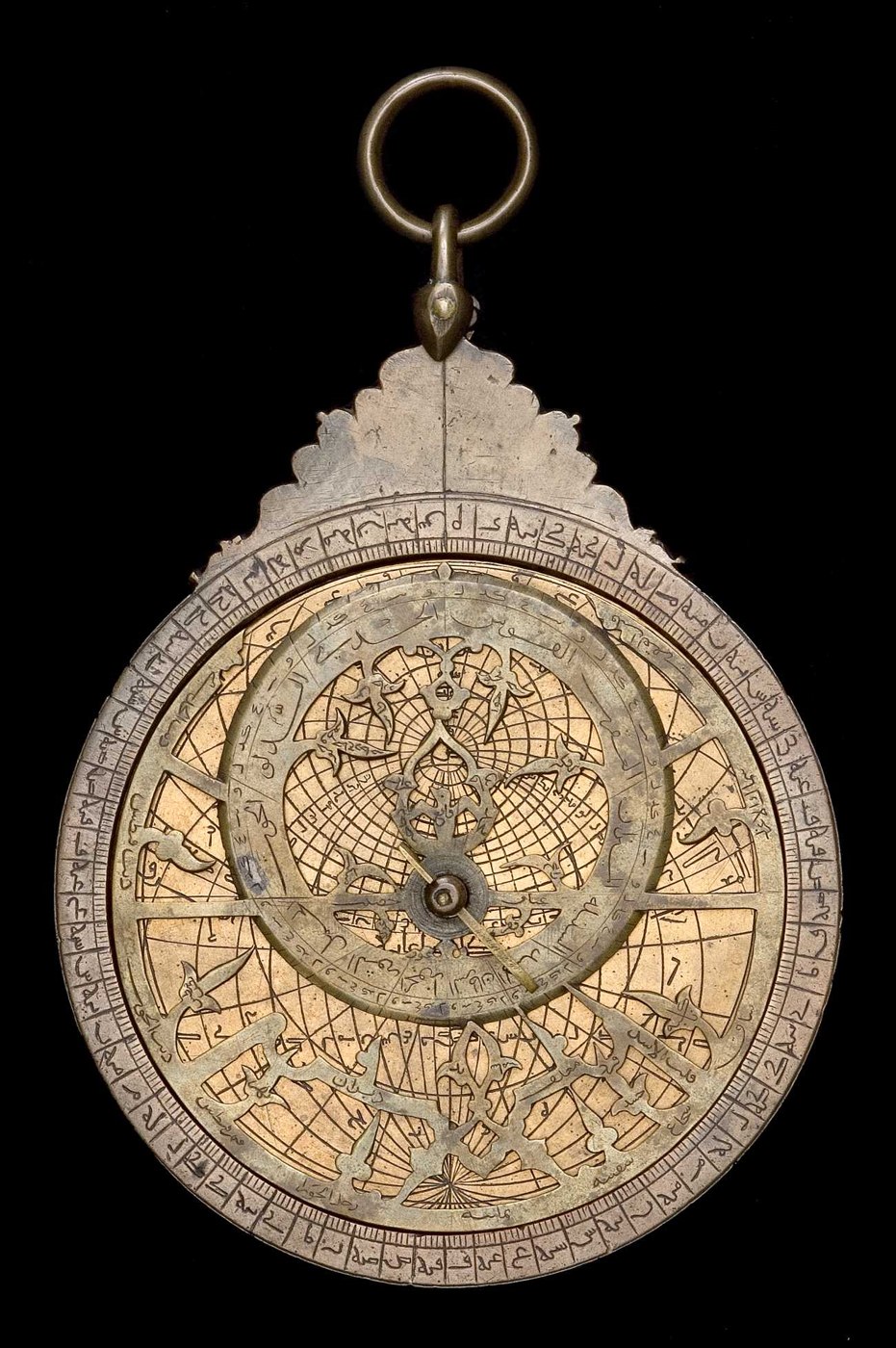
This brass astrolabe, inventory number 39063, is an astronomical instrument manufactured in Persia in 1481/2 by the maker Muḥammad Ṣaffār. It features a mater and limb of one-piece construction, with an Indo-Persian style throne attached to an integrated base. The instrument incorporates an omega-shaped shackle and a round-section suspension ring. The back contains Kufic and Nashki script inscriptions, including the maker's signature and a shadow square, alongside seven functional scales including altitude, declination, and sine/cosine. The instrument includes four plates covering latitudes from 21° to 36°, and a gazetteer within the womb listing coordinates for 31 cities. The rete, of a foliate type, is broken near the ecliptic.

Front view of the astrolabe, showing the rete, limb scale, and suspension assembly.
Front view of the astrolabe, showing the rete, limb scale, and suspension assembly. — History of Science Museum, University of Oxford. Rights pending — permission not yet requested. Original source

Catalogue identity

Source
www.mhs.ox.ac.uk
Category
Tool · Arabic-inscribed astrolabe, Iran
Maker / attribution
Muḥammad Ṣaffār
Reference
39063
Catalogue / lot identifier
39063
Source-reported date
1481/2
Source-reported place
Persia

Source-reported attribution and specifications are not independent authentication. A listing does not establish present ownership, current display, availability or permission to reproduce.

Object description

Construction and Mater

The astrolabe is constructed primarily of brass and features a one-piece mater and limb. The limb includes a degree scale covering 0 to 360 degrees of arc, marked at 5-degree intervals. The instrument is suspended via a simple, round-section ring connected to an omega-shaped shackle, which features inverted tear-drop shaped tabs. The throne is of an Indo-Persian style, attached to an integrated base, and remains largely undecorated except for vertical lines on the front and back.

The womb contains a gazetteer with geographical coordinates for 31 cities ranging from Herat to Balkh. A pin is positioned in the lower section of the womb to secure the tympans and prevent them from rotating during use.

Evidence for this section
  • “The mater and limb are of one-piece construction.”
  • “The throne is of the indo-persian type made of brass attached with integrated base”
  • “The womb contains a gazetteer with coordinates for 31 cities:”
  • “The horse is most likely a replacement.”

Rete and Back Design

The zodiacal signs are inscribed on the rete in Arabic. The rete structure is noted as broken just above the center within the ecliptic, which itself displays variable and inconsistent divisions. The back of the instrument hosts two distinct scripts: Kufic and Nashki. It is laid out with seven specialized scales used for calculations, including altitude, declination, sine/cosine, cotangent, and shadow squares.

The maker's signature is located in the lower half of the back. A shadow square is present, accompanied by an inscription regarding the shadows of the fingers and feet. The back of the throne shows a partial, incomplete attempt at inscribing the maker's name.

Evidence for this section
  • “The rete contains 0 stars.”
  • “There are two different scripts on the back of this instrument: a Kufic and a Nashki style..”
  • “The back contains 7 scales of the following types:”
  • “In an early alteration the name of Muḥammad Hāshim, perhaps an early owner, has been inscribed over part of the original maker's signature.”

Provenance and History

The instrument was acquired by the History of Science Museum through a presentation by Lewis Evans in 1924. According to historical records, Evans purchased the astrolabe in 1921 from I. Sassoon & Co., a London-based antique dealer. The dealers indicated that the piece originated from the 'celebrated' Richard Collection. This collection gained recognition through its display at the 1889 Paris exhibition and was dispersed shortly after the event.

Condition reports note that the rule, or alidade, does not original fit the instrument and appears to have been engraved by a different hand, indicating it is a replacement. Furthermore, the horse is suspected to be a later addition.

Evidence for this section
  • “Presented by Lewis Evans in 1924”
  • “Evans bought it from I. Sassoon & Co., antique dealers of London, in 1921, who stated that it came from the 'celebrated' Richard Collection.”
  • “The rule does not fit the instrument well and appears to be engraved in a different hand, suggesting that it is not original.”

Open research questions

  • What is the specific nature of the 'variable' ecliptic divisions on the rete, and do they indicate an amateur repair?
  • Can the provenance link to the 'Richard Collection' be further validated through exhibition catalogues from the 1889 Paris exhibition?

Source evidence

Recorded claims and source quotations for Astrolabe by Muḥammad Ṣaffār
FieldSource-reported valueSource quotation
MakerMuḥammad Ṣaffār“Maker Muḥammad Ṣaffār”
Date1481/2“Date 1481/2”
Inventory Number39063“Inventory number: 39063”
MaterialBrass“Material Brass”
ProvenancePresented by Lewis Evans in 1924“Presented by Lewis Evans in 1924”
InscriptionMaker's signature referencing the year 886“هذه الأصطرلاب العبد الفقير ٳلى الله الغفار في سنة ست وثمانين وثمان مائة شمس الدين محمد صفار”
Latitude Range21° to 36°“latitudes ranging from 21°0' to 36°0'”

Visible details

  • Maker's signature in Arabic script on the back of the instrument.
  • Replacement alidade and horse visible on the rete and back.
  • Inscribed name of Muḥammad Hāshim on the throne.
  • Presence of a shadow square in the lower half of the back.

Research qualifications

  • The horse and alidade are reported as likely replacements.
  • The name Muḥammad Hāshim, inscribed on the throne, is identified as a potential early owner rather than the maker.
  • The ecliptic division is described as variable and poorly executed.

Photograph identity and source facts were screened before import; rights clearance remains pending.

Consulted source

Astrolabe, inventory 39063 (Persia, 1481/2)

Reviewed 2026-10-26 · Record a233189460

Terms in this record

Glossary explanations for terms named in this object’s record.