
Skip to content
The Encyclopedia of Horology

Tool · Arabic-inscribed astrolabe, Iran

Astrolabe by Muḥammad Mahdī

Partially verified

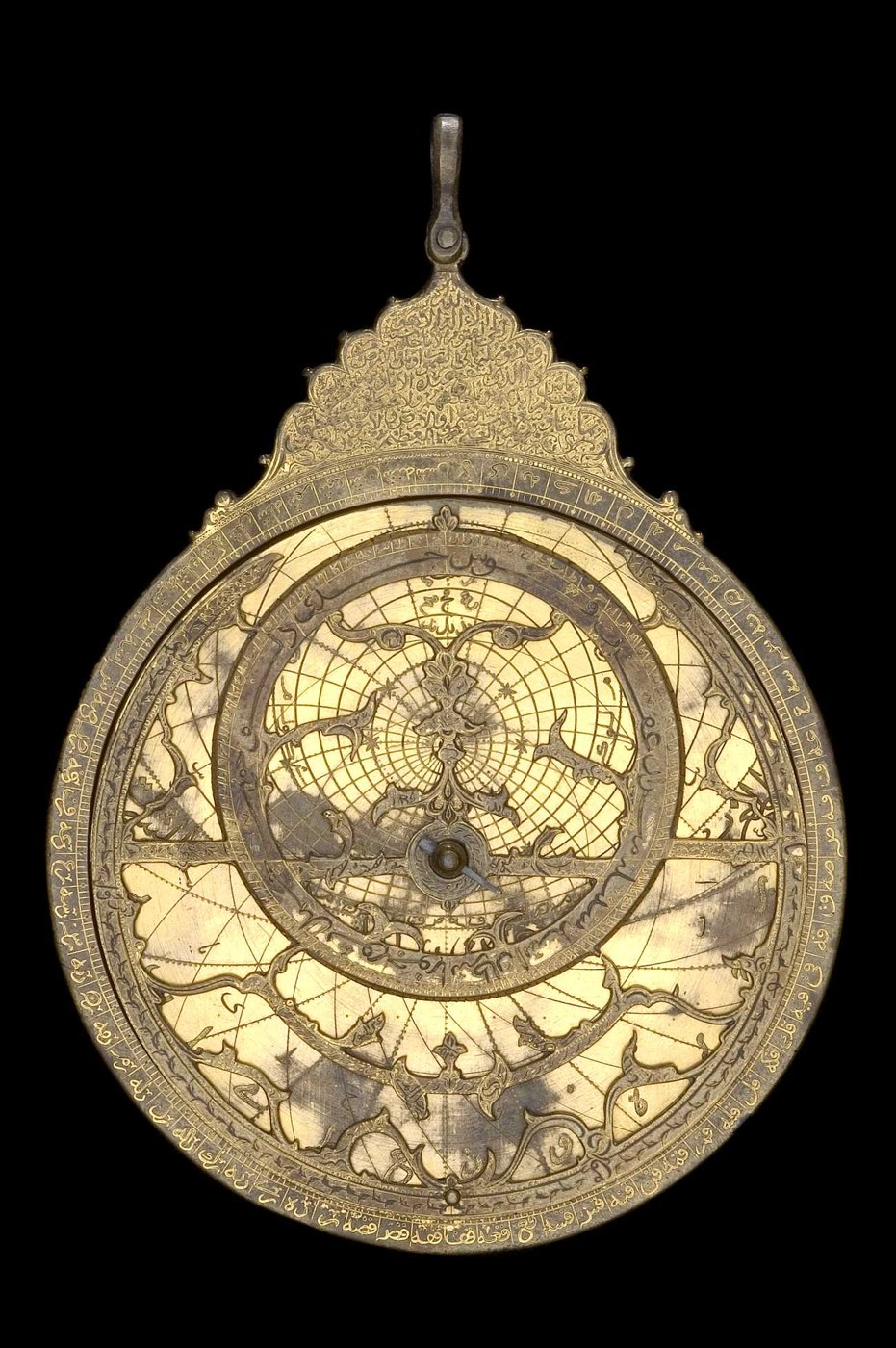
This gilt brass astrolabe, designated by inventory number 50143, is attributed to the maker Muḥammad Mahdī and dates to approximately 1650. Originating from Persia, the instrument features a complex design including an indo-persian engraved throne and an omega-type shackle. The mater and limb are constructed as a single piece, with the limb inscribed with a list of the twelve Shiite Imams. The instrument includes five plates covering latitudes from 22° to 45°. Its back is engraved with 13 distinct scales including altitude, declination, and a shadow square, alongside a signature within a cartouche identifying the maker as Muḥammad Mahdī al-Yazdī. The rete is of the foliate single-knob variety and is accompanied by a double-ended alidade. The object was presented to the History of Science Museum, Oxford, by Lewis Evans in 1924, who had previously acquired it from Akchoté Frères in Paris.

Front view of the astrolabe showing the rete, mater, and throne, featuring an embossed Qur'anic inscription on the throne.
Front view of the astrolabe showing the rete, mater, and throne, featuring an embossed Qur'anic inscription on the throne. — History of Science Museum, University of Oxford. Rights pending — permission not yet requested. Original source

Catalogue identity

Source
www.mhs.ox.ac.uk
Category
Tool · Arabic-inscribed astrolabe, Iran
Maker / attribution
Muḥammad Mahdī
Reference
50143
Catalogue / lot identifier
1924-0/2011
Source-reported date
ca. 1650
Source-reported place
Persia

Source-reported attribution and specifications are not independent authentication. A listing does not establish present ownership, current display, availability or permission to reproduce.

Object description

Construction and Design

The astrolabe is crafted from gilt brass and features an indo-persian style throne with an integrated brass base and an omega-type shackle. The mater and limb are manufactured as a single-piece construction, with a tab positioned at the bottom to secure the tympans. The limb is decorated with a degree scale and a significant inscription around the edge listing the twelve Shiite Imams, starting with Muḥammad the chosen and concluding with Muḥammad al-Mahdī.

The rete is of the foliate single-knob type and lacks marked stars. It features standard zodiacal labels. The instrument comes with five plates that provide a latitude range from 22°0' to 45°0'. The double-ended alidade is original to the instrument and is of a rigid, simple type, though it currently lacks the pin and horse assembly required to secure the components together.

Evidence for this section
  • “The throne is of the indo-persian, engraved type made of gilt brass”
  • “The mater and limb are of one-piece construction.”
  • “The rete is of the foliate (single knob) type.”
  • “The rete is attached using a pin & horse. The horse is missing.”

Back Scales and Gazetteer

The reverse of the astrolabe is highly detailed, containing 13 distinct scales. These include multiple circular and concentric scales for altitude, cotangents measured in feet and fingers, and a shadow square. Additional features include scales for declination, the azimuth of the Qibla, zodiacal signs, terms, and faces.

The instrument also contains a comprehensive gazetteer located within the womb. This gazetteer lists coordinates for 62 cities, covering a broad geographical range from Mecca and Medina to cities in modern-day Afghanistan, India, and Central Asia. The specific inscriptions and scales on the back are attributed to the work of Muḥammad Mahdī al-Yazdī, whose signature is found within an unusually-shaped cartouche on the rear of the device.

Evidence for this section
  • “The back is inscribed: with a maker's signature marked as نقشه محمد مهدي اليزدي (Engraved by Muḥammad Mahdī al-Yazdī).”

Provenance and Acquisition

The astrolabe is currently held by the History of Science Museum at the University of Oxford. It was donated to the institution by Lewis Evans in 1924, who is recorded as the primary benefactor for this acquisition.

Prior to its donation to the museum, the instrument was purchased by Lewis Evans from the firm Akchoté Frères in Paris. The records maintain the inventory number 50143, which serves as the identifier for both the catalogue and museum accession archives.

Evidence for this section
  • “Presented by Lewis Evans in 1924”
  • “Evans bought it from Akchoté Frères, Paris.”

Open research questions

  • What is the purpose of the unusually-shaped cartouche for the signature?
  • Are there remaining traces of star pointers that may have been lost or removed from the rete?

Source evidence

Recorded claims and source quotations for Astrolabe by Muḥammad Mahdī
FieldSource-reported valueSource quotation
MaterialGilt brass“Material Gilt brass”
Dateca. 1650“Date ca. 1650”
MakerMuḥammad Mahdī“Maker Muḥammad Mahdī”
Inventory Number50143“Inventory no. 50143”
ProvenancePresented by Lewis Evans in 1924“Presented by Lewis Evans in 1924”
Maker's NameMuḥammad Mahdī al-Yazdī“Engraved by Muḥammad Mahdī al-Yazdī”
Place of ManufacturePersia“Place Persia”
Total Cities in Gazetteer62“The womb contains a gazetteer with coordinates for 62 cities”

Visible details

  • The shackle is an omega-shaped (Ω) component.
  • The maker's signature is located on the back in an unusually-shaped cartouche.
  • The instrument includes a gazetteer with coordinates for 62 cities.

Research qualifications

  • The inscription on the back is reported as worn and difficult to read.
  • The horse for the central pin is missing.
  • The inclusion of 'al-Yazdī' in the signature is the source's interpretation of a potentially worn inscription.

Photograph identity and source facts were screened before import; rights clearance remains pending.

Consulted source

Astrolabe, inventory 50143 (Persia, ca. 1650)

Reviewed 2026-10-26 · Record a72570e9e3

Terms in this record

Glossary explanations for terms named in this object’s record.