
Skip to content
The Encyclopedia of Horology

Tool · Arabic-inscribed astrolabe

Astrolabe by Khalīl Muḥammad ibn Ḥasan ‘Alī

Partially verified

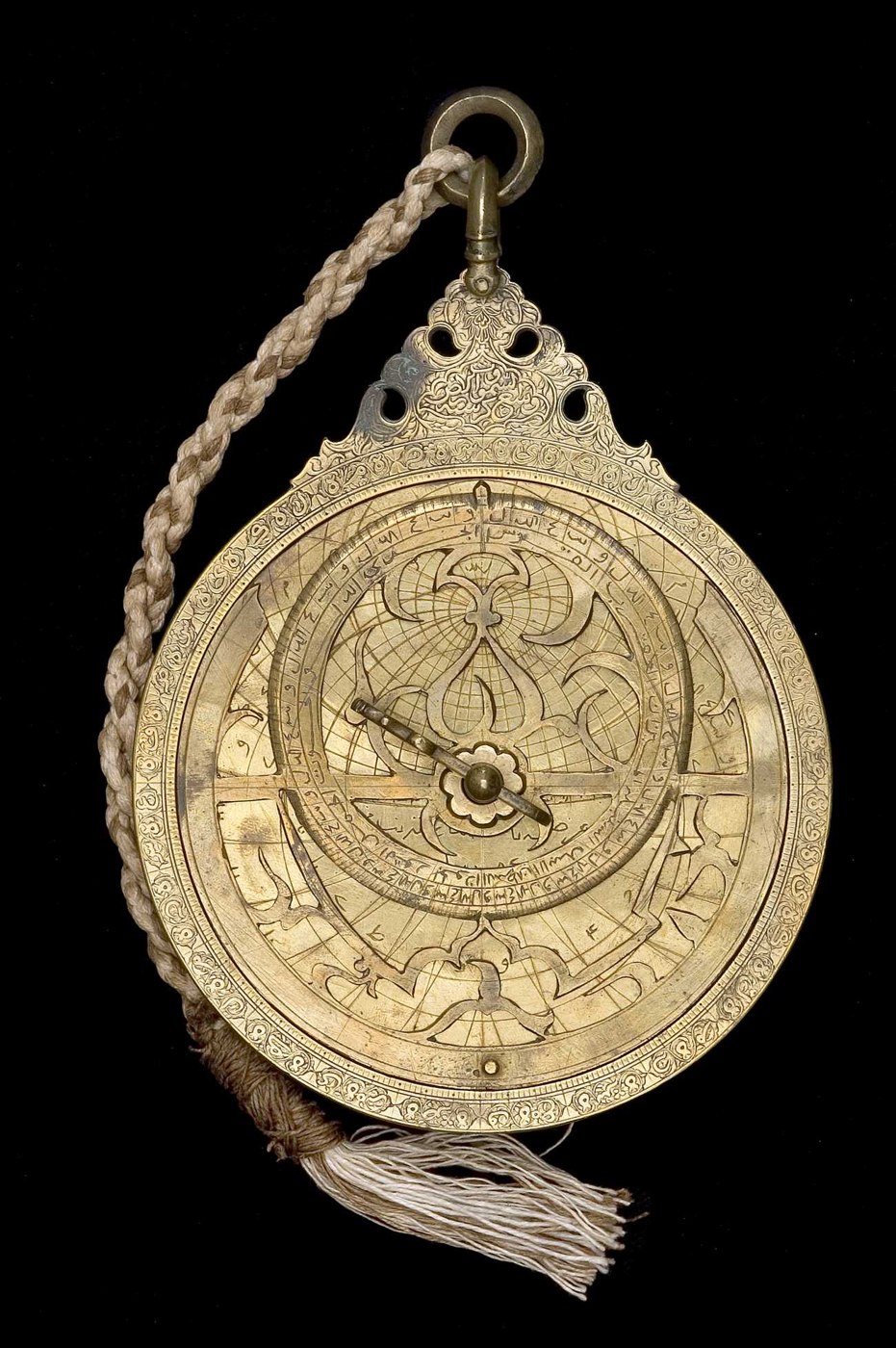
This brass astrolabe, attributed to the maker Khalīl Muḥammad ibn Ḥasan ‘Alī, dates to circa 1700 and originates from Iṣfahān. The instrument features a pierced, Indo-Persian style throne with an integrated base and omega-type shackle. The mater and limb are constructed from a single piece of brass, with the limb featuring a degree scale and a gazetteer of 46 cities on the womb. The back of the instrument contains 17 scales, including altitude, azimuth of Qibla, sine/cosine, and shadow squares, accompanied by specific calligraphic inscriptions, including a maker's signature. The assembly is held together by a pin and horse, with the horse displaying a distinct duck-head feature.

The obverse of the astrolabe (inventory 35313), showing the replacement rete and the pin and horse assembly.
The obverse of the astrolabe (inventory 35313), showing the replacement rete and the pin and horse assembly. — History of Science Museum, University of Oxford. Rights pending — permission not yet requested. Original source

Catalogue identity

Source
www.mhs.ox.ac.uk
Category
Tool · Arabic-inscribed astrolabe
Maker / attribution
Khalīl Muḥammad ibn Ḥasan ‘Alī
Reference
35313
Catalogue / lot identifier
1957-84/166
Source-reported date
ca. 1700
Source-reported place
Iṣfahān

Source-reported attribution and specifications are not independent authentication. A listing does not establish present ownership, current display, availability or permission to reproduce.

Object description

Construction and Main Body

The astrolabe is primarily constructed of brass, featuring a mater and limb formed from a single-piece construction. The instrument includes a pierced, Indo-Persian style throne that is attached to an integrated base. This throne is decorated with extensive embossing and includes an inscription quoting a Qur'anic verse. The suspension mechanism consists of a squared cross-section ring and an omega-type shackle, which is secured by decorative tabs and a pin.

The limb is inscribed with a degree scale spanning 0 to 360 degrees, marked every five degrees. The interior womb contains a comprehensive gazetteer listing the coordinates for 46 cities, providing longitudes and latitudes for locations spanning from Mecca to Kabul. The quality of the instrument's primary components is described as finished and elegant, contrasting with later replacement parts.

Evidence for this section
  • “The mater and limb are of one-piece construction.”
  • “The throne is of the indo-persian, pierced type made of brass attached with integrated base made of brass”
  • “The womb contains a gazetteer with coordinates for 46 cities”

Back Scales and Inscriptions

The back of the astrolabe is highly detailed, containing 17 distinct scales. These include traditional navigational and mathematical scales such as altitude, azimuth of Qibla, sine/cosine, and cotangent scales measured in feet and fingers. The back also features astrological information, such as zodiacal signs, terms, faces, and lunar mansions.

The back bears two primary inscriptions. One is the maker's signature, crediting the work to ‘Abd al-Aʾimmah, and a philosophical inscription at the bottom edge which reflects on the transitory nature of existence. These are presented in cartouches, highlighting the decorative and intellectual emphasis of the instrument’s design.

Evidence for this section
  • “The back contains 17 scales”
  • “نمقه العبد عبد الائمة (Embellished by the servant ʿAbd al-Aʾimmah). Inscription in cartouche.”
  • “The aim of the engraving is that it should remain after me, for I see not the continuity of earthly existence.”

Replacements and Rete Details

The current rete is a later replacement, distinguished by its crude workmanship and lack of naming for the 19 star pointers.

The rete is held in place by a pin and horse assembly. Like the rete, the double-ended alidade is a later addition and contains no markings or scales, bearing little resemblance to the refined quality seen on the rest of the original instrument.

Evidence for this section
  • “The most obvious indication that this rete is not original to the instrument is the relatively crude workmanship.”
  • “The rete is attached using a pin & horse. The head of the pin is decorated with radial lines. The horse is unusual in that there is the head of a duck immediately behind the horse's head.”
  • “This is a later addition to the instrument and bears no markings or scales.”

Open research questions

  • What is the identity of the maker who created the replacement rete?
  • At what approximate time was the rete replaced, given the stylistic departure from the original instrument?

Source evidence

Recorded claims and source quotations for Astrolabe by Khalīl Muḥammad ibn Ḥasan ‘Alī
FieldSource-reported valueSource quotation
MakerKhalīl Muḥammad ibn Ḥasan ‘Alī“Maker Khalīl Muḥammad ibn Ḥasan ‘Alī”
MaterialBrass“Material Brass”
Inventory number35313“Inventory no. 35313”
AcquisitionPresented by J. A. Billmeir in 1957“Presented by J. A. Billmeir in 1957”
Rete statusReplacement“it is clear that the original rete of this astrolabe was lost and the present one is a later replacement”
Maker's signature‘Abd al-Aʾimmah“نمقه العبد عبد الائمة (Embellished by the servant ʿAbd al-Aʾimmah)”
Gazetteer capacity46 cities“The womb contains a gazetteer with coordinates for 46 cities”

Visible details

  • The throne is pierced with four arabesque designs.
  • The rete features 19 star pointers without names.
  • The horse-shaped pin includes an unusual duck-head detail.
  • The alidade is a double-ended replacement without scales.

Research qualifications

  • The rete is a later replacement and does not match the quality of the rest of the instrument.
  • The alidade is a later addition to the original assembly.
  • The exact date of the rete replacement remains unknown.

Photograph identity and source facts were screened before import; rights clearance remains pending.

Consulted source

Astrolabe, inventory 35313 (Iṣfahān, ca. 1700)

Reviewed 2026-10-26 · Record 66ab99baa8

Terms in this record

Glossary explanations for terms named in this object’s record.