
Skip to content
The Encyclopedia of Horology

Tool · Nuremberg astrolabe

Astrolabe by Georg Hartmann

Partially verified

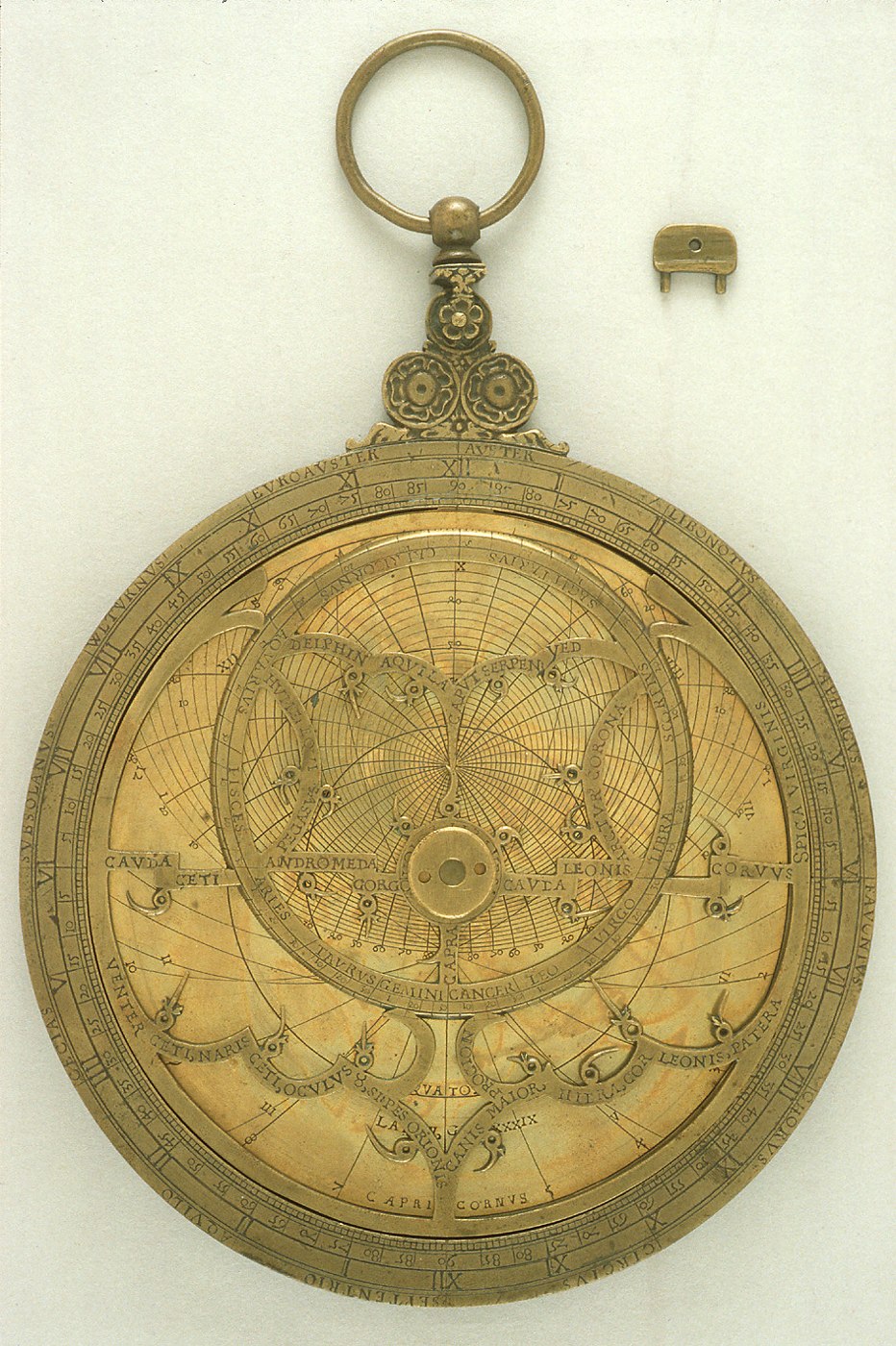
This 160 mm diameter brass astrolabe is signed by the Nuremberg maker Georg Hartmann and dated 1537. The instrument features a mater with a signature and date, an alidade, and three plates for varying latitudes. The throne exhibits the Hartmann shape, featuring two roses, a rosette, and two fir cones in a triangular arrangement supported by foliate scrolls. The rete is designed with arcs and split ends at the tropic of Capricorn and includes 27 named star pointers. The instrument contains matching components identified by the number '9'. The reverse side includes altitude scales, calendrical scales, two hour quadrants, and shadow scales, alongside the arms of Nuremberg and an Imperial Eagle. It is part of the collection at the British Museum, having been acquired from William Wareham in 1880, and is documented in institutional academic catalogues for European scientific instruments.

The front of the astrolabe showing the rete, star pointers, and the separate adjusting key.
The front of the astrolabe showing the rete, star pointers, and the separate adjusting key. — © British Museum, London. Rights pending — permission not yet requested. Original source

Catalogue identity

Source
www.mhs.ox.ac.uk
Category
Tool · Nuremberg astrolabe
Maker / attribution
Georg Hartmann
Reference
Not recorded
Catalogue / lot identifier
MLA 1880,3-8.2
Source-reported date
1537
Source-reported place
Nuremberg

Source-reported attribution and specifications are not independent authentication. A listing does not establish present ownership, current display, availability or permission to reproduce.

Object description

Construction and Design

The instrument is constructed from brass and measures 160 mm in diameter. The mater's rim displays the Latin names of 12 winds arranged clockwise, with internal markings for equal hours in Roman numerals and a 90 to 0 degree altitude scale. The throne possesses a distinct appearance characterized by two roses, a rosette, and two fir cones arranged in a triangle, supported by foliate scrolls. The reverse of the instrument features multiple circular scales including altitude, calendrical, and shadow scales, specifically 'VMBRA RECTA' and 'VMBRA VERSA'.

The central area of the reverse side depicts an Imperial Eagle and the arms of Nuremberg, consisting of a crowned harpy on the left and a double-headed eagle on the right. The axis is composed of a threaded rivet secured by a nut with two holes, designed to be adjusted with a double-pointed key, which is included with the instrument.

Evidence for this section
  • “The throne has the characteristic Hartmann shape: two roses, a rosette, and two fir cones in a triangular layout supported by foliate scrolls.”
  • “The axis of the astrolabe consists of a rivet with a threaded nut pierced with two holes to be turned with a double pointed key.”

Rete and Plates

The rete is formed primarily of circle arcs with split ends at the tropic of Capricorn and holds 27 pierced star pointers with their names engraved. The ecliptic is divided into 12 segments of 30 degrees, featuring serrations on the outer edge for single degrees. The equinoctial bar is counterchanged six times across its structure.

The astrolabe includes three interchangeable plates, each marked on both sides with latitude-specific information ranging from 39 to 54 degrees. These plates display circles for the tropics and the equator, azimuths, and almucantars. They also feature astrological houses configured in the Regiomontanus manner, numbered with Roman numerals. Each plate is assigned a specific identifier, including a number and dots, which aligns with the components of the mater.

Evidence for this section
  • “Each plate is marked on one side with a '9' and one (1a), two (2a), or three (3a) dots respectively according to the increasing latitudes.”

Signatures and Provenance

The instrument bears the signature 'GEORGIUS HARTMAN NORENBERGE FACIEBAT' and the date 'ANNO MDXXXVII'. Individual components of the device are marked with the number '9', which is visible on the rete, the plates, and the mater.

The instrument was acquired by the British Museum from William Wareham in 1880. It is recorded in the museum's inventory and has been published in academic documentation regarding scientific instrument collections in European history.

Evidence for this section
  • “Below the shadow scales is the maker's signature 'GEORGIUS HARTMAN NORENBERGE FACIEBAT' and the date 'ANNO MDXXXVII'.”
  • “The instrument was purchased from William Wareham in 1880 and is described in F. A. B. Ward, A Catalogue of European Scientific Instruments”

Open research questions

  • What specific evidence indicates the original sighting vanes on the alidade were removed or if they were never attached?
  • How does the numbering system using the '9' mark relate to other documented Hartmann instruments from the same production period?

Source evidence

Recorded claims and source quotations for Astrolabe by Georg Hartmann
FieldSource-reported valueSource quotation
MakerGeorg Hartmann“Signed by Georg Hartmann”
Date1537“Dated 1537”
Place of manufactureNuremberg“Nuremberg”
Diameter160 mm“160 mm in diameter”
Accession numberMLA 1880,3-8.2“Registration no. MLA 1880,3-8.2”
SignatureGEORGIUS HARTMAN NORENBERGE FACIEBAT“'GEORGIUS HARTMAN NORENBERGE FACIEBAT'”

Visible details

  • The throne features two roses, a rosette, and two fir cones in a triangular layout.
  • The mater rim is engraved with Latin names of the 12 winds clockwise.
  • The equinoctial bar of the rete is counterchanged six times.
  • The alidade lacks sighting vanes but shows rivets on one arm.

Research qualifications

  • The exact purpose of the numeric '9' markings is suggested to indicate extensive production but remains a descriptive interpretation.
  • One arm of the alidade appears to have rivets for a vane, but the vane itself is absent.

Photograph identity and source facts were screened before import; rights clearance remains pending.

Consulted source

Astrolabe

Reviewed 2026-10-26 · Record dfb99e8546

Terms in this record

Glossary explanations for terms named in this object’s record.