
Skip to content
The Encyclopedia of Horology

Tool · Nuremberg astrolabe

Astrolabe by Georg Hartmann

Partially verified

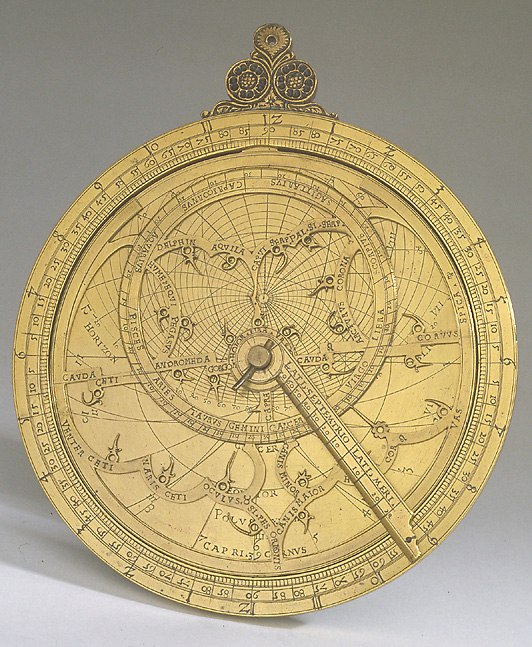
This planispheric astrolabe, crafted from gilt copper with a diameter of 145 mm, was signed by Georg Hartmann in Nuremberg in 1545. The instrument features an elaborately engraved throne decorated with floral motifs, although the suspension ring is no longer present. It includes a central mater, three climate plates calibrated for various latitudes, and a rete displaying 27 star positions identified by name. The back of the instrument contains an extensive set of scales, including zodiacal and calendrical information, a shadow square inscribed 'VMBRA VERSA' and 'VMBRA RECTA', and a central engraving of a two-headed eagle. The alidade is fitted with reclining sights featuring both holes and notches for alignment. The instrument represents the work of Hartmann, who was active as a scientific instrument maker in Germany during the middle of the 16th century.

Front view of the gilt copper astrolabe by Georg Hartmann, showing the rete and alidade.
Front view of the gilt copper astrolabe by Georg Hartmann, showing the rete and alidade. — Istituto e Museo di Storia della Scienza, Firenze. Rights pending — permission not yet requested. Original source

Catalogue identity

Source
www.mhs.ox.ac.uk
Category
Tool · Nuremberg astrolabe
Maker / attribution
Georg Hartmann
Reference
Not recorded
Catalogue / lot identifier
1111
Source-reported date
1545
Source-reported place
Germany

Source-reported attribution and specifications are not independent authentication. A listing does not establish present ownership, current display, availability or permission to reproduce.

Object description

Structural Composition and Components

The astrolabe is constructed from gilt copper and measures 145 mm in diameter. It comprises a mater that houses three distinct plates calibrated for various latitudes, specifically covering ranges between 39 and 54 degrees. The rete is engineered to display 27 stars, which are represented as bored points on the metal surface, each accompanied by its specific stellar name. The zodiacal circle is inscribed with Latin nomenclature for the signs.

The instrument includes an alidade equipped with reclining sights that incorporate both holes and notches to facilitate accurate observation. The throne section of the device is characterized by a block design featuring floral motifs, which are engraved on both its front and reverse surfaces. The original suspension ring is noted as missing.

Evidence for this section
  • “Gilt copper; 145 mm in diameter”
  • “The rete displays 27 stars, represented by points bored into the base, and accompanied by their names.”
  • “The alidade is provided with reclining sights, with two holes and notches to help the instrument to be aimed accurately.”
  • “The throne is made up of a block with floral motifs, engraved on both the front and back. The suspension ring is now missing.”

Inscriptions and Back Design

The reverse side of the astrolabe is densely inscribed with navigational and calendrical data. The limb is divided into four quadrants of 90 parts each. It includes a circle graduated X to XXX, repeating twelve times, alongside Latin names for the months and signs of the zodiac. The central region displays hour lines and an engraving of a two-headed eagle with outstretched wings.

The lower section of the back is occupied by a half shadow square, labeled 'VMBRA VERSA' and 'VMBRA RECTA' twice. Beneath this shadow square, the maker's signature is engraved, providing the attribution to Georg Hartmann and the date of manufacture. The pointer is also inscribed with 'LATI. SEPTEMTIO' and 'LATI. MERI' designations.

Evidence for this section
  • “The back of the astrolabe displays its limb divided into 4 quadrants, each of 90 parts, then a circle X to XXX, repeated 12 times”
  • “The upper part of the central area of the back of the instruments bears the hour lines 1 to 6, 7 to 12”
  • “Under the half-square is the signature 'GEORGIUS HARTMAN NOREM.BERGE FACIEBAT ANNO 1545'.”

Provenance and Identification

The instrument is held by the Istituto e Museo di Storia della Scienza in Florence under inventory number 1111. It is attributed to the Nuremberg maker Georg Hartmann, who was a known producer of scientific instruments during the middle of the 16th century. The piece is catalogued as part of the Epact collection of medieval and Renaissance instruments.

The physical condition of the object includes the loss of the suspension ring, though the instrument is described as being made with significant precision. All identifying marks, including the maker's name and the completion date of 1545, are prominently displayed on the reverse of the plate.

Evidence for this section
  • “Holding museum: Istituto e Museo di Storia della Scienza, Firenze”
  • “Inventory number: 1111”
  • “The maker, Georg Hartmann , was active in Germany in the middle of the 16th century.”
  • “The instrument is very accurately made, and the engravings are both precise and elaborate.”

Open research questions

  • What is the specific historical context for the discrepancy in latitude plate descriptions within the source?
  • How does the presence of a double-headed eagle motif correlate with other known instruments by Georg Hartmann from this period?

Source evidence

Recorded claims and source quotations for Astrolabe by Georg Hartmann
FieldSource-reported valueSource quotation
MakerGeorg Hartmann“Signed by Georg Hartmann”
Date1545“Dated 1545”
MaterialGilt copper“Gilt copper; 145 mm in diameter”
LocationNuremberg“Nuremberg”
SignatureGEORGIUS HARTMAN NOREM.BERGE FACIEBAT ANNO 1545“'GEORGIUS HARTMAN NOREM.BERGE FACIEBAT ANNO 1545'”
Inventory Number1111“Inventory number: 1111”

Visible details

  • Floral-motifed throne
  • Two-headed eagle engraving on the back
  • Rete displaying 27 star points
  • Reclining sights on the alidade

Research qualifications

  • Latitude plates vary between source overview and detail descriptions
  • Originality of missing suspension ring not verified

Photograph identity and source facts were screened before import; rights clearance remains pending.

Consulted source

Astrolabe

Reviewed 2026-10-26 · Record 4d96e43af0

Terms in this record

Glossary explanations for terms named in this object’s record.